Arc B - Welcome to Barovia

An adventure for five 1st-level heroes.
In this arc, the heroes travel to the gloomy village of Barovia, which has been ravaged by death and despair in the wake of Strahd’s revival. When the heroes arrive at the barricades, they meet Ismark, the eldest child of the village’s recently wounded burgomaster.
At the Blood of the Vine Tavern, the heroes learn that the village has been under attack by Strahd’s undead horde each night for the past six nights—and that the horde is expected to return at dusk. In exchange for food, shelter, and information, Ismark asks the heroes to take up arms alongside the Barovians and prepare to defend the village’s fortifications against the onslaught of the dead.
After successfully defending the barricades, the heroes learn that Strahd has personally invaded the burgomaster’s mansion, killing Ismark’s father and biting his sister, Ireena. With the village’s burgomaster dead, Strahd formally withdraws the horde from the village, allowing Ismark, Ireena, and the heroes to pick up the pieces.
The following morning, Ireena and Ismark ask the heroes to help bring their father’s remains to the local church for burial, escort Ireena to Vallaki, and ask the seer Fravartiš how Strahd can be defeated. Upon delivering the Burgomaster's coffin to the church the following dawn, the heroes can meet Doru, Father Donavich's son, who Strahd transformed into a vampire spawn as punishment for his rebellion. The heroes then face a choice: Will they destroy Doru, as Father Donavich requests—or spare him?
The heroes’ arrival in the village of Barovia has been substantially reworked to create a strong inciting incident for the campaign, ensuring they have an immediate and concrete reason to seek out Fravartiš’s Tarokka reading, an opportunity to form relationships with the villagers of Barovia, and personalized stakes in seeing Strahd defeated.
B1. Old Svalich Road
This scene takes place in Chapter 2: Area A.
The journey from the tower to #B2. Gates of Barovia is two miles long and takes forty minutes.
This scene unfolds as described in Old Svalich Road (p. 33).
B2. Gates of Barovia
This scene takes place in Chapter 2: Area B.
This scene unfolds mostly as described in Gates of Barovia (p. 34). However, the eastern gates don't open for people trying to leave Strahd's domain.
The journey from the Gates of Barovia to #B3. Svalich Woods is one-quarter mile long and takes five minutes.
B3. Svalich Woods
This scene takes place in Chapter 2: Area C.
This scene begins as described in Svalich Woods (p. 34). However, when the players find the corpse of Dalvan Olensky, read:
The foul scent leads you to a human corpse half-buried in the underbrush about fifteen feet from the road. The young man appears to be a commoner. His muddy clothes appear to have been torn by brambles and thorns. Crows have been at the body. He holds a tarnished compass in one hand.
The dead man doesn't appear to have any visible wounds, but a character with the Heal skill, or who makes a successful medium Reason test, learns that he died of exhaustion; on a failure, the hero learns only that the young man has been dead for several days.
While Dalvan's compass remains close to the edge of the Barovian valley, its needle trembles strangely even when held still.
Dalvan's hand holding the compass is splayed out in the direction of a nearby tree, which bears thirteen tally marks and an arrow that points deeper into the woods, along what seems to be a well-traveled footpath.
In the wake of Strahd's attack on the village of Barovia, one of the survivors—a young man named Dalvan Olensky—was overcome with terror and despair.
Determined to find a way free from Barovia, Dalvan traveled to the encampment at Tser Pool, seeking out the reputed seer Fravartiš. Fravartiš read his future in the Tarokka cards, and drew the Horseman—a card that predicted that he would die in the Barovian valley.
Panicked, Dalvan returned to the village of Barovia under cover of night, stole a horse and compass, and set off for the eastern road out of Barovia. When the Svalich Road seemed to end, Dalvan delved into the woods, crossing through the mist and reemerging on the opposite side of the road.
A terrified, desperate, and delirious Dalvan repeated the loop thirteen times, his stolen horse expiring from exhaustion halfway through. It wasn't long before Dalvan succumbed to the effects of the Barovian fog as well—though not before inscribing his own epitaph in the form of the carving on the fourth tree.
Fravartiš regrets Dalvan's fate—but as the avatar of the Seeker, she is bound to read the future when asked, and knows that no efforts to escape can unravel a future that she has foreseen.
Like all compasses in Barovia, Dalvan's compass behaves strangely as it approaches the vicinity of the edge of the Barovian valley—such as by Yester Hill in Arc J - The Stolen Gem or toward the peak of Mount Ghakis in Arc S - A Sword of Sunlight. Because there is no true "magnetic north" beyond the Mists that encircle Barovia, the needle of a compass that approaches the edge of the valley begins to tremble and eventually spin wildly the closer it gets. (This strange behavior ends when the compass is removed from the edge of the valley.)
If the heroes follow the footpath in the direction of the arrow, they soon come to a second tree, which bears another thirteen tally marks and an arrow that points further along the direction of the footpath. The edge of the footpath here bears the corpse of a horse, which is in a similar state of decay to Dalvan's.
If the heroes continue to follow the footpath in the direction of the arrows, they come to a third tree, which bears another thirteen tally marks and an arrow that points further along the direction of the footpath, which visibly vanishes into a wall of impenetrable fog.
The fog is part of the Mists that surround and entrap Barovia. If the heroes brought Dalvan's compass with them, the needle is now spinning wildly in circles.
If the heroes follow the footpath through the fog, they emerge after a few minutes in an unfamiliar portion of the Svalich Woods. Each time the heroes emerge from the wall of fog around Barovia, they must make a Might test as the fog saps their energy and drains their life force.
<= 11: The hero is weakened until the next combat encounter; at the beginning of the next combat encounter, they are weakened (save ends).
12-16: The hero takes 3 corruption damage.
17+: The hero is unaffected.
If a hero attempts this test again before they finish a respite, they take a bane. If a hero attempts this test for a third time before they finish a respite, they take a double bane. A hero already weakened by the mists who obtains a tier 1 result becomes slowed until they finish a respite. A hero already slowed and weakened in this way who obtains a tier 1 result becomes dazed until they finish a respite.
Dazed and slowed and weakened weren't enough for them? I suggest checking in with your players above-table about what they hope to achieve by repeating this experiment numerous times. Make it clear to them that they cannot get through the fog.
Upon emerging from the fog, the heroes can see a fourth tree, which bears another thirteen tally marks and an arrow that points further along the direction of the footpath. In addition, the fourth tree appears to bear a carving and has an object protruding from its trunk. If the heroes inspect it, read:
Someone has stabbed an old dagger in the trunk of this old, gnarled tree. Beside it is a rough carving of a figure atop a horse, just above two sets of rough-hewn words:
"THE HORSEMAN RIDES."
"THE SEER SPOKE TRUE."
If the heroes follow the footpath in the direction of the arrow, they find that it crosses the Svalich Road before returning to the location of Dalvan's corpse.
If the heroes then leave Dalvan's corpse and return, they find that both his and the horse's remains have vanished.
Dalvan’s task in the original module—placing a warning note at the eastern Barovian gates—makes little sense, given that Burgomaster Indirovich would know that those who arrive in Barovia from beyond the Mists can’t turn back, even before they enter the Barovian gates. Instead, Dalvan’s role has been revised to foreshadow Fravartiš’s prophetic insight and communicate the perils (and mechanics) of entering the Mists.
Dalvan and his horse will later reappear as the skeletal rider described in Skeletal Rider (p. 31) in Arc C - Into the Valley. The rider will again appear in Arc O - Dinner with the Devil, guiding the heroes at Fravartiš’s direction to a tree and long-lost locket, which the heroes can use to let Varushka’s spirit find peace in Arc O - Dinner with the Devil.
B4. Barovian Overlook
This scene takes place in Chapter 2: Area D.
The heroes emerge from the Svalich Woods one mile and twenty minutes after departing Dalvan's corpse. When they do, read:
The dark woods fall away, revealing a misted, gloomy valley dotted with thick clouds of fog.
Rolling thunderclouds cast a gray pall over the land below, no sun visible in the cold, grey light. Evergreen trees climb the sides of the mountains that enclose the valley. To the north rises a stony mount with tufts of trees; to the south, a snow-capped peak with rugged slopes towers imperiously above the land below.
The muddy road continues on ahead, passing through yellowed grasses and farmland until it reaches a small, humble settlement hunkered down in the earth. Alongside the road, a river flows as clear as a blue winter sky through the valley.
Far above the village looms a dark, twisted castle, standing alone atop a pillar of sheer stone. For an instant, a distant spear of lightning crackles, illuminating the towering keep in harsh lights and shadows—and then a thick bank of fog rolls in, concealing the village and castle from view.
The journey from here to the outskirts of the village is two miles long and takes forty minutes.
B5. The Village of Barovia
The village of Barovia has been heavily fortified to defend against Strahd’s nightly siege. Barricades composed of logs, planks, and broken furniture have been erected at every major entrance into the settlement, with additional obstructions raised in every alleyway or gap between the villagers’ homes. A trench has been dug around the village and planted with sharp stakes, and archers patrol the rooftops at all hours of day and night.
B5a. The Barricade
This scene largely unfolds as described in Approaching the Village (p. 41). However, modify the description as follows:
As the morning deepens, the overcast skies brightening to a dull, gloomy grey, the outskirts of the village come into clearer view. A wide dirt trench surrounds the settlement, five feet across and just as deep, with hundreds of sharpened wooden stakes thrusting up like jagged teeth from the earth within. Up ahead, beside a tall heap of charred wood, the road continues over a makeshift wooden bridge, the muddy ground beyond giving way to slick, wet cobblestones.
Wooden barricades stand haphazardly along the streets. The structures around them bear scorch marks and gashes, and several buildings show partially collapsed roofs or walls, allowing the cold, creeping fog to drift silently inside.
The tall shapes of village dwellings stand above, looming out of the dense fog that clings to the earth. Figures bearing crossbows patrol the old rooftops above, while a half-dozen haunted-looking villagers make repairs to a thirty-foot-long barricade blocking the main street. A tall, broad-shouldered man with shoulder-length blond hair and a chiseled jaw leads the work, wearing an old longsword buckled to his hip and a set of splint armor over a collared coat. A raven with blue-tipped wings perches atop one of the rooftops nearby, watching the proceedings below with obvious interest.
The man is Ismark Kolyanovich, a human knave who is largely as described in E2. Blood of the Vine Tavern (p. 43). The raven is Muriel, a disguised wereraven and member of the Keepers of the Feather. Two villagers bearing light crossbows and named Kereza and Korga stand watch on the rooftops nearby, while six more villagers make repairs to the barricade.
Roleplaying Information
Resonance. Ismark should inspire flattery with his genuine interest and empathy for the heroes, sympathy for his guilt and desperation, endearment for his anxiety to step beyond his ancestor's shadow, and gratitude for his friendliness and aid.
Emotions. Ismark most often feels concerned, guilty, friendly, melancholy, defiant, hopeful, desperate, and grateful.
Motivations. Ismark wants to keep his village and Ireena safe, keep his father's memory alive, and one day match his ancestor's legacy.
Inspirations. When playing Ismark, channel Jon Snow (Game of Thrones), Faramir (Lord of the Rings), and Trevor Belmont (Castlevania).
Character Information
Persona. To the world, Ismark is a courageous, reliable, and compassionate leader. To those he trusts, Ismark is a self-doubting, struggling warrior desperate to keep his loved ones safe. Deep down, Ismark worries that he will never live up to his ancestor's deeds—and fears that he has already irreparably failed.
Morale. In a fight, Ismark would first seek to mediate the parties' conflict, but would gladly draw his sword—and even fight to the death—if he believed that he was fighting for something or someone worth protecting.
Relationships. Ismark is the adoptive brother of Ireena Kolyanovna, and the great-grandson of Ismark the Great.
As the heroes approach, Kereza challenges them. Read:
A woman on the rooftops calls down to you: “Halt! Declare yourselves—be you dead or alive?" Her compatriot, a grim-looking man clad in leather armor, twitches toward the crossbow at his hip.
Kereza is suspicious of the heroes, believing them to be vampires, zombies, or ghouls in disguise. Regardless of the heroes’ response, Ismark intervenes, gently chiding Kereza for her paranoia and reassuring the other Barovians with good humor that the heroes are clearly alive, “just like us."
Ismark then kindly invites the heroes beyond the barricade through a removable section and welcomes them. He confesses, however, that he’s afraid they’ve come at a poor time, sharing that the village has been under siege by an undead horde the past several nights.
After confirming that the barricade is nearly repaired, Ismark invites the heroes to join him at the Blood of the Vine Tavern at the center of town, where they can speak further and share drinks. (“We have at least three hours before dusk falls," he says, squinting at the gray sky overhead. “Should give us enough time before the dead return.")
If the heroes agree, Muriel follows them to the town square, staying aloft in the air overhead and watching with keen interest.
Ismark doesn’t know that the blue-winged raven is a wereraven, and doesn’t know whether anyone has given it a name. He believes the raven’s presence is a good omen, however, and can share the superstition about ravens described in Beliefs and Superstitions (p. 28)—namely that you should never harm a raven, lest ill fortune befall you.
This scene has been written to immediately convey the villagers’ wariness, establish Ismark as a sympathetic ally, and introduce the wereraven Muriel Vinshaw and the ravens of Barovia, thereby foreshadowing the Keepers of the Feather.
Muriel will later reappear in Arc C - Into the Valley, fleeing a greater strix after eavesdropping on Strahd’s meeting with Fravartiš, and will accompany the heroes to the town of Vallaki throughout the remainder of Arc C. Muriel will also appear in her human form and persona in Arc J - The Stolen Gem to accompany the heroes as they journey to the Wizard of Wines winery, and will reveal her true lycanthropic nature at Yester Hill.
B5b. The Town Square
As the heroes and Ismark pass through the village streets, read:
Haggard villagers with haunted eyes watch as you pass, their clothes stained dark with mud or blood and their hands never far from a bow, axe, or pitchfork. Ismark greets each one by name. Several approach him, speaking quietly in hushed tones before fleeing once more into the groaning homes or gloomy alleyways around you.
Ismark guides you through a second, larger barricade, manned by grim-faced villagers wielding clubs and spears. Beyond it stands an old, chipped stone statue standing at the center of a small town square, depicting a man wearing leather armor and holding a sword. More than a dozen makeshift tents and campfires have been set up around it, hosting a haggard-looking host of young, old, and sickly-looking villagers.
Add the description of the exterior of the Blood of the Vine Tavern, given in E2. Blood of the Vine Tavern (p. 43).
The tents host the village’s elderly, sick, and children, who have been gathered here as a fortification of last resort. The statue bears a weather-worn plaque at its base, which reads: “ISMARK ANTONOVICH THE GREAT. Burgomaster of Barovia. Bane of Vampires. 618—662 B.C." (“B.C." stands for “Barovian Calendar.")
If the heroes ask about the statue, Ismark can share the following information:
- In life, Ismark Antonovich, also known as Ismark the Great, was a mighty warrior and the burgomaster of the village of Barovia. In his prime, he fought scores of vampires and other undead left behind when Strahd vanished from public view. He eventually died defending a group of trappers from a dire wolf attack at the age of 44, and the statue outside was erected in his honor.
- Ismark Antonovich was Ismark Kolyanovich's great-grandfather. Ismark's father, Kolyan, gave him that name in the hopes that he would one day become a great warrior.
B5c. The Blood of the Vine Tavern
This area is largely as described in E2. Blood of the Vine Tavern (p. 43). However, Arik is the sole owner and proprietor of the tavern. (Mirabel and Sorvia aren’t present in the tavern, having fled the village for Vallaki the day before the siege began. The players will encounter Alenka later, leading a mob at the burgomaster's mansion.)
After entering the tavern, Ismark pays Arik to fetch them drinks. As the heroes sit down with him, Ismark apologizes for the state of the village and asks how they’ve come to arrive in the valley. "You must have a thousand questions," he says sympathetically. "I'd be glad to answer as many as I can."
Ismark can share the following information:
- The heroes have entered the land of Barovia, a realm surrounded by deadly fog and ruled by Strahd von Zarovich, a powerful vampire who slumbered in Castle Ravenloft until recently.
- Outsiders are occasionally spirited into Barovia by the mists. (Ismark has no knowledge of Death House, but vaguely remembers tales of unorthodox ways by which travelers have come to the valley.) There is no escaping Barovia once an outsider has entered it.
- Just over three months ago, Doru, the son of the village priest, raised a rebellion against the castle, hoping to free the valley from its prison in the mists. Their revolt failed, awakening Strahd from his dormancy and spurring the vampire to vow vengeance upon the village below.
- Several dozen Barovians fled to the town of Vallaki, almost a day’s travel to the west. The remainder stayed in the village, determined to defend their homes and those who were unable to make the journey.
- Six nights ago, Strahd’s undead forces began attacking the town. Each night, the Barovians beat back multiple waves of the dead—and each night, the horde comes ever-closer to breaching the village’s defenses.
- Many Barovians fear that the village is doomed. The undead have infested the woods to the north, west, and south, blocking the Old Svalich Road just past the Ivlis River. With the Mists blocking passage to the east, the village has been effectively cut off from the world, left to survive on its own—or perish.
Ismark can also share the village’s recent history, as well as most of the information in Roleplaying Ismark (p. 43) and Barovian Lore (p. 26). However, Ismark doesn't mention a "mad wizard" or Vistani. (Note that Ismark’s father, Burgomaster Kolyan Indirovich, is still alive—albeit wounded—in the burgomaster’s mansion, and Ismark’s sister, Ireena Kolyanovna, hasn’t yet been bitten by Strahd.)
Bildrath's Fury
Shortly after Ismark begins answering the heroes' questions, read:
Something slams against a nearby table—and the sound draws your attention to a man sitting not far away, his clenched fist twitching against his table's wooden surface. He is squat, with greasy receding salt-and-pepper hair and a patched, well-worn coat. A scowl mars his face as he turns his dark eyes toward your group. "It's a fool's errand to put your faith in Ismark the Lesser," he rasps, eyes lingering upon each of you. "Best to seek better company, lest you wind up in the ground with the last fools that trusted him."
The man is Bildrath Cantemir, the owner of Bildrath's Mercantile (p. 43). If any of the heroes appear interested in speaking with him further, he invites them to sit at his table instead to "hear the real story of this bloody land." "The wine's shit," he grunts, shoving a pitcher of wine across the table, "but so's everything else."
If asked about Bildrath's statement about "the last fools that trusted him," Ismark winces. "He's right to hate me," he says quietly. "I asked the other villagers to stay and defend our homes. I was arrogant and foolish—I didn't appreciate just how powerful the Devil and his creatures were." He closes his eyes. "Now dozens of my friends and neighbors are gone—and I'm still here."
Should one or more of the heroes join him, Bildrath can share the following information:
- Just over three months ago, a pack of would-be "revolutionaries" marched off to Castle Ravenloft to "slay the vampire." Doru, the son of Father Donavich, the village priest, "filled their heads with fairy tales" of banishing the Mists and bringing the Sun back to Barovia.
- None of the revolutionaries ever came back. A few days later, a half-shadowed elf came to the village and announced that the village had ninety days to make peace with the gods before the lord of Castle Ravenloft—now awoken after a hundred years of slumber—exacted penance for their disobedience.
- Some villagers left. Many others wanted to leave. However, Ismark delivered a resounding speech in the village square before the statue of Ismark the Great, promising the villagers that those who remained would stand and defend their homes. "The audacity of the bastard," Bildrath sneers. "Standing in front of his great-grandfather's statue like he was worth a tenth of him."
- Bildrath wanted to leave—but his sister, Marta, and her husband, Dragomir, chose to stay with their daughter, Olga, inspired by Ismark's words. Unwilling to leave his family, Bildrath stayed as well. "They figured they'd fight to defend what's theirs," he chokes out, blinking back tears. "Bloody fools should've run, and never looked back."
- Ninety days after the elf delivered his proclamation, the undead came, swarming in hordes dozens strong from the Svalich Wood. The villagers fought back, defending the streets with barricades, swords, and arrows. "But the dead kept coming," Bildrath croaks. "And Marta—" He falls silent. (Bildrath lost Marta and Dragomir in the attacks, and blames Ismark for his failure to protect them, which left Olga—Bildrath's niece—an orphan.)
When he's regained his composure, Bildrath warns the heroes that the village is doomed, and likely all of Barovia with it. "There's no sun to bring back," he spits. "No escape from the mists. This is Hell, now and for all eternity. The sooner you lot accept that, the better off you'll be."
Unless the heroes intervene, the following sequence then unfolds:
- Ismark stands up, pushing his seat away from the table. "That's enough, Master Cantemir," he growls.
- "You going to put me in my place, Master Kolyanovich?" Bildrath sneers. "Stop lying to these people. They're as good as dead, just like we'll all be, soon enough."
- "There's always a chance," Ismark says heatedly. He swallows, and glances back at the heroes. "You might have given up on our people, Bildrath, but I haven't."
- Bildrath eyes Ismark, his hands curling into fists. After a long, lingering moment, he spits on the floor and exits the tavern without addressing Ismark or the heroes. The taproom remains deathly quiet.
Not here! The heroes will learn of Gertruda's fate later tonight, after the siege, and will almost certainly never meet Mary.
Ismark’s Request
After Mary departs, Ismark asks them to aid in defending the village’s eastern barricade that night. “Like it or not, we’re all in this together," he says somberly. “The more hands, the better. I don’t know if I can promise coin, but I can promise it’ll help all of us survive the night—yourselves included." In exchange for the heroes’ aid, Ismark is glad to offer them room and board at his family’s home. (The Blood of the Vine Tavern doesn't have rooms for rent.)
If the heroes agree to aid in the town’s defense, Ismark is deeply grateful. He asks them to first retrieve a crate of “fire bottles" from his sister, Ireena, who is overseeing the defense of the village’s southern perimeter from their home, E4. Burgomaster’s Mansion. (Ismark, who has to return to the western barricades to prepare for the return of the dead, can’t take the time to do so himself.) If asked, Ismark can explain that a “fire bottle" is a bottle of distilled wine topped with a rag wick, meant to be lit and hurled at approaching undead.
Once the heroes have retrieved the crate of fire bottles and had an opportunity to rest at the manor, Ismark tells them, they should take the fire bottles to the eastern barricade—the place where they first entered the village—where they’ll be stationed throughout the night.
B5d. The Burgomaster’s Mansion
This area is largely as described in Burgomaster’s Mansion (p. 44). However, Burgomaster Kolyan Indirovich has not yet been killed, and Ireena hasn’t yet been bitten.
A hero with the Nature skill, or who succeeds on a medium Reason test, sees scores of wolf paw prints and human footprints around the mansion.
The Angry Mob
When the heroes arrive, they find a mob of ten Barovian villagers has formed outside of the mansion. Read:
A small mob of villagers have gathered outside of the manor, brandishing pitchforks, brooms, and axes. A plain, tired-looking woman stands at their front, her wavy brown hair tied back with a wrinkled white bandana.
"Give her up, Kolyan!" she calls out. “Your defenses have held the Devil at bay, but they haven’t ended his scourge. It’s time to take matters into our own hands."
An older man dressed in fine clothes, his thinning gray hair receding across his scalp, leans heavily on a cane in the door. Heavy, bloodstained bandages wrap around his stomach, forehead, and left knee. Beside him stands a young woman with warm brown skin, long red hair, and a steel breastplate over a long-sleeved gray tunic, her face ashen and tense. A rapier hangs in a sheath at her side, her right hand hovering over its glinting hilt.
“Go home, Alenka," the man booms. “The rest of you as well. For as long as I am burgomaster, I will not permit this village to turn against itself."
The brown-haired woman is Alenka Konstantinovna, a middle-aged Barovian noncombatant. The older man is Burgomaster Kolyan Indirovich, who is weakened due to his injuries. The red-haired young woman is Ireena Kolyanovna.
Roleplaying Information
Resonance. Ireena should inspire flattery with her genuine interest in the heroes' goals and interests, sympathy for her sense of guilt and fear of Strahd, endearment for her determination to continue moving forward, and gratitude for her efforts to help the heroes succeed.
Emotions. Ireena most often feels curious, thoughtful, melancholy, guilty, stubborn, joyful, determined, defiant, and anxious.
Motivations. Ireena wants to keep her fellow Barovians and Ismark safe, honor her parents' memory, learn new stories, and one day explore distant lands.
Inspirations. When playing Ireena, channel Belle (Beauty and the Beast), Elizabeth Swann (Pirates of the Caribbean), Eowyn (Lord of the Rings), and Katniss Everdeen (The Hunger Games).
Character Information
Persona. To the world, Ireena is a compassionate, curious, yet stubborn young noblewoman. To those she trusts, Ireena is an anxious, yet determined young woman who dreams of freedom and adventure. Deep down, Ireena wonders whether giving herself up to Strahd would be the best way to protect those she loves.
Morale. In a fight, Ireena will always turn to words before a sword. If necessary to defend herself, though, she'll draw her rapier—reluctantly, if protecting herself, and proudly, if protecting another.
Relationships. Ireena is the (knowing) adopted sister of Ismark Kolyanovich, the (unknowing) sister of Izek Strazni, and the second (unknowing) reincarnation of Tatyana Federovna.
Roleplaying Information
Resonance. Kolyan should inspire comfort with his warmth and reassurances, endearment and sympathy for his stubbornness in the face of his disability, and flattery with his genuine interest in the heroes’ history and skills.
Emotions. Kolyan most often feels curious, thoughtful, eager, stubborn, cheerful, and grim.
Motivations. Kolyan wants to keep his people and children safe.
Inspirations. When playing Kolyan, channel Jean-Luc Picard (Star Trek), Greg Universe (Steven Universe), and Atticus Finch (To Kill a Mockingbird).
Character Information
Persona. To the world, Kolyan is a steely, strong-willed, yet compassionate leader. To his family, Kolyan is a supportive and cheerful father wholly dedicated to his children.
Morale. In a fight, Kolyan would attempt to negotiate a peace—but keep one hand on his blade if necessary to defend himself or his neighbors.
Relationships. Kolyan is the burgomaster of the village of Barovia, the biological father of Ismark Kolyanovich, the adoptive father of Ireena Kolyanovna, and the grandson of Ismark the Great.
Alenka is the sister of Anton Konstantinovich, a Barovian man married to Dezdrelda Konstaninova. Two nights ago, Anton and Dezdrelda mysteriously vanished in the middle of the night during the siege; their bodies were never found. Their loss has driven Alenka to grief and paranoia, and given her a desperate need to seek an end to the siege by any means possible.
Unbeknownst to Alenka, Anton and Dezdrelda are prisoners of Volenta Popofsky, one of Strahd’s vampiric brides, in Castle Ravenloft. The heroes will later encounter Anton as a masked servant in Arc O - Dinner with the Devil.
Driven to desperation by Strahd’s attacks on the village, Alenka and the mob believe that a sacrifice or offering is needed to appease the vampire and soothe his rage. The following conversation unfolds if the heroes don’t intervene:
- Alenka stonily informs Kolyan that a sacrifice to the vampire isn’t madness, but “common sense." “Legends say the Devil Strahd enjoys preying upon red-haired women," she tells him. “If her blood might win his favor, how can we do otherwise?"
- Kolyan replies that Alenka is a “fool" if she believes surrendering Ireena—or anyone else—will appease the Devil of Castle Ravenloft. “You are grasping for answers in a world that has none to offer," he thunders. “And we are Barovians. We do not turn on our own."
- Alenka retorts that Ireena isn’t a true Barovian—after all, Kolyan found her wandering the woods near the Pillarstone of Ravenloft as a child. (Ireena and Kolyan are already aware of this, and show no surprise at this statement.) “She’s not one of us," Alenka says sharply, “and if you’re going to choose her over us, neither are you."
- Two of Alenka’s compatriots step closer to the mansion, brandishing their weapons. Kolyan gasps, “How dare you," steps forward, and nearly crumples from his wounds. Ireena catches him before he falls and commands the mob not to “lay a finger on her father."
If the heroes are still present and haven’t yet intervened, Ireena pleads for their help as Alenka’s mob advances.
If the heroes intervene, Alenka, Kolyan, and Ireena receive them with unfamiliarity and surprise, though Alenka is suspicious that they may be spies for “the Devil Strahd." (If Ismark’s name is mentioned, Ireena and Kolyan are reassured, though Alenka spits on the ground and quietly cursed “Ismark the Lesser" under her breath.)
The heroes can disperse the mob by negotiating with Alenka.
Interest: 2
Patience: 2
Impression: 1, but the heroes are new to Barovia, so Alenka has no idea who they are
Native Language: Vaslorian
Motivations
- Peace: Alenka believes the best the Barovians can hope for is to be left alone by Strahd and his forces. Arguing that giving up Ireena will just encourage Strahd to take more from the village appeals to this motivation.
- Protection: Alenka cares for the Barovian villagers, and doesn't want more of her friends and neighbors to be hurt. (Since Ireena isn't originally from the village, Alenka has convinced herself that Ireena's well-being matters less than the other villagers'.) Threatening or intimidating the villagers appeals to this motivation, as does showing sympathy for her loss.
- Vengeance: Alenka's anger over her lost family members is currently (mis)directed at Ireena, Ismark, and Kolyan as the most readily available targets, but could be redirected at Strahd and his forces.
Pitfalls
- Benevolence: Alenka believes that helping others just because it's the right thing to do is a childish idea that will inevitably be punished.
- Justice: Alenka believes that there is no justice in Barovia while Strahd holds power; she also believes Strahd cannot be defeated, so there will never be justice in Barovia. Only a naïve fool would think otherwise.
- Higher Authority: Alenka is suspicious of anyone she thinks might be a spy for "the Devil" Strahd, and believes Kolyan and Ismark have no rightful authority over her since they failed to protect the village of Barovia from Strahd.
The negotiation with Alenka can have the following outcomes:
- Interest 5: Alenka agrees to leave Ireena alone. The mob disperses. Alenka apologizes for letting her grief get the better of her, and offers to stand guard outside the mansion while the heroes confer and rest. The heroes earn 1 Victory each.
- Interest 4: Alenka agrees to leave Ireena alone. The mob disperses. The heroes earn 1 Victory each.
- Interest 3: Alenka agrees to leave Ireena alone if the heroes join the village's defense against the undead siege that night. The mob disperses. The heroes earn 1 Victory each.
- Interest 2: Alenka agrees to wait one day before delivering Ireena to Strahd, but no longer than that.
- Interest 1: Alenka commands the heroes to stand down and allow Ireena to be taken. If they refuse, she directs the mob to knock them unconscious before taking Ireena.
- Interest 0: Alenka immediately directs the mob to knock the heroes unconscious and take Ireena.
If the heroes appear ready to attack the mob unprovoked, Kolyan pleads for them to avoid violence. “They’re confused," he says hoarsely, “but they’re Barovians, all the same."
If combat breaks out, Ireena joins the heroes in defending the mansion while Kolyan pleads for the combatants to avoid killing anyone. The heroes can easily defeat the mob; no need to play out the combat, but you should ask the players if the heroes are striking to kill or just to incapacitate. If two of the Barovians are knocked unconscious, or if one is killed, the remainder flee.
Wanton death to the Barovian commoners will alienate the villagers and the members of Ismark’s family. Remember that heroes can always choose to knock a creature unconscious instead of killing them (Draw Steel: Heroes 278).
If the heroes successfully disperse the mob, Kolyan and Ireena invite them into the manor with gratitude.
This scene has been added to communicate Ireena’s origins to the heroes, foreshadow Strahd’s interest in her, offer a dramatic question while the heroes visit the mansion, and endear Ireena and Kolyan to the heroes before Strahd’s arrival during the siege later that night.
Within the Mansion
This area is largely as described in E4. Burgomaster’s Mansion (p. 44). However, remove the last sentence in this area’s description (referring to Kolyan’s corpse).
If the heroes assisted in dispersing the mob, Kolyan and Ireena welcome them warmly, especially if the heroes mention Ismark’s name. Whether or not the heroes mention that Ismark granted them room and board at the manor, Kolyan invites them to stay for lunch in gratitude for their aid in dealing with Alenka.
Lunch with the Burgomaster
Lunch, which is already stewing in a pot over the kitchen hearth, is a stew of turnips and rabbit meat. Ireena apologizes for the sparse meal, but the heroes can clearly see that the family’s pantry is nearly bare.
During the meal, Kolyan and Ireena ask the heroes about their interests and lives outside of Barovia. Ireena especially is fascinated by tales of the world beyond the mists.
If the heroes are looking to purchase additional supplies, Ireena offers them directions to Bildrath’s Mercantile (just up the street, and one of the only two businesses open in the village), but warns them not to mention Ismark's name. If the heroes ask her why Ismark is called "the Lesser," Ireena and Kolyan wince, and can share the following information:
- When Strahd's shadow elf servant—a cruel-looking man named Rahadin—delivered his warning three months ago, many Barovians were prepared to flee the village for Vallaki.
- Ismark, however, delivered a thundering and inspiring speech, invoking the memory of Lugdana and Ismark the Great to encourage them to stay and fight for their homes. Most did so.
- When Strahd's siege began, many who lost homes or loved ones blamed Ismark, who they felt had led them astray with his foolish fantasies of heroism and valor. They now call him "Ismark the Lesser" in mockery of his ancestry.
- No one feels more guilty or ashamed than Ismark himself, who has taken the weight of every death incurred in the siege on his own shoulders.
If the heroes ask about Doru's rebellion, Ireena can share the following information:
- Doru was a friend of theirs, and the son of the village priest Father Donavich. He was a bright and cheery young man, with a sunny disposition and a zeal for everything he did.
- Just over three months ago, without warning, Doru announced a crusade against Castle Ravenloft, which he proclaimed would free Barovia from the mists and return sunlight to the valley. Over two dozen young Barovians accompanied him, as well as a scholar from distant lands named Alanik Ray, who had been staying as a guest at Ismark and Ireena's home for the previous several weeks while studying Barovian history and ecology.
- Ireena doesn't recall much about Alanik, other than that he was a curious, somewhat intense man who kept to himself, took long walks into the Svalich Woods, and owned a pet monkey. She does remember, however, that he had a furious argument with Doru at one point, which confused her when he accompanied Doru to Castle Ravenloft shortly thereafter.
Kolyan’s Dilemma
During lunch, Kolyan invites the heroes to help him deliberate on a dilemma he’s been trying to solve, noting that he would find it useful to have “an outside perspective" on the matter. If the heroes agree to do so, read:
The burgomaster nods toward a sheet of parchment lying across a writing desk. On its surface, you can make out a crude drawing of the area around the village, with thin lines depicting the Old Svalich Road and the Ivlis River to the southwest, and darker shapes depicting the Svalich Wood to the north, west, and south.
"Each night," he rumbles, “dozens of undead lay siege to our defenses, killing some and wounding many more. Instead of attacking all at once, however, they arrive in groups, with each wave striking our defenses separately, and almost randomly throughout the night. What do you make of that?"
After the heroes have discussed and answered Kolyan’s question, read:
Kolyan nods. “Interesting. One more thing: Although dozens of the dead attack the village each night, our scouts have reported that hundreds more lurk in the woods around us—perhaps as many as a thousand. If they attacked all at once, we would surely be overrun—and yet, seemingly by the grace of the Lady of Morning, they have not. Why?"
If the heroes provide a suitably impressive or insightful answer, Kolyan asks if they intend to travel to the other settlements beyond Barovia if they survive the night—namely, Vallaki and Krezk to the west. If the heroes express an interest in doing so, Kolyan fetches a quill and ink from his writing desk and offers to draft them a signed letter of introduction. When completed, the letter reads as follows:
To whom it may concern,
I humbly ask that you provide the bearer of this letter with what aid you can. Trust in their purpose, assist in their endeavors, and offer shelter and counsel if you are able. Please extend to them every courtesy you would afford a friend of mine.
With utmost respect,
Kolyan Indirovich
Burgomaster of Barovia
The letter is sealed with the wax sigil of the burgomaster of Barovia: a longsword before a rising sun. Kolyan concedes that he cannot promise the letter will be obeyed, noting it has been “years" since he traveled to any of the other settlements in the valley. He vows, however, that it should at least “open the ears" of those they may wish to approach, such as Baron Vargas Vallakovich and Lady Fiona Wachter of Vallaki, or Burgomaster Dmitri Krezkov of Krezk.
Heroes who present Kolyan’s letter of introduction to Baron Vargas Vallakovich, Lady Fiona Wachter of Vallaki, or Burgomaster Dmitri Krezkov of Krezk within the first ten minutes of meeting them, or their servants or family members, have an edge on any Presence test made within that ten minutes, provided it is possible for the test to succeed.
Rooms at the Mansion
If the heroes mention Ismark's offer to provide them with rooms, Ireena shows them to the mansion’s two guest bedrooms and provides them with basic supplies. "I can't say how much sleep you'll be able to get, or when," she says apologetically, her own eyes bearing dark circles beneath them. "But if nothing else, they should provide a quiet place to rest."
If the heroes ask about her parents, Ireena freely shares the following information while asking after the heroes' own families:
- Ismark and Ireena's mother was Korina Targolova. Korina died of a sickness fourteen years ago, but Kolyan has done his best since then to continue raising both children alone. (The scarf Ireena wears is her last memory of her mother.)
- Kolyan, their father, was the one who found Ireena when she was a young girl, by the edge of the Svalich Woods near the Pillarstone of Ravenloft. Ireena doesn't remember anything of her past before then, but is grateful to her parents for taking her in and loving her dearly.
As the heroes explore their rooms, one of them finds a torn excerpt of Van Richten's Guide to Vampires by Dr. Rudolph van Richten sitting on a night table by the bed. This excerpt of the preface, which Van Richten tore from Doru's book in the midst of a furious argument, reads as follows:
In some shadowed corners of the world, the vampire reigns as a fearsome predator. Beyond mere bloodlust, these creatures are cursed with a range of abilities and weaknesses that make them as enigmatic as they are terrifying.
Their bodies are resilient to mundane weapons, shrugging off blows that would fell most mortals and regenerating even grievous wounds in a matter of moments. They move with unnatural grace, their senses sharply attuned to the whispers of the night. But it is in their supernatural abilities that their true horror lies. They can bend the will of others to their own, ensnaring friend and foe with but a gaze and a whisper. They can shift form with the ease of thought, becoming bats, wolves, or even a sinister mist that creeps beneath doorways and through cracks. And those their fangs kill become vampire spawn—ravenous creatures with a vampire's hunger for blood.
These creatures are not wholly invincible, however, possessing a tapestry of strengths woven with fatal weaknesses. Sunlight and running water can end their cursed existence, and wooden stakes through the heart will paralyze them as they sleep. They recoil from the sight of certain holy symbols, and cannot enter a residence without an invitation. They bear neither shadow nor reflection, and must return to their coffins, crypts, or graves to rest by day.
It is said that the bloodlust of these creatures is an unquenchable fire that burns within their undead hearts. The young and newly turned are slaves to this craving, often losing themselves in a frenzy at the mere scent of blood. But those who have walked the night for centuries, as well as those with indomitable focus and will, may learn to temper this fire. Those who do so possess the rare ability to conceal their monstrous nature, retracting and exposing their fangs at will—a sign that the monster within is held at bay, if only while the vampire allows.
To create a new vampire, a vampire must fully drain the blood of its victim without killing it—a torturous and careful process that can often take multiple nights. For some vampires, this process is a practical means of creating fresh and powerful thralls; for others, it presents a sadistic opportunity to slowly break their victim's will. Some vampires in the latter camp may even appear as an intermittent predator in the night, haunting their target over days or weeks before finally ending their suffering.
Kolyan and Ireena don't recognize the excerpt, but Ireena recalls that Doru owned a copy of Van Richten's Guide to Vampires, which he loved. Neither is sure how this excerpt came to be in their guest room.
When the heroes are ready to depart, Ireena retrieves a wooden crate containing twelve fire bottles (see below) from a closet, with each bottle packed securely between wads of straw.
This bottle of Purple Grapemash No. 3, which bears the stamp of the Wizard of Wines winery, has been distilled, increasing its alcohol content, and had its cork removed and replaced with a rag wick.
As maneuver, a creature can use a lit torch or other fire source to light the wick. The next ability they use with the Ranged, Strike, and Weapon keywords deals fire damage instead of its normal damage as they throw the bottle. If the ability targets multiple creatures, it deals fire damage to only one of the targets and its normal damage to the others.
Heroes who insist upon visiting E5. Church (p. 45) find it largely as described in #B5i. The Barovian Church below. However, Olga is not at the church at this time, and Father Donavich does not mention Doru's fate without Ireena or Ismark present. Father Donavich will not leave the church.
B5e. Bildrath’s Mercantile
This scene takes place in Chapter 3: Area E1.
Should the heroes choose to visit it before proceeding to #B5f. The Eastern Barricade, this area is largely as described in Bildrath’s Mercantile (p. 43). Prices in Bildrath's Mercantile are about twice what the heroes are accustomed to, though even Wealth 1 is still enough to buy basic supplies. If asked about his inflated prices, Bildrath cites the recent economic upheaval.
If any heroes were kind to him in the tavern, Bildrath offers the heroes a special discount, for them only. If any heroes defended Ismark in the tavern, Bildrath glowers at them and instead sells those heroes items at a markup so high that purchasing basic supplies will reduce a hero's Wealth by 1, spitefully claiming these prices to be a “special deal" for friends of the town’s “great hero."
Remember that Draw Steel isn't interested in making heroes account for every arrow and stick of butter they might need. The heroes do not need to buy anything from Bildrath, though they might do so as an excuse to learn the town's gossip from him, or to gain his favor.
During the heroes’ conversation with Bildrath, Olga (she/her) enters the room carrying a box of wares that Bildrath asked her to fetch. Olga, a large, lively young woman in her early twenties, is excitedly curious about the heroes’ presence, but Bildrath orders her to return to her bedroom in order to avoid “disturbing the customers."
Olga is a spy for Strahd, recruited by Rahadin just after his warning to the village three months ago. She wants to learn who these outsiders are, and if they mean any harm to Strahd, whom she views as the rightful king of Barovia.
Olga knows she'll probably have another opportunity to get to know the heroes later at the barricades, so doesn't overtly protest being told to mind her own business now.
If Bildrath orders Olga to remove the heroes from the store, Olga attempts to grapple them and pull them out the door, preferring to avoid violence if at all possible.
B5f. The Eastern Barricade
Preparing the Barricade
Shortly after returning to the barricade at the eastern entrance to the village, the heroes are met by Bildrath and Olga. Olga is carrying a spear, and Bildrath carries a light crossbow.
When the heroes first encounter Olga, read:
A sturdy figure stands at Bildrath’s side—a young woman, tall and brawny. Her auburn hair, neatly braided back from her face, gleams in the torchlight. Muscles ripple beneath her tunic as she waves cheerfully at you, grinning.
Bildrath greets the heroes warmly or coldly, depending on their interaction at the Blood of the Vine Tavern and (if they visited him there) Bildrath's Mercantile. Regardless of Bildrath’s disposition, Olga is glad to meet new friends—and glad for the opportunity to learn more about these outsiders, especially if they mean harm to Strahd.
Pronouns: she/her
Roleplaying Information
Resonance. Olga should inspire sympathy for the loss of her parents, endearment for her cheerful, optimistic demeanor, and flattery for her curiosity about the players' pasts and current abilities.
Emotions. Olga most often feels hope, curiosity, fascination (with Strahd, unfortunately), grief, and self-satisfaction.
Motivations. Olga wants to serve Strahd faithfully above all. Secondarily, she also hopes to help her family and neighbors live long enough to understand that Strahd is their rightful ruler, and to live happily with the people she loves.
Inspirations. When playing Olga, channel Dottie Underwood (Agent Carter) and Sylvia Tilly (Star Trek: Discovery).
Character Information
Persona. To the world, Olga is a cheerful, friendly young woman—a dutiful daughter and niece. To those she trusts (very few people, these days), Olga is a grieving, oddly secretive orphan, desperate to move past her parents' deaths by proving useful to others.
Morale. In a fight, Olga would hold up her hands and plead for peace. If ignored, however, she would swiftly use her strength to restrain any combatants, with righteous fury if acting in service of Strahd.
Relationships. Olga is an orphan and the niece of the general-store owner Bildrath Cantemir. Olga alone knows that she is a spy for Strahd, recruited by his chamberlain Rahadin after Strahd's warning to the village of Barovia three months ago.
Bildrath is pleased to see the heroes’ delivery of fire bottles. He can inform the heroes that they have been assigned to defend the eastern barricade from any smaller bands of undead that might drift around the edges of the village rather than attacking from the north, south, or west.
If any of the heroes treated him kindly at the Blood of the Vine Tavern or Bildrath's Mercantile, Bildrath instructs Olga to present them with a crate containing ball bearings, caltrops, iron spikes, and flasks of oil from his shop, to be used in preparing the barricade for the siege. Bildrath also directs the heroes to a pair of tall ladders nailed to one of the houses nearby, which can allow any ranged combatants to ascend to the house’s roof. Finally, Bildrath instructs Olga to stay with the heroes at the eastern barricade and defend them as well as she would defend him.
Bildrath then invites the heroes to join in the village's preparations for the siege. The heroes can engage in a montage test.
Montage Test Difficulty: Moderate
Rewards: 1 Victory, and advantages in the upcoming combat
| Heroes | Success Limit | Failure Limit |
|---|---|---|
| 3 | 4 | 3 |
| 4 | 5 | 3 |
| 5 | 6 | 4 |
| 6 | 7 | 5 |
Montage Challenges
The following challenges can be part of the montage test.
Arms and Armor: Crafting or repairing weapons and armor of all kinds can help rebuild the defenders’ stores. Suggested Characteristics: Might, Reason. Suggested Skills: Alchemy, Blacksmithing, Fletching.
Evacuation: Heroes can help noncombatants get out of the open and find defensible positions before the horde arrives. Suggested Characteristics: Intuition, Presence. Suggested Skills: Handle Animals, Lead, Persuade.
Fortification: Characters can help build or repair barricades. Suggested Characteristics: Might, Reason. Suggested Skills: Architecture, Endurance, Lift. Can be attempted twice. If the heroes succeed at this challenge, the heroes' barricade is sturdily reinforced and has 6 Stamina per square; otherwise, it has 3 Stamina per square.
Inspiration: Improving morale with rousing speeches or performances can help prepare the Barovians for the fight to come. Suggested Characteristics: Intuition, Presence. Suggested Skills: Brag, Lead, Perform. If the heroes succeed at this challenge, their NPC allies' characteristics are treated as 1 higher for the purpose of resisting potencies on effects that would impose the frightened condition.
Training: Heroes can help train the village’s defenders. Suggested Characteristics: Might, Presence. Suggested Skills: Endurance, Intimidation, Lead. Can be attempted twice: once for Olga and the other villagers, and once for Bildrath, who hates group activities. If the heroes succeed at this challenge, the NPC they trained has an edge on their Weapon abilities during the siege.
Trapmaking: Digging concealed pits and placing hindrances will make it harder for the attackers to approach the village. Suggested Characteristics: Might, Reason. Suggested Skills: Conceal Object, Strategy, Mechanics. On a Tier 2 result for this test, the heroes may place a spike trap on the encounter map. On a Tier 3 result, they may place two spike traps and four squares of flammable oil on the encounter map.
Montage Outcomes
One of the following outcomes ends the montage test.
Total Success: The heroes show impressive leadership and competence in preparing for the siege; the villagers are inspired to great feats in battle. In #Ismark’s Last Stand, Ismark starts the encounter with 30 Stamina. Each hero earns 1 Victory.
Partial Success: The village is somewhat better fortified, but the heroes can't be everywhere at once, and some villagers are caught unprepared when the undead hordes arrive. A minor NPC the heroes have met, like Arik the bartender, dies in the siege. Ismark begins his last stand with 25 Stamina. Each hero earns 1 Victory.
Total Failure: The heroes' efforts aren't enough to overcome the villagers' despair and exhaustion. Several minor NPCs (I suggest Bildrath, Mary, and Alenka) die in the siege. Ismark begins his last stand with 20 Stamina.
The Siege
Dusk falls soon after the heroes complete their preparations. If she's not already at the barricade, Olga arrives at a jog, carrying her spear, claiming that Ismark asked her to lend her strength to the heroes at the barricade. (This isn't true, but the heroes don't have time to ask questions—Olga has carefully timed her arrival to perfectly coincide with the horde, specifically for this reason.)
Read:
As the last shades of light fade from the sky, an eerie silence descends upon the village. A chill wind whispers through the streets, carrying with it the faint scent of decay as the leaves of the Svalich Woods rustle in the distance.
A blood-curdling howl pierces the night, followed by a second—and then a third. The cacophony of inhuman shrieks and moans grows louder, echoing across the basin from all directions as the distant forest seems to come alive.
A battle map for the eastern barricades by DM Andy Maps is available here.
The barricade the heroes have been assigned to defend is a six-square-long, two-square-tall assembly of tree logs, piled furniture, and nailed wooden planks. Each square of the barricade has 3 Stamina (or 6 Stamina if the heroes reinforced the barricade during the montage test) and immunity to psychic and poison damage.
Wooden platforms scattered across the western side of the barricade allow defenders to peer over the edge and attack approaching enemies. While behind the barricade and standing on a platform, defenders have cover.
At night, torches mounted at two-square intervals along the barricade illuminate the surrounding area out to a distance of eight squares. On the night of the siege, thick fog rolls in with the undead up to the area of illumination, preventing defenders from seeing any approaching creatures early.
Bildrath does not join the heroes at the barricade—he's too old for frontline combat, though he's happy to send Olga to help out instead. If you feel compelled to include Bildrath, he has the statistics of a human archer.
If the zombies successfully break through the barricade, Olga attempts to hold the choke point with her spear, though she’s grateful for any aid the heroes might provide.
Encounter Difficulty: Hard
Victories Awarded: 2
Expected Party: Five heroes at level 1 with 2 victories, and one level 1 retainer (Olga)
Enemies:
| Group | Creatures |
|---|---|
| 1 | Two zombies |
| 2 | Eight rotting zombies |
| 3 | Eight rotting zombies |
| 4 | Two ghouls |
| 5 | Eight rotting zombies (round 2) |
| 6 | Two ghouls (round 2) |
| 7 | Two soulwights (round 2) |
| 8 | One plagued zombie (round 3) |
Balancing:
If you have fewer or more than 5 heroes, or Olga is not present, modify the encounter in the following ways:
| Number of heroes | Modification |
|---|---|
| 3 heroes without Olga | Remove two zombies from the beginning of the encounter, the two ghouls who arrive in the second round, and one of the soulwights who arrive in the third round. |
| 3 heroes and Olga, or 4 heroes without Olga | Remove two zombies from the beginning of the encounter, and remove the two ghouls that arrive in the second round. |
| 4 heroes and Olga, or 5 heroes without Olga | Remove two zombies from the beginning of the encounter. |
| 6 heroes and Olga | Add two ghouls (in their own initiative group) to the encounter. |
If your players are the type to really push their luck, the heroes might arrive at the siege with eight victories, having not yet taken a respite. The encounter-balancing math, adding two ghouls per two victories, should still work fairly well...unless you have only three heroes. Victories do have diminishing returns, and a party of three heroes may not be able to handle eight or nine hero slots worth of enemies. (My own party of three heroes nearly died.) If you have three heroes with eight victories, I suggest having waves of enemies on rounds 1, 3, and 5 instead of 1, 2, and 3, or even eliminating one wave altogether.
The First Wave. Not long after darkness falls, two zombies, sixteen rotting zombies, and two ghouls emerge from the darkness and approach the barricade. Read:
At least a dozen figures shamble toward the barricade, the whites of their eyes glinting in the torchlight. Their low, guttural moans echo through the night, their rotting arms outstretched toward you. The zombies are flanked by four gaunt, feral, humanoid creatures with razor-sharp claws and hungry, glowing eyes. These ghouls move with a predatory grace, their lipless mouths revealing rows of pointed teeth as they release shrieking howls that echo through the night.
In combat, the zombies focus their attacks on the barricade, attempting to batter it down. Once the zombies have broken a hole in the barricade, they attempt to flood through it, attacking any defenders who stand in their way. The ghouls attempt to leap or climb over the barricade.
The Second Wave. At the beginning of the second round of combat, eight additional rotting zombies emerge from the darkness, joined by two ghouls and two soulwights. Read:
Still more rotting zombies and ghouls shamble toward you from the gloom. They are followed closely behind by what appear to be two armored corpses, both clutching swords that glow with malevolent necromantic energy.
The zombies again attempt to batter down the barricade, the ghouls attempt to climb over it, and the soulwights attempt to drain the life from the weaker defenders—that is, Bildrath and Olga, if present.
The Third Wave. At the beginning of the third round of combat, a plagued zombie approaches the barricade. Read:
One more undead shambles slowly from the darkness, their white eyes staring dully past the flickering torchlight. Their flesh, though rotting, is a smooth, sickly white, their skin run through with raised, crimson veins. A faint cloud of reddish mist spills continually from their mouth and down onto the bloodstained earth before dissipating into the air.
The plagued zombie uses their Plague Spreader ability, attempting to hit as many creatures as possible. (Neither Bildrath nor Olga have seen or heard of a plagued zombie before, and both are ignorant of the virus it carries.)
Meanwhile, the zombies and soulwights attempt to batter through the barricade if necessary and engage the defenders at melee range.
B5g. The Western Barricade
The Raven’s Guidance
Shortly after the heroes dispatch the final wave, the wereraven Muriel appears to them in raven form. Read:
A small, dark silhouette plunges from the skies above, resolving into the form of a familiar raven, its blue-tipped wings flashing in the torchlight. Its eyes are wide and panicked, and an urgent, desperate shriek sounds repeatedly from its wide-open beak.
Although she can’t speak in raven form, Muriel attempts to nonverbally alert the heroes that the western barricade has fallen, pulling their hair and clothes toward the town square. If the heroes don’t immediately follow, read:
You hear terrified shouts in the distance, and the sound of crunching wood.
Ismark’s Last Stand
If the heroes follow her, Muriel guides them west toward the town square, then leads them through a series of alleyways behind and around the Blood of the Vine tavern, finally emerging on the north side of the street just west of the town square. When the heroes arrive, read:
Dozens of bodies litter the street, bloody and unmoving. The air is thick with the pungent scent of rot and death, and the howling wind sings with the sound of terrified screams.
The barricade protecting the town square has been shattered, its splintered remains surrounded by a mound of corpses nearly six feet high. In the square, children scream as the elderly and infirm watch with muted horror.
The torches to the west have been extinguished, the town’s western defenders fled—or killed. Only one figure remains standing: Ismark, his clothes torn and bloody, bearing a longsword in his left hand and a shortsword in his right. Twenty feet away from him stand six pale-skinned zombies, their flesh a smooth, sickly white that bulges with crimson veins. Their eyes stare dully toward the tents in the town square beyond, and, as clouds of reddish mist spill gently from their gaping mouths, they take a shambling step forward. Four more zombies follow closely behind.
Ismark, who has been winded or almost winded (determined by the outcome of the montage above), welcomes any help the heroes can provide against the plagued zombies. Ismark obstructs the plagued zombies directly while taking the Defend action on each of his turns, hoping to delay them while providing the heroes sufficient time to defeat them.
The plagued zombies, which begin 24 squares from the center of the town square, attempt to move as far as possible in a straight line toward the town square on each turn. If they can’t, they attack any creatures within range. (The plagued zombies don't attempt to move around creatures obstructing them, even if doing so could allow them to reach their destination.) If they reach the center of the town square, they use their Plague Spreader ability to target as many villagers as possible. If any are present, the non-plagued zombies attack the nearest available living targets.
A battle map for the town square by DM Andy Maps is available here.
Encounter Difficulty: Standard
Victories Awarded: 1
Expected Party: Five heroes at level 1 with 4 Victories each
Enemies:
| Group | Creatures |
|---|---|
| 1 | One plagued zombie |
| 2 | One plagued zombie |
| 3 | One plagued zombie |
| 4 | One plagued zombie |
Balancing:
If you have fewer or more than 5 heroes, modify the encounter in the following ways:
| Number of heroes | Modification |
|---|---|
| 3 | Remove one plagued zombie from the encounter. |
| 4 | Replace one plagued zombie with two zombies. |
| 6 | Add two zombies (in their own initiative group) to the encounter. |
If Ismark reaches 0 Stamina, he falls unconscious. A hero can use a maneuver to perform a moderate Reason test to stabilize him.
Renown
When the heroes successfully save Ismark and the villagers in the town square, their Renown increases by 1. (Recall that their Renown was set to 0 upon their arrival in Barovia.)
Rahadin’s Proclamation
Shortly after the heroes defeat the plagued zombies, a lone horseman flanked by twelve zombies approaches the town square from the west. Read:
You hear the sound of hooves squelching through mud. From the shadows on the western road emerges a cloaked figure riding an ash-gray horse with dull, shadowed eyes. Behind it trail a dozen shambling undead, flanking the horseman with six to a side.
Despite the flickering orange torchlight around you, the man seems to be illuminated by a different light entirely. Shades of gray and black writhe across his face, as if from shadows of objects unseen. The flickering other-light reveals a tall, lithe figure with long, black hair that falls past his neck. A light cloak is draped across his shoulders, its edge rimmed with thick, white fur, and gloves of supple black leather cover his hands. A dark tunic trimmed with silver is visible beneath a layer of tough, yet flexible black leather armor, and a curved saber hangs from a sheath at his belt, with a pair of scimitars strapped to his back above it.
His ears taper sharply upward to elven points, shadowy antlers rise from his brow, and his strangely bright eyes bear a quiet awareness and a casual, almost predatory gaze as they shift slowly across his surroundings. A long, wicked scar cuts across his forehead, and his lips are pulled back into a thin, perpetual frown.
This is Rahadin, riding a phantom steed. As he comes to a halt at the edge of the town square, he pulls a scroll from his cloak and unfurls. If not interrupted, he begins to read from it, his resonant voice carrying across the square:
"Five score and seven days past, this people rose in unlawful rebellion against Strahd von Zarovich, Count of Barovia, Master of Castle Ravenloft, and Protector of the Balinok Mountains. For this treasonous act, this settlement has been met with righteous punishment, so that its inhabitants might learn the weight of their defiance.
"Witnessed by the eyes of the dead and damned, this price has been extracted in blood, common and noble alike. Let it be known that on this day, the mercy of Strahd von Zarovich extends once more unto those who return to their fief and field—while those who continue in their folly shall be swept away as chaff before the wind."
If not prevented, Rahadin searches the crowd, his gaze finally settling on Ismark. Leaving the undead behind, he approaches Ismark on horseback.
When Rahadin arrives, the broken blade emits a high-pitched hum and trembles violently, spinning like a compass needle in his direction just as it did upon sensing Death House. If the hero shows the broken blade to Rahadin, he at first claims to have no memory of it, noting dispassionately the thousands that he has slaughtered. However, in combat, Rahadin eventually comes to remember the blade's origins, dismissing it as "the shattered toy of a weak and worthless man."
As Rahadin approaches the heroes (or vice versa), the heroes can hear the sounds of his screams of the dead. Read:
It begins with a dull roar—a prickle at the edge of your awareness, like the washing of the ocean against the shore. As the man grows closer, however, the muffled sound grows ever—more insistent, amplifying and building upon itself—until it resolves from a more innocuous sound, almost like waves, into a torrent of screams.
Your ears fill with a cacophony of a thousand voices, pleading, suffering, dying: a psychic onslaught that crashes against your mind from every direction, leaving little room for thought. The man, however, remains unflinching—seemingly undisturbed by the symphony of screams that surrounds him.
The heroes can notice that any other Barovians within three squares of Rahadin appear to be similarly disturbed. (Any Barovians beyond the three-square radius can’t hear the screams.) When Rahadin speaks, the screams somewhat recede—enough to allow him and others to be heard—but gain a notable accent of fear.
Note that the heroes and Barovians do not take psychic damage from Rahadin's screams of the dead, since they are not (currently) Rahadin's enemies.
Upon approaching Ismark, Rahadin inspects him briefly, then states coldly: “Please accept my congratulations on your new position—and my condolences on your loss." Unless obstructed, he then turns his horse around and departs the village, once more trailed by the twelve zombies.
Rahadin’s initial proclamation leaves Ismark stiff and stone-faced, but his subsequent greeting leaves Ismark shell-shocked and frozen. Shortly after Rahadin departs, Ismark appears to process the weight of Rahadin’s words, releases a bellowing, wordless cry, and runs for the burgomaster’s mansion. (If Olga is present, she urges the heroes to follow Ismark.)
Rahadin takes little interest in the heroes. If challenged, he states merely that the siege was “the will of Strahd," and informs the heroes that it is “not for them to question the actions of their betters." If asked his identity, he shares only that he is Rahadin, chamberlain of Castle Ravenloft, and a humble servant of Strahd von Zarovich.
If attacked, Rahadin first commands them to “cease their foolishness," noting that “in the spirit of the night’s mercy, and in light of their foreign nature," he is not unwilling to overlook their disobedience on this single occasion. If the interfering hero continues their interference, Rahadin swiftly and efficiently dispatches them. Use his Rahadin, Castle Chamberlain statblock. Since the heroes can't possibly win this encounter, there's no need to adjust his Stamina or anything else, and you should be as nasty as you like—feel free to focus down one hero at a time with maximum brutality.
Once an interfering hero has been knocked unconscious, Rahadin uses the pommel of his saber to slam their wrist, knee, or ribs, temporarily causing that hero to become weakened or slowed (Rahadin's choice) until they finish a respite.
B5h. Return to the Mansion
Strahd’s Aftermath
If the heroes follow Ismark to the burgomaster’s mansion, they find its grounds abandoned and the front door ajar. Upon arriving, Ismark rushes inside, shouting for his father and Ireena.
Ismark and the heroes can find Kolyan and Ireena in the first-floor parlor. Read:
A red pool surrounds the burgomaster’s unmoving form, his glassy eyes staring unseeing toward the ceiling as blood drips from a long, elegant slash across his chest. Not far away, Ireena lies crumpled across the carpet beneath a boarded-up window, its ragged curtains drifting lazily in the cold wind.
Upon arriving, Ismark lets out a strangled cry of anguish, and immediately descends to cradle his father’s head in his hands.
Kolyan is obviously dead. A hero who inspects Ireena and checks her breath or pulse finds that she is alive, but pale and weak, with two bloody puncture wounds piercing the flesh of her neck.
Shortly after the heroes arrive, Ireena stirs awake, shrieking in despair when she sees her father’s corpse. If asked, she can share the following information, though she readily admits that her memory is hazy:
- As the siege progressed, she returned to the manor to retrieve a fresh quiver of crossbow bolts. As she returned to the door, she heard her father inviting someone to enter their home. (“Father’s voice sounded strange," she whispers, holding her arms to her chest. “He was calm—too calm—like someone else was speaking for him.")
- Though she doesn’t remember who the visitor was, she remembers a tall, gaunt silhouette; a deep, resonant voice; and a set of burning, hypnotic red eyes.
- The voice—a man’s—spoke to her, and her memory went blank. She remembers feeling a sudden, sharp pain on her neck, followed by the sound of her father shouting. As she fell into unconsciousness, she recalls hearing the voice murmur, “We shall meet again."
Ireena is horrified by her father’s death and the prospect that their home was visited by the Devil, Strahd von Zarovich. She is bewildered as to why Strahd might kill her father but spare her, and is deeply disturbed by the prospect that she is somehow responsible for Kolyan’s fate.
Once the heroes have sufficiently comforted the siblings, Ismark exhaustedly asks the heroes to remain at the mansion with Ireena while he returns to the town square to ensure that any wounded Barovians are cared for. “We will see to our father’s burial tomorrow," he adds, quietly. "And if you can—try to get some sleep. You've more than earned it."
The Argument
Ismark returns to the manor shortly before midnight. Shortly thereafter, any heroes who remain awake, or who have the Alertness skill, overhear a muffled argument from the kitchen below.
The heroes can eavesdrop on this conversation with a successful medium Agility or Intuition test. Read:
The murmurs from the next room are largely indistinct, obscured by the low groans of the old house's timbers. As you strain your ears, however, the siblings' words come slowly into focus.
Ireena's voice, sharp with indignation, pierces the silence. "You have no right, Ismark. You can't just keep me here like a toddler who needs constant watching. I'm Father's child as much as you, and protecting our people is my duty too. The Devil has his sights set on me, and none of you are safe if he decides you're in his way."
Ismark's reply is heavy, burdened with grief. "Our people need you to rebuild. And don't tell me you believe the legend about people with red hair?"
Ireena laughs, sharp and short. "Of course not, but others do; you know that. Having me by your side won't help the village's faith in you as their new burgomaster."
Ismark sighs. "I'm not sure I have faith in me as the new burgomaster. I don't know how to be what Father was, especially not without you. I always thought we'd step up to fill his place together, you know? I'm not ready. And what if you get hurt?"
A snort of defiance echoes from the other side of the thin wooden partition. "I am no coward, Ismark, and I will not further endanger our friends and neighbors in their hour of need."
There's a pause. Then, Ireena says, quietly, "Gertruda left the village this morning. Alone."
You hear a ragged breath from Ismark's direction. "Why?"
"Her mother thinks she went to Vallaki—she was convinced that help from Vallaki is the only way to end our suffering," Ireena murmurs.
There's a long, suffering silence. Then—
Ireena seems to hesitate, her words slightly fumbled. "I hate to leave you. But you'll be a fine burgomaster—Father taught us both well—and there are others who need my help. Think about our neighbors who fled for Vallaki. They need guidance, advocacy—and perhaps a leader to bring them home one day."
There is a long pause. Ismark's voice is low when he finally speaks—barely even audible. "I still don't like it."
Ireena's response is quiet. "I know. I'm sorry. But after losing Father, I can't...I can't bear the thought of losing you too."
The silence that follows is palpable, weighted with unspoken emotions. Finally, Ismark's voice breaks it, fragile and quiet. "Very well. I can't pretend to be happy about it, but I'll manage somehow, and I'll pray for the Lady to light your way. So long as we bury Father first—together."
Ismark and Ireena ascend the stairs a few moments later. A hero with the Read Person skill, or who suceeds on a medium Intuition test, notices that both have blotchy, red eyes, as if from crying.
If confronted, Ireena shares that she intends to travel to Vallaki, a fortified town to the west. St. Andral’s Church in Vallaki is said to be hallowed ground, protecting its congregants from vampires and other undead. If questioned, Ismark reluctantly agrees that Barovia, surrounded by suspicious neighbors and in the shadow of the Devil’s keep, is no longer safe for Ireena.
If the heroes ask about Gertruda, Ireena can share the following information:
- Gertruda is a twenty-one-year-old villager. Ever since Doru, her betrothed, marched on Castle Ravenloft and failed to return, Gertruda has become fixated on the town of Vallaki, believing that if she could only journey to Vallaki and speak with the Burgomaster, she could convince him to bring aid.
- Gertruda's mother, Mary, has repeatedly forbidden Gertruda from traveling away from the village. With the advent of the siege, however, Gertruda has become stubbornly convinced that help from Vallaki is the only way to end the village's suffering.
- Last night, Mary and Gertruda had a tumultuous argument that ended with both on poor terms. This morning, Mary woke to find their old horse, Nori, missing from her stall—and Gertruda nowhere to be found. Mary believes Gertruda took Nori in an effort to outrun the zombie horde.
Ireena learned of Gertruda's disappearance during the preparations for tonight's siege, when Mary came to the mansion to ask for help. Ireena promised that she and Ismark will organize a search party to look for Gertruda, and to find her and bring her home safely if she didn't make it to Vallaki.
If the heroes offer to assist the search party in locating Gertruda, Ismark thanks them for their generosity, but assures them that the hunters and trappers he plans to organize know the local roads and woods far better than they, and should be able to skirt alongside the edges of the undead horde without risking much trouble. "The more who accompany them, however," he says apologetically, "the more likely the horde notices their movements and attacks."
Gertruda, despairing at the state of the village and determined to show the same courage as Doru, left Barovia for Vallaki the morning of the heroes' arrival, seeking to get aid from the Burgomaster. Gertruda, however, never made it to Vallaki. As she made her way through the Svalich Woods, Strahd’s black carriage came upon her—and the Devil himself stepped out. Terrified, but unwilling to show fear, Gertruda politely demanded Strahd allow supplies to be delivered to Barovia so that the villagers could rebuild.
Strahd appeared amused by Gertruda’s courage and invited her to Castle Ravenloft to “discuss reparations further." Realizing that this was an invitation she couldn’t refuse, Gertruda reluctantly agreed to accompany him.
Since then, Gertruda has remained an “honored guest" in the castle, though it’s become clear that Strahd has no intention of allowing her to leave her chambers—much less the keep itself.
When the heroes return to their room, they can see two swarms of bats—Strahd's spies—gathered on the eaves of a nearby house, watching silently from the darkness.
Your heroes will likely want to take a respite after the siege of the village. They can do so now or after Kolyan's funeral.
If the heroes successfully defended the Village of Barovia against the undead siege, they all gain the Hero of the Village title.
Morning at the Mansion
The heroes' rest at the mansion passes without incident. When they awaken the following morning shortly before dawn, they can find the burgomaster's corpse lying in a simple wooden coffin in the living room surrounded by wilting flowers and a faint odor of decay. Ismark and Ireena are in the dining room, quietly drinking tea.
When the heroes descend to the main floor, Ismark greets them and insists on fixing them bowls of goat's milk porridge and cups of chamomile tea for breakfast. While Ismark busies himself in the kitchen, Ireena solemnly and apologetically asks the heroes for a favor.
Escorting Ireena. Ireena first quietly notes that she appears to have become a target for both the Devil and her fellow villagers, and that she believes her presence in the village, which lies directly beneath the shadow of Castle Ravenloft, endangers everyone she knows and loves. She shares that she had hoped Ismark could escort her to Vallaki, a settlement in the heart of the valley, beyond the view of Castle Ravenloft and (she hopes) beyond the reach of Strahd. Ireena notes that St. Andral’s Church in Vallaki is said to be hallowed ground, protecting its congregants from vampires and other undead. Since Ismark can't leave Barovia due to his duties as his father's successor, Ireena asks the heroes if they would be willing to bring her to St. Andral's Church in his stead.
Draw Steel Against Strahd is a campaign about heroes. It's also a campaign about making allies, and the bonds and strength that grow from those alliances.
As such, while Ireena is not an essential NPC to the campaign, a party that declines Ireena's request likely has mismatched expectations with the type of campaign you plan to run. If the heroes refuse to escort Ireena to Vallaki, pause the game and check in with them to clarify and confirm expectations. If the players are still reluctant to bring Ireena with them, ask questions and discuss the issue further before resuming the game.
Seeking Fravartiš. After Ismark emerges from the kitchen, he shares that Strahd's attack on the village has only strengthened his belief that the Barovians must find some way of escaping the vampire's tyranny. "We can't go on living like this," he croaks, his knuckles whitening as he stares into his mug. "I've heard how terrible things were a hundred years ago, before he went to sleep. Vampires lurking in every shadow. Parents and their children disappearing in the night. Rats and wolves and bats reporting our every move to the castle. Even if the Devil goes dormant again in fifty or sixty years' time, who would we be if we condemned our children and grandchildren to that same fate?"
Although he asks them to be discreet in doing so, so as to avoid drawing Strahd's wrath back down upon the village, Ismark asks the heroes to seek the wisdom of Fravartiš, a hakaan seer and sage who dwells at Tser Pool. "If anyone might know how the Devil can be destroyed and our people freed," he murmurs, "it's her."
If the heroes agree to do so, a hero with the Alertness skill, or else the hero with the highest Intuition score, notices a rat—one of Strahd's spies—watching them with rapt, malevolent, and intelligent interest from beneath a nearby piece of furniture. Once noticed, the rat immediately dashes toward the kitchen in a clear attempt to escape.
The heroes have one round to kill the rat as it scurries toward a large hole in the kitchen wall. The rat has 1 Stamina. If they fail to kill the rat, Ireena skewers it with her rapier before it can escape, recognizing it as one of Strahd's spies.
Delivering the Coffin. After asking their first two favors, Ismark and Ireena ask the heroes to assist in carrying Kolyan's coffin to the church. If they do, the two siblings accompany the heroes to the church.
Fravartiš is an Old Persian name; as I understand it, the v is pronounced like the w in "water", and the š is pronounced like sh in "show". If you, dear reader, speak Farsi or perhaps even Sanskrit, and have more specific pronunciation notes, please let me know.
B5i. The Barovian Church
This scene takes place in Chapter 3: Area E5.
When the heroes arrive at the church with the burgomaster’s body, Ismark is disturbed by the damage wrought to its walls and roof. As he knocks on the front door and calls for Father Donavich, if Olga is still alive, read the following:
As Ismark's knock echoes through the cold air, a voice rings out from the darkened street: "He won't come out."
A tall silhouette steps forward from the mist—Olga.
If Bildrath died in the siege, add:
Olga's clothes are still disheveled and bloodstained, and her cheeks are blotchy and red.
Olga, who is out for a walk ("It helps me think," she says, if asked), can share the following information if asked:
- Father Donavich used to be a kind and friendly man, always ready to share a word of wisdom or a warm crabapple pie with visitors.
- Ever since the siege started, however, Donavich shut himself inside the church and turned away visitors more often than not. When Olga last saw him two days ago, Donavich looked like he hadn’t slept or bathed in almost a week.
- Father Donavich hasn’t worn his holy symbol (a bronze sunburst) since the rebellion, which Olga considers odd.
- Olga misses Doru, who left to lead the rebellion against Strahd three months ago alongside the stranger, Alanik. (Olga also misses Alanik’s pet monkey, which she loved to play with.) Despite his uncle telling him that Doru died at Castle Ravenloft, Olga hopes that he somehow survived. (This is true, but Olga is leaving quite a lot out; she believes that Doru deserved to be punished for his rebellion, but hopes that Strahd has been merciful and that Doru saw the error of his ways quickly enough to be forgiven.)
When the heroes move to enter the church, Olga hesitates, then asks if they might have a moment to talk after the funeral. She wouldn't want to delay the ceremony, of course, but she has something important to ask the heroes.
Inside the Church
This area is largely as described in Church (p. 45). However, modify the descriptive text for E5a. Hall (p. 45) to remove Doru’s scream:
The doors open to reveal a ten-foot-wide, twenty-foot-long hall leading to a brightly lit chapel. The hall is unlit and reeks of mildew. Four doors, two on each side of the hall, lead to adjacent chambers.
You can see that the chapel is strewn with debris, and you hear a soft voice from within reciting a prayer.
Doru does not cry out to his father when the heroes enter the chapel. Instead, when the heroes first approach the chapel, Donavich’s prayers halt.
The sound of mumbled prayer stops, and a hoarse, tired voice rings through the chamber from the figure kneeling behind the altar. “I cannot offer the blessing you seek. Go, and leave this accursed place in peace."
Father Donavich was no supporter of Doru’s march on Castle Ravenloft. A mild and soft-spoken man, Donavich feared that Doru would meet only his end beyond the walls of the keep. To keep his son safe, however, and as a token of his love, Donavich gave Doru his holy symbol, as well as his blessing.
Donavich’s holy symbol, however, did little to protect his son. When Strahd began his siege on the village of Barovia six nights ago, his undead forces were not alone: Strahd also sent Doru, now a freshly turned vampire spawn, to terrorize the church and torment his father. Donavich barely managed to lure and trap Doru in the undercroft, where he remains imprisoned still.
Since Doru returned, Father Donavich has been unable to cast any spells and no longer feels the Lady’s presence when he prays. When Strahd sent Doru back to Barovia, he allowed Doru to continue wearing his father’s holy symbol as a cruel joke. As a result, Donavich wrongly believes that Doru’s undead nature has corrupted his symbol—and, therefore, his relationship with the Lady—and so prevented him from reaching the Lady’s divine grace.
In fact, however, it is Father Donavich’s own loss of faith that hinders him—a crisis that keeps him from realizing an even starker truth. Donavich believes that his son, Doru, is dead, and that the vampire spawn trapped in the undercroft is a foul and profane beast that wears Doru’s skin. He is mistaken: though his body is now undead, Doru’s soul is very much alive.
Though he cannot ignore Strahd’s direct commands, and though his thirst for blood weighs heavily on his thoughts and actions, Doru continues to fight bitterly against his own vampiric nature. Though he doesn’t always succeed, it was this resistance that allowed his father to entrap him in the undercroft at all. When hope rises in him, Doru calls out to his father to release him, pleading for salvation and forgiveness. Donavich, however, has so far refused to respond.
Doru continues to wear his father’s holy symbol, both to reassure himself that they will one day reconcile and to steel his will when the vampire’s urges rise too strongly within. His ability to resist the call of blood has slowly grown since his imprisonment—but so too has his exhaustion, exacerbated by slow starvation. Now, Doru’s sanity balances on a knife’s edge, and a simple push could mean salvation—or damnation.
Roleplaying Information
Resonance. Donavich should inspire sympathy for his sorrow and fears, pity for his separation from the Lady, endearment for his kindness and hospitality, and discomfort for his zealous condemnation of Doru’s undead nature.
Emotions. In his current state, Donavich most often feels grief, guilt, exhaustion, compassion, and obsession. If reconciled with Doru, he most often feels hope, relief, gratitude, confusion, fear, and shame.
Motivations. Father Donavich wants to free his son from Strahd’s clutches—at any cost.
Inspirations. When playing Father Donavich, channel Eddard Stark (Game of Thrones), Walter White (Breaking Bad), and Denethor (The Lord of the Rings).
Character Information
Persona. To the world, Father Donavich is a grieving, yet zealous father. To those he trusts, Donavich is a broken man adrift in the world, lost and confused without guidance or purpose.
Morale. In a fight, Father Donavich would ordinarily fight to defend his people and church. In his current state, however, he would immediately surrender, too wracked with guilt to even defend his own life.
Relationships. Father Donavich is Doru’s father and the priest of the Barovian church.
If he learns that Ismark and Ireena are with the heroes, Donavich acts more warmly toward them and apologizes for the chapel’s state of disrepair.
If a hero shows the sunrise medallion to Father Donavich, he recognizes it as a symbol of the Lady of Morning, and grows warmer and friendlier toward that hero.
As the conversation unfolds, the following exchanges might occur:
- If Ismark, Ireena, or a hero asks about burying the deceased burgomaster, Father Donavich informs them that he would be glad to oversee a burial, but that he cannot perform the holy rites that would sanctify Kolyan’s remains. (Donavich is sorrowful to hear of Kolyan’s death, and expresses his condolences for his passing.)
- If Ismark, Ireena, or a hero notes the damage done to the church, Father Donavich informs them that it was caused by a vampire spawn that attacked amidst the siege—the undead husk of his son, Doru. (Both Ismark and Ireena are shocked and horrified to learn of Doru's fate, having believed he died at Castle Ravenloft.)
- If Ismark, Ireena, or a hero informs him that Gertruda (Doru's betrothed) has gone missing, Father Donavich mourns her and murmurs a quiet prayer that the Lady of Morning keep and protect her soul.
If the heroes inquire further, Donavich can share the following information:
- When Doru set off for Castle Ravenloft, Father Donavich gave him his holy symbol of the Lady—a bronze sunburst on a leather cord—to keep him safe in the face of darkness. When Doru failed to return, however, Donavich feared the worst.
- Six days ago, as the siege was beginning, Doru returned to the church at midnight, now transformed into a vampire spawn. Donavich managed to lure Doru into the undercroft and trap him there.
- Ever since Doru returned, Donavich hasn’t been able to cast spells or feel the Lady’s presence. He believes that this is because Doru still has his holy symbol, and that Strahd’s foul influence has corrupted Donavich’s connection to the gods.
- Donavich believes that his son is dead, and that the creature that wears his skin is a mockery that must be destroyed.
Donavich knows that he can’t defeat Doru and can’t bear to see his son’s face again. If the heroes are willing, however, Donavich asks them to descend to the undercroft, destroy Doru’s body, and retrieve his holy symbol. In exchange, Donavich offers to complete the proper burial rites and to tell the heroes of a place where they can find safety from the Devil Strahd.
If the heroes agree, Donavich produces the key to the padlock in E5d. Trapdoor (p. 45) and allows them to enter. Ismark remains upstairs with Ireena, reluctant to expose her to a vampire—even Doru—but promises the heroes that he will join them should Doru prove too dangerous for them to handle.
<= 11: Ismark seems concerned for Ireena's safety.
12-16: The hero sees that Ismark is too horrified by Doru's fate to face him directly. Ismark notices the hero's scrutiny and is visibly uncomfortable.
17+: Ismark is too horrified by Doru's fate to face him directly.
Descent to the Undercroft
The undercroft is largely as described in E5g. Undercroft (p. 47). However, modify the last sentence of the description as follows:
Candlelight from the chapel above slips through the cracks, but there's no sign of any creature in the gloom.
Doru, a Barovian vampire spawn, has climbed up the walls to cling to the ceiling at the sound of the heroes’ approach. A hero with the Alertness skill automatically spots him in the darkened upper corner on the far side of the room. Otherwise, read the following after a few seconds have passed.
A young man’s voice, strained and tired, echoes from the darkness above. “You’ve come to kill me, haven’t you?"
Doru prefers to speak with the heroes from the safety of darkness, but won’t refuse if the heroes command him to reveal himself. If he does, read the following:
From the darkness of the cross beams above, a figure unfurls itself like a moth from its cocoon, moving like a spider as it lowers itself slowly to the ground. As it comes into the faint light, the shadow resolves into the form of a young man, his youthful features strikingly reminiscent of Father Donavich.
His skin is ghostly pale, with dirt and grime streaked across his face. His clothes are ripped and worn, and his hair is an unkempt mess of tangles and knots. His eyes are red and bloodshot, his gaze darting from face to face. A leather cord hangs around his neck, holding a bloodstained bronze sunburst that rests against his chest. He swallows and licks his lips—and a pair of pointed fangs pokes through.
"If you want to kill me, I won't stop you," he says, his voice cracking. "But I just have one request first."
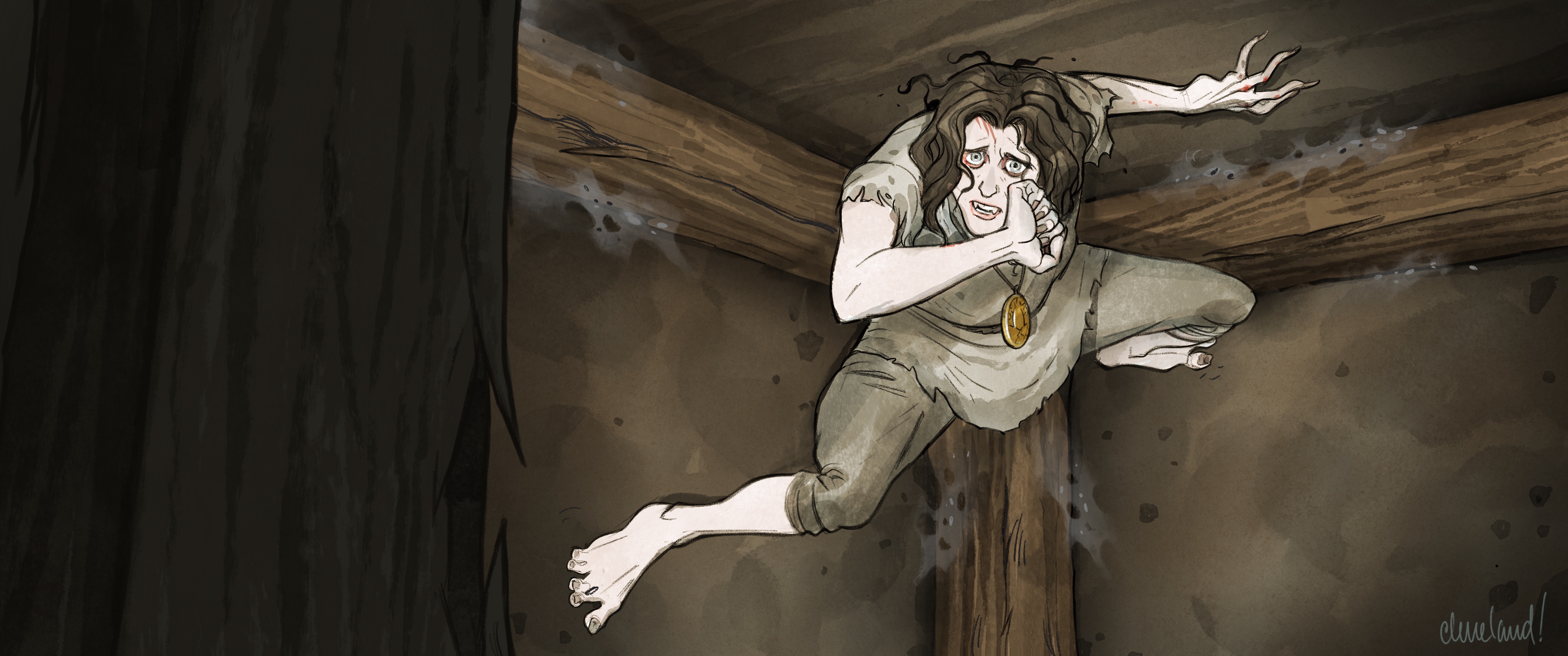
"Doru" by Caleb Cleveland. Support him on Patreon!
Roleplaying Information
Resonance. Doru should inspire sympathy for his struggles against his vampiric nature, mild discomfort with his occasionally inhuman mannerisms, and endearment for his clear dedication to his father and Gertruda.
Emotions. Doru most often feels grief, guilt, shame, desperation, resignation, and hope.
Motivations. Doru wants to reconcile with his father, ensure Gertruda's safety, and find out what happened to Escher.
Inspirations. When playing Doru, channel Theon Grejoy (Game of Thrones), Zuko (Avatar: The Last Airbender), Jesse Pinkman (Breaking Bad), and Steve Harrington (Stranger Things).
Character Information
Persona. To the world, Doru is a monstrous, bloodthirsty vampire spawn. To those he trusts, Doru is a broken, guilty man who is desperate to avoid hurting those he loves.
Morale. In a fight, Doru would seek to flee to avoid hurting anyone—but if his father or Gertruda were endangered, he would fight savagely to protect them.
Relationships. Doru is Father Donavich's son, Escher's former lover, and Gertruda's betrothed.
Doru’s request is simple: to prove to himself that he can control his vampiric urges, he wants the heroes to expose him to the scent of fresh blood. If he can refrain from attacking, he wants the heroes to tell Father Donavich that his son is still alive. If he can’t, he wants the heroes to kill him. In either case, he won’t stop the heroes from taking the holy symbol once the experiment is complete.
Doru doesn't fight to defend himself if attacked. Instead, he curls into a ball at the end of the room and pleads for the heroes to give him a chance—just one chance—to prove himself. If the heroes decline, Doru whimpers for his father to save him as he dies, though his pleas go unheard and unheeded.
Doru's Trial
If the heroes agree to fulfill Doru’s request by exposing him to fresh blood, he asks them to strike him down if he succumbs, and then asks them if they truly believe he can overcome his vampiric nature.
If a hero shows the sunrise medallion to Doru and allows him to touch it, his control increases by 1, to a maximum of 6. .
As the heroes converse with Doru, secretly track three counters: humanity, bloodlust, and control. If one or more heroes speaks Vaslorian, Doru's control instead starts at 5. Doru has several tethers—things that connect him to his humanity—and pitfalls, which weaken his control on his bloodlust.
This isn't quite a negotiation, but if your heroes have negotiation-specific features, I suggest letting them be used here. The only exception is renown and related features, such as a Vanguard Tactician's Commanding Presence; the heroes haven't been in Barovia for long enough to develop a reputation yet.
Humanity: 2
Bloodlust: 3
Control: 4
Native Language: Vaslorian
Tethers
- Protection: Doru wants to protect his father and the other residents of the village from his bloodlust. Encouraging Doru to believe in his inner strength for the sake of his loved ones appeals to this tether.
- Freedom: Doru wants to return to his life as a valued member of the village of Barovia, but knows he is a threat to his loved ones as long as Strahd lives. Promising to defeat Strahd, which would free Doru from Strahd's control, appeals to this tether.
Pitfalls
- Higher Authority: Doru hates Strahd, yet also knows that the vampiric curse forces him to obey Strahd's direct orders. Arguing that Strahd would want Doru to control himself, or conversely that the burgomaster or some other authority figure's orders should be enough to countermand Strahd's control over Doru, invoke this pitfall.
- Revelry: Doru's current existence is hellish to him—yet the curse forces him to find the idea of fully embracing his bloodlust sickeningly attractive. Suggesting that vampirism could be enjoyable invokes this pitfall.
As the heroes converse with Doru, they will likely attempt to encourage him to hang onto his humanity. If an argument appeals to one of Doru's tethers, the hero's test has the following outcomes.
≤ 11: Doru's control decreases by 1.
12-16: Doru's humanity increases by 1, and his control decreases by 1.
17+: Doru's humanity increases by 1, and his control doesn't change.
If an argument doesn't appeal to one of Doru's tethers or invoke one of his pitfalls, the test to encourage Doru is more difficult and has the following outcomes.
≤ 11: Doru's bloodlust increases by 1, and his control decreases by 1.
12-16: Doru's control decreases by 1.
17+: Doru's humanity increases by 1, and his control decreases by 1.
If an argument invokes a pitfall, it automatically fails. Doru's bloodlust increases by 1, and his control decreases by 1.
The heroes may also try to uncover Doru's tethers or pitfalls in order to make more persuasive arguments. The test has the following outcomes.
≤ 11: The hero learns no information about Doru's tethers or pitfalls, and Doru becomes uncomfortable and agitated under the hero's scrutiny. Doru's control decreases by 1.
12-16: The hero learns no information about Doru's tethers or pitfalls.
17+: The hero learns one of Doru's tethers or pitfalls (their choice).
If a hero lies to Doru with an argument that fails to increase his humanity, Doru catches them in the lie, and his faith in them weakens; Doru's bloodlust increases by 1.
What Doru Knows
Doru can share the following information with the heroes if asked:
- As a child, Doru was enraptured by stories of the sun and the light and hope that it once brought to the valley. As he grew older, he learned swordsmanship from Ismark and studied the book Van Richten’s Guide to Vampires to learn how to destroy the undead. He dreamed of one day destroying the Devil of Castle Ravenloft and bringing freedom to his people.
- Sixteen weeks ago, a foreign scholar calling himself Alanik Ray arrived in Barovia and rented a room in the burgomaster's manor. When an enormous undead dire wolf attacked a group of children who had strayed too far from the village, however, Doru alone saw "Alanik" fend it off with expert skill—and when the wolf knocked "Alanik" down, something fell from his face and his appearance magically changed, revealing him to be the legendary vampire hunter Dr. Rudolph van Richten.
- Doru confronted him and insisted that Van Richten lead the village in revolt against Castle Ravenloft. Though Van Richten was reluctant at first, he eventually agreed—on the condition that Doru allow him to keep his disguise. Two days later, Doru, aided by a man named Escher—the village bard and Doru’s oldest friend—had assembled more than two dozen fighters to march on the keep.
- With Van Richten’s aid, the mob struck down any undead guards that tried to stand in their way. However, when they finally opened Strahd’s crypt, Escher was nowhere to be found—and Strahd’s coffin was empty. (If asked, Doru forcefully denies that Escher betrayed them.)
- Shortly thereafter, Strahd emerged from the shadows and attacked the mob with merciless force. Most of Doru’s companions were slain. Doru himself was turned into a vampire spawn, and later learned that Escher had been as well. Doru doesn’t know what happened to Van Richten, but was forced to confess the old man’s identity when Strahd interrogated him later.
- Doru spent nearly three months at Castle Ravenloft, during which Strahd repeatedly forced him to drink the blood of his former companions. Six nights ago, Strahd commanded Doru to return to the church and his father.
- Doru can’t disobey Strahd’s direct orders, and can feel his presence at all times. His vampiric bloodthirst is a constant distraction, and it’s difficult to control his predatory urges and instincts. When he first returned to the church, he was almost grateful that his father had locked him in the undercroft, where he couldn’t do any harm.
- Doru doesn’t know if his soul or body can be saved, but he’s kept his father’s holy symbol to remind him of his faith and family, and to steel his will against the addictions of his new form. If not for that, he suspects that he would have lost control days or even weeks ago. (Doru doesn’t know why Strahd allowed him to keep it, but suspects that Strahd viewed it as a form of ironic amusement.)
If the heroes ask about his argument with "Alanik," Doru admits, shamefacedly, that he forced Van Richten to accompany his rebels to the castle, threatening to march on Castle Ravenloft with or without Van Richten's help. (An enraged Van Richten ripped out the preface of Doru's copy of Van Richten's Guide to Vampires—which Doru bought from a traveling caravan ten years prior—in order to make a point. "He warned me that faith and books meant nothing in the face of true evil," Doru murmurs. "I should have listened." Doru isn't sure what happened to the rest of the book.)
As the conversation continues, Doru might ask the heroes:
- whether Escher has been seen in the village, and
- whether Doru’s betrothed, Gertruda, survived the siege.
If told that Gertruda has left the village alone for Vallaki—likely in a misguided effort to save Doru himself—Doru becomes visibly distraught, but hopes aloud that she made the journey safely. He asks the heroes to look out for her and help bring her home should they find her. Doru feels that he has earned his fate, but believes that Gertruda, a good and compassionate woman, deserves far better.
Doru's Fate
When the heroes expose Doru to fresh blood, read the following:
Doru’s muscles tense and he squeezes his eyes shut. A few moments later, his nostrils flare, and a thin line of saliva begins to run down his lips. He whimpers, his clawed fingers flexing and twitching.
"When the shadows come," he whispers, “I will not yield. Darkness is the destroyer, and temptation its weapon. I will face the night and its horrors and await the horizon. For in the light of the Lady's love, only light can remain."
Doru's voice shakes, his emaciated body trembling. One fist is clenched at his side, the other squeezing the bloodstained sunburst that lies across his neck.
"In the light of the Lady's love," he repeats, gasping for breath. "In the light of the Lady's love. Gertruda. Gertruda. Gertruda —"
Doru's trial ends when his humanity reaches 5, his bloodlust reaches 5, or his control reaches 0.
If Doru's bloodlust reaches 5, or his control reaches 0 with more bloodlust than humanity, he succumbs to the bloodlust. Doru pauses, then attacks. Draw steel. If the heroes defeat Doru, there is no reward; this is a tragedy, not a heroic victory.
Otherwise, if Doru's humanity reaches 5, or his control reaches 0 with at least as much humanity as bloodlust, Doru successfully resists his bloodlust. Read:
After what seems like an eternity, Doru's body finally relaxes. His tense muscles seem to uncoil, his breath grows steadier, and the look of strain fades from his face. His eyes remain closed a moment longer, then flutter open—and the fangs in his mouth slowly retract, leaving only an ordinary pair of canines behind.
"I have not yielded," he whispers hoarsely. "Not yet."
Doru thanks the heroes and relinquishes the holy symbol without protest. If the heroes mention it, he is surprised to hear that his fangs have retracted, but recognizes the significance with humility and disbelief. (Doru has, after all, read Van Richten's Guide to Vampires many times.)
Milestone. If the heroes successfully help Doru overcome his bloodlust, award each hero 1 Victory.
Doru warns the heroes that Strahd will likely take an active interest in newcomers to his land, and that they should therefore be careful. As a token of his gratitude, he provides the heroes with the location of a hidden weapons cache that Van Richten kept in case of emergencies. To reach it, the heroes must cross the River Ivlis Bridge and travel down the Old Svalich Road three hundred paces south into the woods, until they arrive at an ancient oak tree. They'll find the cache nestled in a hollow beneath the tree's roots.
If the heroes appear interested in learning more about vampires, Doru can share the information contained in the Chained to the Grave feature of the Barovian vampire and Barovian vampire spawn statblocks, as well as the broad details of the other features in the Vampire Attributes featureblock. Doru notes, however, that the Devil is unlike any other vampire. "He holds powers beyond any ordinary vampire's ken. He is . . . unfathomable." He shudders, his eyes squeezing shut in painful remembrance. (Doru can't share any specifics regarding Strahd's capabilities, only that he seemed to slaughter Doru's friends "in mere moments.")
Before the heroes depart, Doru asks them once more to tell Father Donavich that his son is still alive. If asked to accompany them upstairs, he declines to do so. "I have sinned with my hubris, and this is my penance," he says softly. "I will leave this prison only when my father allows."
The Burial
If the heroes return to Father Donavich with his holy symbol in hand, he accepts it with gratitude.
If the heroes tell Father Donavich that they killed Doru to obtain the symbol, read:
Donavich's eyes well up with tears as he clasps the symbol in his hands, holding it so tightly his knuckles begin to turn white. A strangled sob escapes him as he sinks to his knees, cradling the sunburst like an infant.
"My boy—my dear, precious boy," he murmurs, his voice barely above a whisper. "May the Lady forgive me for what I've done—and for what I couldn't do."
He swallows and his face tenses, his expression growing as hard as stone. "It had to be done. For his sake—and ours."
Otherwise, if the heroes spared Doru and relay his final message, read:
Donavich stumbles back as if he's been struck, his face pale and his eyes wide with shock. For a moment, he simply stands there, silent—and then the silence is broken by a pained noise, a cross between a gasp and a sob, as he clutches the symbol to his chest.
His eyes glisten as he runs a trembling hand through his hair, a myriad of emotions playing across his face in quick succession: disbelief, rage, grief, shame, and—finally—hope. He sags against a nearby pew, his body shaking with exertion.
"My boy," he chokes out. "He's—he's still my boy?"
Once he’s received his holy symbol, Father Donavich gladly agrees to conduct Kolyan’s burial.
The cemetery is as described in E6. Cemetery (p. 48). At night, the cemetery is watched by two swarms of bats—spies of Strahd’s—who hang to the eaves of the church and the nearby mausoleums, watching the heroes.
Upon entering the cemetery, Donavich retrieves four shovels from a shed abutting the church and shares them with the heroes. When the grave is fully dug and dawn has begun, Donavich offers prayers to the Lady of Morning, asking for Kolyan’s deliverance in the following refrain:
O Lady of Morning
Lady of blessed light and patron of the cycle of life
We commend into thy mercy and thy radiance Master Kolyan Indirovich
Now departed hence from us and gone evermore into your glory.
We beseech thee to grant unto him thy mercy and everlasting peace
As thou deliver'st him from this everlasting darkness into infinite light
From pestilence into growth
From shadow into day
And from death into new life.
Grant him entrance into Your land of light and joy
In the fellowship of thy saints
And the brilliance of thy presence
By Your will and grace.
At the conclusion of Donavich’s prayer, Ismark and Ireena offer the following words in memory of their father:
Ismark wipes his eyes. "Kolyan Indirovich bore all the qualities of a great burgomaster: he was kind, compassionate, and just. But above all else, he was our father—the man who taught us to choose courage over fear, hope over despair, and laughter over sorrow. Even though he has left us, his lessons and memory never will. May he find rest in the Lady's embrace, and may his legacy be never forgotten."
Ireena stares at the grave for a few moments, her fingers twisting anxiously into knots. Finally, she says, quietly, "When you found me, I was a stranger—a child, lost in the woods. You and Mother took me in, cared for me, and loved me as your own. When I asked you why, you only ever said: Because I needed it." She falters, choking on the words, then says: "I can never hope to repay what you gave me. But, just as you did, I will never stop trying to help those who need it."
Any heroes who wish to may offer words, prayers, or tributes of their own.
The Lady of Morning is Salorna, the human Vaslorian god of life, nature, storm, and sun. Barovia has been in the Mists for so long that her name has been forgotten.
If he has recovered his holy symbol, Donavich first performs a divine ritual to sanctify Kolyan’s remains. Donavich then directs the heroes to lower the coffin into the ground.
With the burial concluded, Strahd’s bats take off into the air, vanishing up into the mist surrounding the base of Castle Ravenloft.
Donavich takes the bats’ presence as a bad omen. In a surprisingly lucid moment, he warns the heroes and Ismark of a Barovian superstition that young people with red hair often find that ill luck travels beside them, and asks if Ireena plans to remain in Barovia now that the Devil has awoken. If told that Ireena and the heroes intend to leave, Donavich suggests the Abbey of St. Markovia in Krezk as an eventual destination. He notes it was once a bastion of good, and may yet still offer some protection.
All Barovians know that the Abbey of St. Markovia lies in the village of Krezk. Most outside of Krezk are unsure as to whether it still operates, though rumors abound that Strahd destroyed it long ago, leaving nothing more than ghosts to haunt its halls. A few Vallakians, including Father Lucian Petrovich of St. Andral's Church, know that the Abbey was reopened more than one hundred years ago, but none beyond Krezk know that the Abbey's current abbot is the same person who reopened its doors over a century ago.
Olga's Request
When the heroes leave the cemetery, they find Olga waiting for them, hands tightly clasped before her, uncharacteristically nervous. The conversation then unfolds as follows:
- Olga states that she understands the heroes intend to leave the village and travel to Vallaki. Would they consider allowing her to travel with them?
- "I'm the strongest person in the village," she hastens to add. "I'm sure I could help with whatever dangers we might face on the road. Not that you're not very competent on your own!"
- If the heroes ask why Olga wants to leave the village, she says, in a low voice: "Everything has been so hard since Mother and Father...everything here reminds me of why they died. I'd like to start fresh, live a peaceful life somewhere I can be happy." (This is partially true, but a hero who succeeds on a hard Intuition test learns that Olga isn't being entirely open, and is holding something back. In truth, Olga would rather "start fresh" by convincing her neighbors and loved ones to accept Strahd as their rightful ruler and earn his forgiveness. She wants to accompany the heroes to spy on their runecasting at Tser Pool and learn whatever she can that might help Strahd.)
- If the heroes appear to doubt her story, Olga hesitates, then "reveals" that Bildrath has become harsh and angry since his sister's death. (This, too, is true, but, again, not why Olga wants to travel with the party.) She fears that her presence is driving her uncle to obsess over his grief.
If the heroes agree to travel with Olga, she offers heartfelt thanks, then hurries off to collect her things from Bildrath's Mercantile.
If the heroes refuse to allow Olga to accompany them, she sighs, frowning, then says: "I understand. I guess I'll have to make my own way out of the village, then. I hope my uncle won't be too worried about me traveling alone." (She hopes that guilt, if nothing else, will persuade the heroes to agree to travel with her.) If the heroes reject her once again, she makes her way slowly back to Bildrath's Mercantile, disappointed, then makes preparations to secretly trail the heroes when they leave the village.
Return to the Mansion
When the heroes return to the burgomaster’s manor following the burial, Ismark packs them three days' worth of rations in cloth sacks for the journey to come. As he does, Ireena tells the heroes that she'll be ready to leave at noon. Until then, the heroes are free to explore the village, shop at Bildrath's Mercantile, or otherwise pass the time.
As Ismark packs the rations, he can share the following information:
- The journey to Vallaki is more than a day's travel if the heroes plan to visit Tser Pool first, and that Ireena and the heroes will likely need to spend a night on the road. He recommends doing so at Tser Pool itself.
- Tser Pool is a bit under two hours' journey from Barovia. (Though Strahd's spies are everywhere, Tser Pool is known to be a safe place for travelers to spend the night, especially given Fravartiš's reputation.)
If your heroes haven't taken a respite since they arrived in the village, encourage them to do so before they leave for Vallaki. Ireena won't leave before noon the day after the siege, but is willing to wait an extra day or two if the heroes need time to recover from their injuries. As everyone in Barovia knows, the roads are extremely dangerous.
B5j. Lugdana's Knoll
Approximately an hour before noon, Ireena quietly slips out of the mansion, walking to Lugdana's Knoll, a small, quiet hill to the north of Barovia. (The hill is named for the holy warrior Lugdana, who, according to legend, first met Burgomaster Ismark Antonovich the Great upon that hill.)
Shortly before noon, if the heroes haven't been keeping track of her, Ismark—who's currently debriefing a pair of Barovian scouts regarding their unsuccessful search for Gertruda—notes Ireena's absence with minor concern and asks the heroes to find her and bring her home.
Because Strahd and his servants have only visited at night, Ismark isn't notably alarmed by Ireena's absence, but still wants to see her brought home as quickly as reasonably possible. Ismark advises that the heroes check Lugdana's Knoll first—one of Ireena's favorite spots around the village—and provides brief directions to get there.
If the heroes visit the knoll, read:
As you pass through the sea of tall grasses north of the village, a gentle knoll rises before you, bordered on the far side by the clutches of the dark Svalich Wood. Plants with white, feathery flowers and a sweet, earthy scent seem to dance amidst the grass atop the hill, their leaves rustling in a whispering wind.
A lonely tree stands atop the hill, its gnarled branches reaching skyward like outstretched arms. Beneath its shade kneels a figure, her gaze fixated upon the ground.
The figure is Ireena, who has donned her chestplate and rapier and now wears a red scarf around her neck. As the heroes approach, they can see that she is using a trowel to dig a hole in the earth between the tree's roots. Ireena, fixated upon her work, doesn't notice the heroes until they call out to her or otherwise enter her field of view.
Ireena greets the heroes with warmth, though with some embarrassment for having driven them to come search for her. She shares freely that she is digging for a small wooden chest that she and her mother, Korina Targolova, buried here before her mother's death fourteen years ago—a coffer whose contents she hopes to take as a keepsake when she departs for Vallaki, given that she doesn't know when, if ever, she'll be able to return home.
If allowed to finish unearthing the chest, Ireena opens it, revealing its contents. The chest contains a silver bracelet set with gemstones, a pressed aster flower, a wooden charm in the shape of the yarrow flower on a leather cord, and a handkerchief with floral patterns.
The flower (which Ireena found and her mother pressed), charm (which Ireena's mother wore as an apprentice to the town's healer), and handkerchief (which Ireena's mother helped her to sew) are all mementos of Ireena's childhood with her mother. The bracelet is an item that Ireena was found carrying when Kolyan found her in the Svalich Wood, which Korina kept as a memento of their "miracle child" after she learned that she could bear no more children.
The bracelet holds no sentimental value for Ireena, and she doesn't remember why she was carrying it when Kolyan first found her, or where she obtained it. She offers it to the heroes as a gift for their agreement to escort her to Vallaki, as compensation for their trouble.
The silver bracelet, which is tarnished and clearly hundreds of years old, looks valuable and bears an intricate pattern of the moon and stars along the exterior, with a moonstone gem embedded at the center of the moon and five lapis-lazuli serving as the stars. On the inside of the bracelet, in tiny, elegant script, the following message is engraved in Common: "Tatyana: May you find your path, and may you find light even in the darkest places—Mother & Father."
Ireena doesn't know who Tatyana is. (Unbeknownst to Ireena, the bracelet was a gift from Tatyana Federovna's parents on Tatyana's eighteenth birthday. It was lost in the Svalich Wood when Tatyana leapt to her death from the Castle Ravenloft overlook.)
After sharing the items in the chest, Ireena removes her scarf, revealing the bite marks on her neck. As she traces her fingers along them, she grimaces. "I don't know why he hasn't killed me or turned me," she says, gritting her teeth as her hands curl into fists. "I don't know if this is some kind of sick game he's playing, or if he just likes to see people suffer."
The anger leaves her as she adds, her voice tightening, "They say people with red hair bring bad luck. I'm sorry—I never wanted to bring any to you." (She is grateful for any reassurances the heroes might offer.)
Ireena gladly returns to the mansion with the heroes, or returns on her own shortly after noon if the heroes failed to find her. She then retrieves a packed traveling bag from her room.
When the heroes are ready to leave, Ireena bids Ismark a heartfelt farewell and sets off on the road.
Ireena uses the Ireena, Barovian Warrior statblock, and follows all the usual advancement rules for retainers (see Draw Steel: Monsters). Her mentor is whichever hero has the strongest bond with her, or whichever hero (if any) trained her in the montage preceding the siege.
None of Strahd's servants or monsters—regardless of their intelligence, and least of all Strahd himself—ever attack Ireena.
Design Notes
Ismark and Ireena. As written in Curse of Strahd, Ireena doesn't have much agency at any point in the adventure. She's first presented as Strahd's victim and not much else; then her brother decides unilaterally that she must leave her whole life behind and go to Vallaki; then she's stalked relentlessly throughout the adventure; then finally she fucks off into a pool for someone else's happy (?) ending. She doesn't even get to see her stalker dead! And her soul isn't even an original! Yikes. Her role in Curse of Strahd: Reloaded is improved, but still puts players in the uncomfortable position of taking her overbearing brother's side and trying to convince Ireena to go against her own wishes. Surely better things are possible.
The siblings' argument and the morning scene at the mansion have been rewritten to give Ireena the active role in deciding her own fate, to give her more emotional depth through survivor's guilt, to further incentivize the heroes to agree to escort her, and to make Ismark more sympathetic and less overbearing. The reveal of Gertruda's disappearance has also been moved to the argument scene to avoid giving the players something quest-hook-shaped that they can't actually follow, to avoid unnecessary repetition, and to decrease the NPC roleplay workload on the Director during the tavern scenes.
Doru's Trial. Doru's trial has been reworked to better use the mechanics of Draw Steel. I considered making it a straight-up negotiation, but didn't like the implications of a decreasing "humanity" meter—Doru is a thinking, feeling person the whole time, and killing him would be a tragedy. So instead, here we have competing humanity and bloodlust clocks.
Barovian Names. What are the human naming conventions of Barovia? Ismark has the patronymic Kolyanovich, after his father Kolyan; Kolyan has the patronymic Indirovich; so we can conclude that the burgomaster's family does use patronymics but does not have a family name. All fine and good. But then, if one looks at the "Barovian Names" sidebar in Chapter 2 (page 25), meant to give a GM a handy list of names for the average random Barovian commoner, we run into several problems. First, we are given only a list of "family names", and a family name isn't the same as a patronymic. Second, this list of names doesn't seem to have a consistent way the gendered forms of these names are derived; we have, for example, "Targolov/Targolova", which fits the pattern one would expect from an east Slavic family name or a Bulgarian patronymic, but we also have "Mironovich/Mironovna", which fits the pattern one would expect from east Slavic (but not Bulgarian) patronymics. Fine for there to be people of different cultures with slightly different patronymic naming conventions, and maybe some of these names are meant to be patronymics and some are family names, but then, Ireena Kolyana fits neither pattern—one would expect her patronymic to be Kolyanova or Kolyanovna. So: do most human Barovians use patronymics, or do they not, and if they do, how are they derived? Do they have family names, or do they not? I must choose a convention or have this debate with myself again every time I name an NPC.
What I've settled on is something like sixteenth-century Russian names. Generally, peasants (e.g. Gertruda, Escher) have only a given name. Minor nobles and wealthier families use patronymics derived from the highest-status parent's name (e.g. Ismark Kolyanovich, Lydia Petrovna). Some use a non-gendered form for their patronymic (e.g. Kasimir Velikovche, sibling to Patrina Velikovna) or drop the patronymic altogether (e.g. Urwin Martikov, estranged from his father). Some very old or noble families also have family names (e.g. Ilya Dmitriyevich Krezkov, youngest son of the burgomaster of Krezk). Some people adopt their spouse's patronymic in an altered form upon marriage (e.g. Ivan Nastasyich might become Ivan Altynov upon marrying Aleksei Altynovna, or Ekaterina Ivanovna might become Ekaterina Petrova upon marrying Olga Petrovna). Some, of course, have particular reasons for breaking this pattern (e.g. the burgomaster of Vallaki uses Vallakovich, the patronymic of town founder Boris Vallakovich, as his family name), and some have names from cultures that don't follow this patronymic/family name convention at all (e.g. the Dursts).
Many thanks to the friends and strangers who advised me on how nonbinary and genderqueer Russians handle their names! This piece was especially helpful.
Anyway, this came up because of Alenka. Alenka, given the second name Konstantinova in Curse of Strahd: Reloaded, is the sister of Anton Konstantinovich, who in turn is married to Dezdrelda Konstantinova. I've changed Alenka's patronymic to Konstantinovna to avoid questions like "how many Konstantins could there possibly be in this tiny village" and "if Alenka is married, where's her spouse". Ireena's patronymic has also been changed to Kolyanovna, to match Ismark's patronymic.
Rahadin the Shadow Elf. Ah, Rahadin. I knew I wanted to change his ancestry to one present in Draw Steel's Orden, and shadow elf seemed like a more interesting option than wode elf. Plus, DnD5e-Rahadin, scheming yet servile, ambiguously "dusky-skinned", feels like an Orientalist trope to me, and I (Japanese) am very tired. So here Rahadin was born to a small court of shadow elves who moved to Orden to escape the schemes of Every Strike of Lightning a Lover Betrayed.
The rest of Rahadin's backstory has also been almost entirely reworked for this guide. Primarily because I'm trans, and I simply am not interested in including gendered genocide in my own games or in the adventures I write. Frankly, bizarre to include that in the original module, I think. You simply oughtn't imply in a throwaway line in an NPC's backstory that an entire society was 100% cis people. (A society of elves, no less.)
Fravartiš. Another major change foreshadowed here! We all know the Vistani in 2016-CoS are heinously racist anti-Roma stereotypes, and 2020-CoS isn't much better. And of course both are inspired by the also-racist tropes in Dracula. The seer, whose magical future-seeing powers are real, is load-bearing for the adventure; but making her an otherwise normal human person who lives in a society of cheerful storytellers—well, I think it would inevitably lead back to racist stereotypes.
So, what to do? Thankfully, an alternative presented itself in the form of existing Draw Steel lore: hakaan! Hakaan heroes have Doomsight, which allows them to see a piece of the future, namely the moment and nature of their own death. This doesn't get us quite all the way to "the seer can tell the heroes useful things about the fate of Barovia", unless the seer's death is also Barovia's death. Enter a piece of lore from Curse of Strahd: Reloaded: in that guide, Madam Eva is an avatar of the Seeker, one of the Ladies of the Fanes, the oldest gods of Barovia. Putting these pieces together, we have what I arrived at for this guide: the seer is a saint (maybe just conduit) of one of the gods of Barovia, and also hakaan, so her Doomsight shows her the moment Barovia falls—when Strahd executes his villainous scheme to consume the souls of all Barovians and escape the Mists on the night of the Grand Conjunction, on the winter solstice of this year.
And thus the seer has a hakaan name.
Of course, I'm not entirely confident I've eliminated this particular strain of racism from the adventure; this is outside my expertise. I do plan to hire have hired! a Romani sensitivity reader for future arcs including formerly-Vistani characters.
Olga. Strahd's spy has been moved from Tser Pool to the Village of Barovia and combined with Bildrath's nephew for several reasons. First, of course, to really get as far away as possible from the racism of the original module. Second, to introduce a bit of dramatic tension when Fravartiš later reveals that a spy is among the party—could it be Ireena? surely it's not someone who actively fought alongside the party? Third, Parriwimple is far too close to ableist depictions of intellectually and developmentally disabled people as eternally "childlike", a kind of ableism that leads to all sorts of oppression and violence against intellectually and developmentally disabled people. None of that here, thanks! Thus, for many reasons, a rework.