Arc C - Into the Valley

An adventure for five 1st-level heroes.
In this arc, the heroes depart the village of Barovia for Tser Pool and the town of Vallaki. As they journey through the woods, they can encounter a pair of Barovian scouts searching for a missing family, distract or do battle with a horde of zombies, and recover a weapons cache left by Dr. Rudolph van Richten.
Upon their arrival at the River Ivlis Crossroads, the heroes encounter Strahd von Zarovich for the first time, accompanied by Escher, one of his vampiric consorts. After a tense conversation, the heroes can head north to Tser Pool.
On the way to Tser Pool, the heroes encounter a raven—the disguised wereraven Muriel Vinshaw—fleeing a monstrous strix, a scarecrow of the skies crafted by the swamp-witch Baba Lysaga. If the heroes defend Muriel from the strix’s onslaught, she joins them for the remainder of their journey to Vallaki, though without revealing her true identity.
Soon afterward, the heroes finally arrive at the settlement at Tser Pool. There, they receive a magical rune casting from Fravartiš, which prophecies the location of three artifacts that will assist them in the fight against Strahd, as well as an ally who is destined to aid them.
While staying at Tser Pool, the heroes hear tales of Strahd's history and the Holy Symbol of Ravenkind, and can also meet Adaska, a hakaan who claims to have once known Rudolph van Richten. As the heroes depart, they also receive a mission from Fravartiš to purchase a toy in Vallaki for delivery to her great-granddaughter, Sitarey.
If the heroes are tasked with escorting Ireena to St. Andral's Church in Vallaki, or if they have their own reasons for doing so, they then return to the Old Svalich Road via the River Ivlis Crossroads, traveling west through the mountains. Along the way, they encounter a strange skeletal rider, a pair of fresh graves, a watchful revenant, the night hag Morgantha in her peddler's disguise, two flocks of friendly ravens, and two werewolf packmates accompanied by their pack of ravenous wolves.
Upon arriving in Vallaki, the heroes can find lodgings at the Blue Water Inn. There, they can engage in downtime activities before meeting a host of colorful characters, including the ringmaster Rictavio and the children of Lady Fiona Wachter. When downtime ends, the heroes can also have a fateful encounter with Baron Vargas Vallakovich and his cruel enforcer, Izek Strazni...
The module’s map of Barovia depicts a dotted line that appears to connect Tser Pool to Tser Falls. Despite its appearance, Tser Falls (p. 37) makes clear that this is not a shortcut. Instead, this dotted line is a footpath that leads to the base of Tser Falls, one thousand feet below the bridge overhead. At no point does it actually reconnect to the main road.
To travel from Tser Pool to Vallaki, the heroes will instead need to travel south, back toward the River Ivlis Crossroads, then take the Old Svalich Road westward.
This adventure does not contain random encounters. As such, whenever the heroes are traveling, you should disregard the Random Encounters (p. 28) section except where a particular encounter is referenced and incorporated directly.
During this arc, the heroes can earn 5-6 Victories, by
- negotiating with Strahd at the crossroads (negotiation, 1 Victory);
- rescuing disguised wereraven Muriel Vinshaw from Baba Lysaga's strix (combat, 1 Victory);
- losing or chasing Olga, Strahd's spy at Tser Pool (montage, 1 Victory);
- optionally fighting some wolves on the road to Tser Falls (combat, 1 Victory);
- defeating the werewolves at the ravine (combat, 2 Victories).
At the end of this arc, the heroes should have enough XP to reach level 2.
C1. The Svalich Woods
The journey from the village of Barovia to the River Ivlis Crossroads is three miles long and takes one hour.
C1a. The Barovian Scouts
As the heroes travel, read:
You set off from the silent village of Barovia, the fog creeping around your feet as you pass onto the Old Svalich Road. A sea of tall, pale-green grasses stretches out before you on either side of the road, all the way up to the edge of the Ivlis River. The sky above is a dull grey, the clouds heavy with the promise of rain.
It's not long before you can see the old arched stone bridge in the distance that spans the clear blue river ahead. Crossing it, you find yourselves on a muddy road that winds its way through the trees. The air is thick with the scent of damp earth and decaying leaves, and the trees press in close, casting deep shadows that carve dark gouges across the road.
If any heroes have the Alertness skill, they hear a rustling noise and see a silhouette crouching in the misty underbrush. Otherwise, the heroes simply hear a voice call out, muffled and diffuse in the fog: “Who goes there? Name yourselves.”
The voice belongs to a gruff Barovian named Kereza (she/they), who is joined by a second, soft-spoken person named Korga (he/they), whom the heroes previously encountered in Arc B - Welcome to Barovia. After confirming that the heroes are not transporting Ireena against her will, the scouts warn the heroes that Strahd’s spies are numerous throughout the Svalich Woods, including wolves, bats, and—at times—the very trees themselves. (If asked about the trees, the scouts can describe seeing animate vines, saplings, and bramble-patches that wander through the woods with hostile intent.)
If Ireena is with the heroes, she can aid the heroes in reassuring the scouts, who recognize her and greet her with quiet respect. The scouts are surprised to see Ireena venturing forth from the village, but agree that Vallaki is likely a safer place than Barovia—assuming, of course, that she can make it there safely. (Ireena stubbornly insists, however, that her journey is a diplomatic and humanitarian one, and that the heroes are her escorts and bodyguards.)
The scouts are searching for the Lansten family: two parents and three young children—a girl and two boys—who went missing during the zombie attack on the village and haven’t been seen since. After asking whether the heroes have seen their quarries on their journey, the scouts warn them not to stray from the road, noting that dead and dark things lurk beneath the treetops. Kereza and Korga then respectfully depart.
Shortly after the heroes resume their trek down the Old Svalich Road, a light drizzle begins to fall, stirring a fine mist that drifts through the underbrush.
C1b. Van Richten’s Cache
As the heroes continue down the road, read:
You travel further into the woods, the muddy road guiding you deeper and further away from civilization. As the road bends, the river brushes up against you once more. Here, the river is wider, its waters dark and calm. You can see the reflection of the trees and fog in its surface. The sound of the quiet, trickling water is met only by the rustling of leaves and the drizzle of soft rain. No birdsong breaks the silence that hangs over the woods.
While traversing this section of the Old Svalich Road, the heroes are stalked by one of Strahd's spies: a wolf. The heroes make a medium group Intuition test.
≤ 11: The heroes don't see the wolf, and it slips away unnoticed to report that the heroes retrieved a monster hunter's cache.
12-16: The heroes see the wolf, but it notices their attention and flees into the forest too quickly to follow.
17+: The heroes see the wolf, which doesn't notice that it's been seen.
(See Strahd's Spies for more information.)
If the heroes received the location of Van Richten’s hidden weapons cache from Doru in Barovia’s church, they can enter the woods to the south to find it. If they do, read:
You step from the road and into the woods, crossing the treeline as your feet squelch into mud and loamy soil. Wisps of fog curl across the earth around you, gnarled trees reaching their arms overhead as gray light filters through the canopy. You walk for three hundred paces, stepping softly through the mulch and mist until you arrive at a clearing, the woods parting to make room for a tall, ancient oak whose knotted black trunk rises far above its peers.
You soon realize, however, that you’re not alone. Five figures shamble or stand aimlessly within the clearing, their clothes muddied and torn and their flesh just beginning to turn pallid and gray.
The five figures are zombies. They also match the descriptions of the Lansten family provided by the scouts—two parents, a young girl, and two young boys.
The heroes can attempt to lure the zombies away from the clearing with a group Presence test, or attempt to ambush and attack the zombies to destroy them altogether with a group Agility test.
≤ 11: The heroes fail to lure the zombies away from the tree, and must fight their way to the cache. Three heroes each lose 1 Recovery.
12-16: The heroes successfully lure the zombies away, but struggle to lose them in the woods. One hero is attacked as they return to the cache, and loses 1 Recovery.
17+: The heroes successfully lure the zombies away, then lose them in the woods. The heroes recover Van Richten's cache with no complications.
≤ 11: The zombies notice the heroes, and the heroes have to slug it out without the element of surprise. Three heroes each lose 1 Recovery.
12-16: The heroes successfully ambush the zombies, but the zombies react more quickly than expected. One hero loses 1 Recovery.
17+: The heroes successfully ambush the zombies and destroy them before they can fight back. The heroes recover Van Richten's cache with no complications.
If the heroes choose to attack the zombies, there's no need to play out this Trivial encounter action-by-action, and the encounter awards no Victories.
If the heroes reach the oak tree, they can find Van Richten’s weapons cache where Doru told them: in a hollow nestled beneath the tree’s roots. The cache itself is a small, unlocked wooden chest containing a quiver of Silvered Ammunition, two vials of Holy Water, and one Healing Potion, along with notes on the ritual necessary to create holy water.
As a maneuver, you can coat a weapon in one vial of holy water. Until the end of the encounter, whenever you use a weapon ability that deals rolled damage using a weapon sanctified this way, the ability deals an extra 2 holy damage.
Alternatively, as a maneuver, you can throw a flask of holy water, making a ranged free strike. The strike deals holy damage instead of its normal damage.
C2. River Ivlis Crossroads
This scene takes place in Chapter 2: Area F.
As the heroes approach this area, the drizzling rain stops. Read:
Soon, the river bends once more out of sight and the dark woods surround the road once again. Finally, though, the trees pull away, revealing a tall cliff at the base of a foggy mountain slope. The air is cold and damp here, and soft wisps of fog swirl around the base of the cliff.
The heroes have arrived at the River Ivlis Crossroads, which is largely as described in River Ivlis Crossroads (p. 35).
The first time the heroes move to depart for Tser Pool, they can hear the sound of a horse-drawn carriage or wagon approaching through the fog. Almost as soon as the sound appears, a large, sleek, black carriage drawn by two black horses comes into view.
C2a. Strahd’s Arrival
The heroes can see a driver sitting in the coach box: the vampire spawn Escher (he/they), a handsome young person in elegant but faded attire. If present, Ireena gasps at the sight of him, whispering that she thought that he was dead.
The heroes should have little time to attempt to conceal themselves before Strahd’s carriage comes into view. However, if the heroes attempt to flee the carriage into the woods, twelve of Strahd’s enormous dire wolves emerge from the fog behind them and snarl, obstructing the heroes' escape.
The carriage then comes to a stop. Read the following, modifying the text as necessary if Ireena isn’t present, and pausing briefly after each paragraph to allow the heroes a short opportunity to act or react:
The driver releases the reins, steps down from the coach box, and moves to open the side door of the carriage, bowing deeply. A moment passes—and then a man steps out from the carriage.
He is tall, gaunt, and dressed in finery befitting a man of aristocratic, even royal stature. A black cloak is pulled neatly around his shoulders, tied at the neck by a blood-red brooch. A longsword rests ensheathed at his hip, its polished hilt gleaming beneath the dim light. His scarlet tunic is worked with intricate designs, and his hair is pulled back from a sharp widow's peak.
His eyes are dark, and as he moves to adjust the ruby at his neck, you see that his fingernails form long, elegant claws. It's only then that you realize that his skin is pale—unnaturally so— and that his eyes glint with a deep, intelligent hunger.
If Ireena is with the party, add:
Ireena rocks backward, as if slapped. She averts her eyes from the man's gaze, her entire body tightening. "Don't look into his eyes," she chokes out.
The man's gaze rests briefly on Ireena, and he smiles—though no warmth reaches his eyes. "Ireena Kolyanovna," he says. "What a pleasant surprise." He then turns his gaze to you.
Whether Ireena is with the party or not, add:
"Good day," he says. "I am Count Strahd von Zarovich—and it is a pleasure to finally meet the newcomers to my domain. My friends have told me so much about you." His eyes linger over each one of you in turn, regarding you like a cut of meat weighed at market, an intriguing but inanimate trinket—a prey animal spotted by a predator in the bush.
At the time that he encounters the heroes, Strahd is returning from a visit to Fravartiš’s cottage at Tser Pool. Finding the Forest Fane’s power difficult to control due to Baba Zelenna’s interference during his slumber, he sought Fravartiš’s counsel in his preparations for the Grand Conjunction. He received the following runecasting:
- "The King and the Night—the master of shadows, the beast in the labyrinth that tears at his chains."
- "The Mage and the Storm—the power you covet, a force untamed by mortal hands, raw and wild with burning fury."
- "The God and the Key—the token you seek, the key to power. Divinity’s heart waits, but where?"
- "The Child and the Gate. I see a maid of stony skin and twilit eyes. She is one way to the token."
- "But there is another—the Bull and the Dagger. The path of sacrifice opens another door. The wall that whispers awaits your tribute."
- "The threads of fate yet spin. The Hunter and the Mists are next. Strangers walk the land—their presence a riddle, their intentions a maze. They dwell in the dusk, their role yet unclear."
- "But the Raven and the Star are last. Change comes on newcomers’ wings, the dusk of an era upon us. As one age ends, another is born."
Much of Strahd’s foretelling was overheard by Muriel Vinshaw, an eavesdropping wereraven, until Strahd detected her presence and drove her away. Both Muriel and Strahd were unaware that Fravartiš knew of Muriel’s presence all along. As the hidden avatar of the Seeker, Fravartiš bears a special bond with Barovia’s wereravens, and deliberately continued her foretelling to allow Muriel to hear it.
Muriel heard the first five pairs of runes that Fravartiš read, but doesn’t know the last two. More information about Muriel and her escape from Strahd’s minions can be found in #C3. The Strix below.
Strahd can be a challenging and anxiety-inducing villain to roleplay. To enjoy the experience, rather than dreading it, consider the following tips:
- Enjoy Invincibility. Strahd is the one NPC in the entire campaign that (until they obtain the Sunsword) your heroes cannot hurt in any meaningful way. Their strongest attacks do little more than tickle him. Their cruelest insults merely amuse him. Enter Strahd-related scenes without fear of player action.
- Embrace Unpredictability. In each scene before Arc R - Trials of the Mountain, Strahd has no particular goal, and won't be disappointed if events unfold differently than he expected. Release any obligation you feel to make the scene conclude in a particular way.
- Explore Darkness. Strahd provides a risk-free opportunity to explore and relish darker emotions, such as (justified) arrogance, (quiet) cruelty, and (subtle) contempt. Savor those emotions and the impact they have on your heroes.
If a hero acts rudely toward Strahd, he sighs and replies, "Disrespect is unbecoming, especially in the face of the Lord of the land you are but a guest in. But you are foreign, and untaught, and confused. I'll give you a warning, this time. But I fear my mercy will not last forever."
The first time a hero disrespects Strahd after receiving his warning, he smiles, holds up a single finger, and says, "One." Strahd's dire wolves, if they have not already emerged, step forth from the shadows and fix their gazes on the rude hero.
The second time that a hero disrespects Strahd, he shakes his head, holds up two fingers, and says, "Two." Strahd's dire wolves step closer to the rude hero and begin salivating.
The third time that a hero disrespects Strahd, he frowns. Read the following:
"You seem to be under the misunderstanding that you are special," Strahd says. "You are not. You are an outsider to my lands, with nary an ounce of respect or common wit. It amuses me, from time to time, to take the measure of those who enter the valley from beyond the Mists."
His eyes narrow. "But you have taken your own measure, and I have found it wanting. You are not brave. You are not cunning. You invite death, and I have never been one to deny my subjects such a wish, no matter how foolish. This final chance I shall grant you to save your own life—for I see no value in it above that of the lowliest creature that crawls in the muck."
He holds up a third finger. "The next time you speak, my pets will kill you. Any who defend you will share the same fate."
If the hero violates Strahd's ultimatum, pause the game and address the player out-of-character. Note that Strahd has promised clear consequences, and that the player's actions will invoke those consequences. Make clear that the player's character will die; that the fight will not be fair; that the player will not be able to prevent their character's death; that any characters who attempt to protect that hero will also die; and that any characters who die will not be resurrected.
If the players confirms their decision, resume the game. Strahd's dire wolves then attack that hero. If any or all of the other heroes do not interfere, Strahd continues his conversation with them, undisturbed.
Twelve dire wolves should be more than enough enough to kill any level 1 party, especially focusing down one hero at a time. If, somehow, they manage to defeat the dire wolves, Strahd executes the offending hero himself.
If, at any point during the encounter, the heroes move to flee, read:
From behind Strahd, you hear a chorus of low, feral growls. Multiple pairs of eyes glint from the underbrush—each one the height of a man's shoulder.
Slowly, from the shadows, slinks a pack of massive wolves, each one as tall as a horse and twice as muscled, measuring nine feet in length from head to haunches. Their fur is a thick, mottled grey, and saliva drips from their yellowed, sharpened teeth.
They take up positions behind and around Strahd, flanking him like a noble's honor guard.
"You must forgive my pets," Strahd says. "They can be...overenthusiastic at the sight of new friends."
These are twelve dire wolves.
If the heroes appear to need further persuading, the dire wolves step forward, growling with their hackles raised. If the heroes proceed to flee, the wolves attack.
If, at any point during the encounter, a hero challenges Strahd or insists that he must be defeated, Strahd smiles, admits he's "never been one to decline a challenge," and invites the hero to defeat him—right here, right now—if they can. He promises to make no effort to stop them for the first three rounds of their assault.
If the hero declines, Strahd dismisses them as a coward, noting with disappointment, "A pity. I had hoped for better." If the hero accepts, Strahd allows them to attack him for three full rounds.
When the three rounds have elapsed, Strahd says, "Impressive determination—if ultimately futile." He adds, "Now, let us see how you fare when the true game begins."
Assuming his Mage stance, Strahd uses The Forest Consumes to slow the hero with caustic vines. On his first turn, Strahd uses his Solo Action malice feature to gain an additional main action, then uses Disarming Glare to attempt to frighten the hero, using his second main action to use Disarming Glare again if the hero is not frightened. The first time the hero is restrained by the vines, he says, "Escape if you can." He then adds, in a lower tone: "But should you find yourself lacking, a simple plea for mercy will release you from your plight." On subsequent turns, Strahd continues to use Disarming Glare, and uses The Forest Consumes at the beginning of every round.
The first time the hero succeeds their saving throw against the restrained or frightened conditions, Strahd applauds their tenacity, then asks whether they shall choose to continue to fight. (If they do, he continues to fight, staying in his Mage stance and preferring to use his Disarming Glare and Sanguineous Flourish abilities, in keeping with his current Gentleman persona.)
If the hero asks to be freed from Strahd's vines, he does so without delay. "Wisdom lies in recognizing one's limitations," he notes. "Remember this moment—for the next time, I may not be as generous."
If the hero is knocked unconscious, he crouches beside them, whispering: "You fought bravely, but even the greatest warrior cannot outlast the inevitable. Rest now, comforted by the knowledge that you have entertained me." He then turns to the remainder of the party and invites them to care for their wounded companion.
C2b. The Conversation Begins
If undiverted, Strahd (he/him) greets each of the heroes individually—by name, if his spies have had a chance to learn them and report back to him. While doing so, he makes a personal comment regarding each character’s ancestry, class (if apparent from their equipment or dress), and/or personality (if reported by his spies). If possible, he frames each comment in the form of a compliment, sympathetic remark, or (sparingly) exceptionally veiled threat.
If Ireena is present, Strahd then asks if "the lady" has properly introduced them to his domain, and apologizes for any "folktales" his subjects may have shared about him. During this conversation, Strahd refers to Ireena with unfailing politeness, addressing her always as Ireena Kolyanovna.
(He does not, however, deny his attack on the village of Barovia, noting only that the people of the village defied him in an act of utmost treason. "I am sure that you can agree that my response was a measured one," he says. "After all, no lord could tolerate a settlement that fostered such sedition. The good people of Barovia needed to be taught a lesson. Their discipline was a kindness that few others would entertain.")
If Olga is present, Strahd ignores her.
As the conversation progresses, Strahd notes that he's heard "such wonderful things" of the heroes' exploits at "a certain old house at the edge of my domain." Strahd then makes brief reference to the heroes' actions in Death House, sardonically lauding their "fierce and fiery valor."
If the heroes ask about the nature of Death House, or its purpose in bringing them to Barovia, Strahd smiles coldly and says only, "The souls of the damned are tragically twisted things. Do not linger upon them."
If the heroes ask about Strahd's driver, Strahd introduces him as Escher, "my coachman and cupbearer." Escher does not respond to the heroes’ questions or statements and simply stands demurely at Strahd’s side.
If the heroes ask whether Strahd has intentionally trapped them in Barovia, he truthfully denies doing so. If asked to release them, however, he declines to do so. "Why should I release you," he says, with a wry smile, "when it amuses me to do otherwise?"
C2c. Strahd's Questions
During the conversation, at moments when it seems natural to do so, Strahd poses the heroes the following questions (in no particular order):
- "Ismark Kolyanovich defied me by obstructing the justice I meted out unto his village. Why should I, as his lord, not punish him for his disloyalty?"
- "I have claimed Ireena Kolyanovna, and marked her as my own. Why should I not take her with me to Castle Ravenloft right now?"
- "You are trespassers in my lands, and the last outsider that entered Barovia fostered sedition and treachery. Why should I not dispatch you now, to prevent you from doing the same?" (Strahd's question is referring to Dr. Rudolph van Richten.)
If the heroes buried Walter's bones and put the spirits of Death House to rest, Strahd poses an additional question:
- "Immediately prior to your entry to my lands, you caused great damage to a group of my servants—the occupants of a particular house on the borders of my domain. I had relied upon those servants to bring me specimens of interest, but your activities have left them indefinitely indisposed. Why should I not punish you for your crimes against them?"
Strahd frames each of these questions as a hypothetical. In asking them, his tone is inquisitive, curious, and at least somewhat amused. If the heroes despair at the prospect of answering these questions at all, Strahd notes, "I am not an unreasonable man. If there is some reason or rationale that I might have missed, then by all means do enlighten me."
The heroes have entered a negotiation.
Interest: 2
Patience: 4
Impression: 9
Native Language: Vaslorian
Motivations
- Legacy: Strahd intends to live forever, and wants to be seen as the all-powerful Devil for the rest of that eternal undeath. He wants a faithful, fearful Barovian populace. Arguments that flatter Strahd's image as a terrifying but "fair" ruler, such as promises that Ismark will never defy him again, appeal to this motivation.
- Power: Strahd wants to restore his lost empire. He is always on the lookout for new generals to serve his conquests, and secretly wonders if the heroes might be good candidates. Arguing that the heroes have the right to defend themselves against weaker creatures, such as the cultists of Death House, appeals to this motivation.
- Revelry: When Strahd awoke from his slumber, many of his vampiric consorts had dispersed to pursue their own petty desires. Strahd is on the hunt for new, more loyal consorts to keep him amused. Arguing that the heroes' exploits thus far have been entertaining appeals to this motivation.
- Discovery: Strahd is insatiably curious about the heroes, including their goals, strengths, and weaknesses. Arguing that the heroes should be allowed to demonstrate their full strength appeals to this motivation.
Pitfalls
- Higher Authority: Strahd believes that he and only he is the supreme authority, and is furious that the Dark Powers have trapped him in Barovia (though he will not reveal his anger openly now). Any appeals to an authority other than Strahd, whether god, guild, or mortal hero, invokes this pitfall.
- Benevolence: Strahd is interested in appearing benevolent (for now), but has no actual interest in generosity. He believes that no creature has a right to anything just by being alive, and revels in cruelty. Suggesting he should do the right thing for the sake of morality invokes this pitfall.
- Freedom: Strahd believes that he is the rightful ruler of Barovia and beyond. Arguments that suggest anyone in Barovia has a right to personal liberty invoke this pitfall.
C2d. Strahd's Concessions
As the heroes attempt to answer his questions, Strahd delights in playing Devil's advocate, pushing back against their responses and probing at the holes in their reasoning. Ultimately, though, if the heroes' points are at least reasonably well-argued, Strahd is willing to accept them. (It should be fairly clear to the heroes, however, that he is merely humoring them by accepting their responses.)
The negotiation can have the following outcomes.
- Interest 5: Strahd agrees to allow Ireena to depart the River Ivlis Crossroads safely, and to overlook Ismark's transgressions, so long as Ismark does not defy him or act counter to his will again. He agrees to forgive the heroes their transgressions against the cult of Death House, and to refrain from judgment against the heroes unless they take action directly against his person. The heroes earn 1 Victory each.
- Interest 4: Strahd agrees to allow Ireena to depart the River Ivlis Crossroads safely, and to overlook Ismark's transgressions, so long as Ismark does not defy him or act counter to his will again. He agrees to forgive the heroes their transgressions against the cult of Death House. The heroes earn 1 Victory each.
- Interest 3: Strahd agrees to allow Ireena to depart the River Ivlis Crossroads safely, and to overlook Ismark's transgressions, so long as Ismark does not defy him or act counter to his will again. The heroes earn 1 Victory each.
- Interest 2: Strahd agrees to allow Ireena to depart the River Ivlis Crossroads safely, but makes no promises about Ismark's safety.
- Interest 1: Strahd agrees to allow Ireena to depart the River Ivlis Crossroads safely, but makes no promises about Ismark's safety. He smiles coldly at Ireena, promising to see her again very soon.
- Interest 0: Strahd agrees to nothing. He sighs, disappointed, and urges the heroes to consider whether they truly wish to make an enemy of him, even though it means certain doom. He departs the crossroads.
The heroes might successfully exact these concessions using a variety of arguments, including (but not limited to) the following:
- The heroes have promised Ismark that they will escort Ireena to Vallaki and they must be allowed to fulfill their word.
- The heroes have taken no hostile action against Strahd and should be granted a presumption of innocence.
- The heroes' actions in Death House were conducted in self-defense, and therefore should be excused.
If the heroes appear to doubt Strahd's fidelity to his concessions, he promises, "Fear not, dear children. I am no liar. We both know deception is for the weak."
When the heroes have answered all of Strahd's questions to his satisfaction, he bids them farewell and steps back into the black carriage.
As he does, a dozen of Strahd’s dire wolves emerge from the woods, if they haven’t already, and move to flank the carriage. Strahd notes that he and his “friends” shall see the heroes again—perhaps very soon. The carriage and the wolves then depart for Castle Ravenloft.
C2e. Departing the Crossroads
As the heroes move to depart the River Ivlis Crossroads after Strahd has left, they encounter The Hanged One (p. 35). The character hanged from the gallows should be the character who was the rudest to Strahd or the least cooperative with his questions.
C3. The Strix
Halfway down the path from the River Ivlis Crossroads to Tser Pool, the heroes hear the sound of a distressed bird cawing from above. A raven with blue-tipped wings—recognizably the same raven that met them in the village of Barovia—then crashes into the road at the heroes’ feet, visibly wounded. This is, again, the wereraven Muriel (she/they), in disguise with 10 Stamina. Her wings and torso have been penetrated by several dozen silver barbs, leaving her unable to fly, regenerate, or transform until removed.
Allied non-player characters—such as Muriel Vinshaw and any other non-retainer NPC fighting alongside the heroes—should fall unconscious upon being reduced to 0 Stamina. If they take damage while unconscious in this way, they die (Draw Steel: Heroes 278).
The raven’s arrival is followed soon after by a terrible, grating shriek and the arrival of a greater strix: a large artificial “bird” crafted of wood, animal skins, burlap, and hundreds of black raven’s feathers.
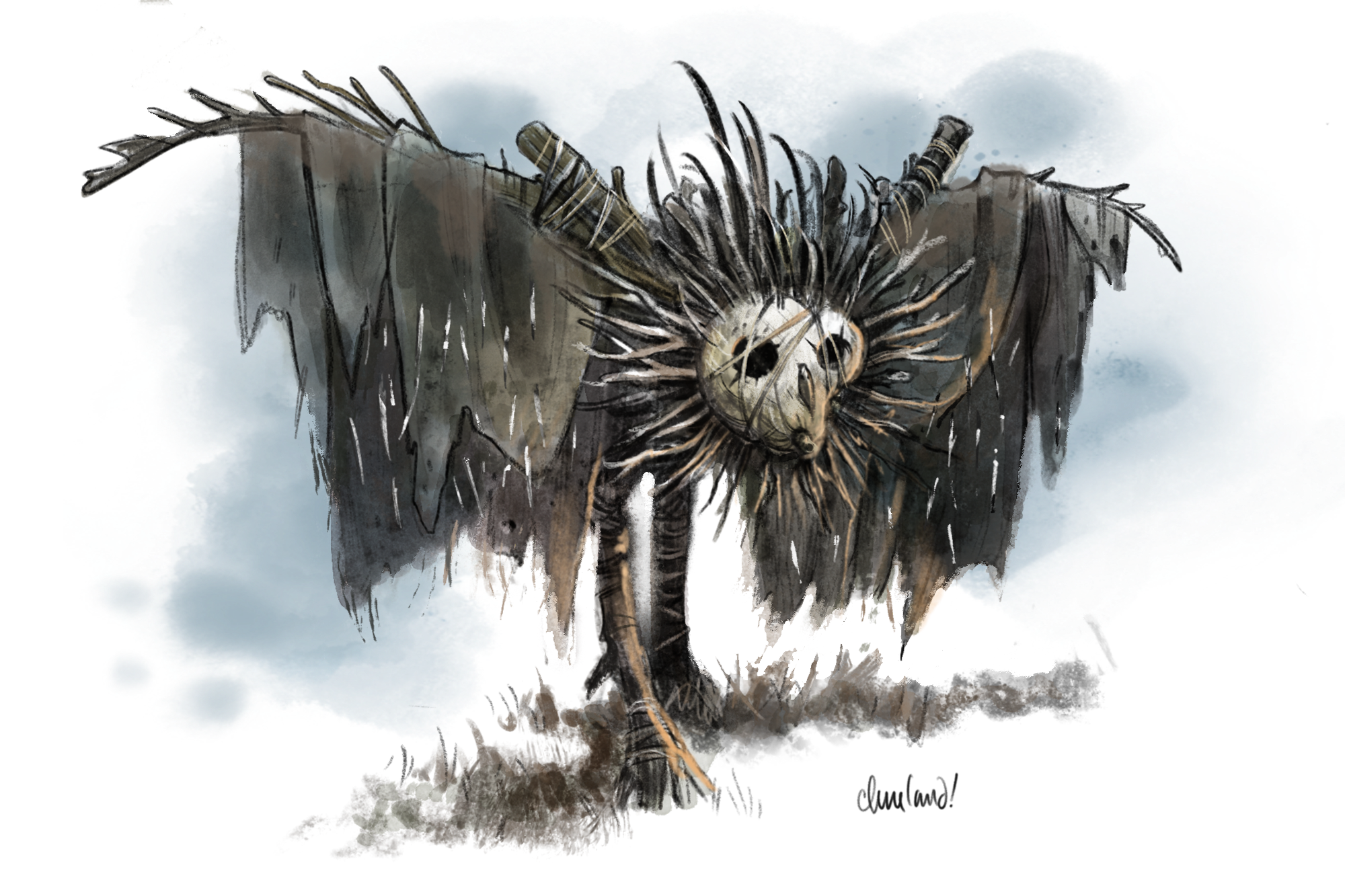
"Greater Strix" by Caleb Cleveland. Support him on Patreon!
The greater strix is joined by two swarms of lesser strix. Each lesser strix is an artificial “crow” slightly larger than a raven, crafted of burlap, straw, twigs, and sharp stone teeth.
Encounter Difficulty: Standard
Victories Awarded: 1
Expected Party: Five heroes at level 1 with 2 Victories each, and two level 1 retainers (Ireena and Olga)
Enemies:
| Group | Creatures |
|---|---|
| 1 | Greater strix |
| 2 | Swarm of Lesser Strix |
| 3 | Swarm of Lesser Strix |
Terrain:
The road is flanked by brambles with poisonous thorns. Two angry beehives are hidden near the road.
Tactics:
The greater strix stays near the path, attacking any heroes who attempt to defend Muriel. The swarms of lesser strix attempt to pull heroes off the path and into the poisonous brambles.
Balancing:
If you have fewer or more than 5 heroes, or Olga or Ireena are not present, modify the encounter in the following ways:
| Number of heroes | Modification |
|---|---|
| 3 heroes with 0-1 Victories | Remove one swarm of lesser strix from the encounter and reduce the greater strix's Stamina to 60. |
| 3 heroes with 2 Victories or 4 heroes with 0-1 Victories | Remove one swarm of lesser strix from the encounter. |
| 4 heroes with 2 Victories, or 5 heroes with 0-1 Victories | Reduce the greater strix's Stamina to 60. |
| 6 heroes with 2 Victories | Upgrade the beehives with killer bees, or add two more beehives. |
| Olga isn't present, but Ireena is present | No modification necessary. |
A hero can use a free maneuver to fall prone on top of Muriel, blocking line of effect from any other creatures to her and preventing her from attacking the strix. A hero can remove the silver barbs in her body and wings by making a medium Reason or Agility test as a maneuver, reducing her to 0 Stamina and causing her to fall unconscious on a failure. Muriel can't regain Stamina while the barbs remain. Once the barbs are removed, if a hero uses an ability that would allow Muriel to spend a Recovery, such as a conduit's Healing Grace, she regains 10 Stamina.
These abominations were built by the witch Baba Lysaga to hunt down wereravens. These particular strix—a gift from Baba Lysaga to Strahd upon his awakening—have been ordered to hunt and kill Muriel, who was spotted eavesdropping on the runecasting that Strahd received from Fravartiš earlier that morning. It continues to pursue Muriel, attacking the heroes instead if they attempt to harm it or otherwise shelter Muriel from its assault. It fights to the death.
Strahd's minions and those loyal to him, including the strix, don't attack Ireena.
If rescued, Muriel remains with the heroes until she can discern their intent. Once the barbs are removed, Muriel’s regeneration immediately returns, healing her wounds in a matter of seconds.
If she learns that the heroes plan to travel to Vallaki, Muriel travels with them while maintaining her raven disguise, hoping to rely upon safety in numbers until she can report her findings to Urwin Martikov at the Blue Water Inn. Under no conditions does Muriel willingly reveal her true nature to the heroes at this time.
While traveling with the heroes, Muriel tries to keep a low profile while ingratiating herself with the group. While she is in raven form, the heroes can communicate with her only through features such as a green elementalist's It Is The Soul Which Hears ability. She denies all knowledge of Strahd or the strix's origins and pretends to be an ordinary, simple-minded raven concerned only with food and avoiding predators. If asked for her name, she excitedly introduces herself as "Blue," and grows increasingly stubborn if questioned.
While accompanying the group, Muriel may use her talent for mimicry to produce any of the following sounds to prompt or react to the heroes:
- Whistle. To signal secrecy or caution.
- Snoring. To signal boredom.
- Laughter. To signal amusement.
- Jingling. To indicate someone's arrival.
- Clicking (like a key turning). To applaud a solution to a problem.
- Trumpet. To celebrate a victory or achievement.
Muriel, like other werebeasts, physically transforms when she shifts between forms. Her appearance isn't an illusion, and she isn't an object or a creature from another world. A void elementalist, or anyone with similar magic-detecting abilities, sees exactly what the other heroes see: a raven with unusually colorful wing tips.
C4. Tser Pool
This scene takes place in Chapter 2: Area G.
The journey from the River Ivlis Crossroads to Tser Pool is one-and-a-half miles long and takes thirty minutes.
C4a. Arrival at Tser Pool
When the heroes arrive at Tser Pool, read:
The road gradually disappears and is replaced by a twisted, muddy path through the trees. Deep ruts in the earth are evidence of the comings and goings of carts and people.
The canopy of mist and branches suddenly gives way to black clouds boiling far above. There is a clearing here, next to a river that widens to form a small lake several hundred feet across. A dozen log cabins, some very tall and some much more compact, stand around the edges of the clearing, a large bonfire at the clearing's center. One much larger cottage stands apart, near the shore of the lake, light shining through its small windows.
The gentle music of a lyre harmonizes with the singing of several very tall figures around the fire, the firelight dancing across their stony skin. A footpath continues beyond this tiny village, meandering north between the river and the forest's edge.
Twelve people—mostly hakaan, though several are human and polder—are standing and sitting around the fire, telling stories. Several more people are resting in the cottages but leap quickly into action if an alarm is raised. Nobody at the settlement is intoxicated.
As the heroes enter the village, they are met by Adaska (he/him), an old hakaan who informs them that one of the village elders, Fravartiš (she/they), has been waiting for them and points them toward Fravartiš’s cottage—though notes that Fravartiš only asked to speak to the heroes, not Olga or Ireena. Adaska is a jovial old man with a twinkle in his eye, stony face full of golden cracks where a human might have wrinkles. Adaska can do a few minor magical tricks, but is otherwise ordinary.
Adaska is happy to answer any questions that the heroes may have about the settlement or about Barovia, as described in Lore of Barovia#Barovian Hakaan Lore.
However, Adaska will not discuss Strahd’s business at Tser Pool. Instead, he shares his belief that Strahd will not soon return, and reassures the heroes that anything discussed at their meeting with Fravartiš will not reach the vampire’s ears.
If the heroes ask whether Strahd visited Fravartiš, Adaska tells them that Fravartiš shares her gifts freely with all—but that each person’s future is different, and often difficult to discern.
Olga waits outside Fravartiš’s cottage without overt protest.
C4b. Fravartiš's Cottage
Torchlight casts a reddish glow onto the high ceiling of this cottage, revealing a table covered in an undyed linen cloth. Runes carved into a stone tablet on the table seem to glow under a tall figure's gaze. The cracks in this hakaan's skin reveal flashes of iridescent black, as of light reflecting from a raven's feathers, nothing like the cheerful gold of the hakaan at the fire.
The figure speaks, her voice like pebbles rolling down a mountainside before an avalanche. "At last you have arrived."
After greeting the heroes, Fravartiš names each hero personally, giving them one or more symbolic epithets related to their histories, their goals, and/or their capabilities.
Roleplaying Information
Resonance. Fravartiš should inspire discomfort with her intimate knowledge of the players’ pasts, gratitude for her dedication to the players’ journey, and reassurance with her confident predictions.
Emotions. Fravartiš's most frequent emotions are amusement, solemnity, concern, and contemplation.
Motivations. Fravartiš wants to see the land of Barovia healed and freed from Strahd's corruption.
Character Information
Persona. To the world, Fravartiš appears as a stoic elder deeply concerned for the welfare of her community and for all of Barovia. To those she trusts, Fravartiš appears kind, yet frustratingly opaque and stubborn.
Morale. In a fight, Fravartiš would calmly insist that her opponent cease their attacks, then—if her allies prove unable to stop her assailant—weaken them with magic before demanding their surrender.
Relationships. Fravartiš alone knows that she is a conduit of the Seeker.
She thanks the heroes for making the journey to Tser Pool. If asked about Strahd’s visit, she says only that each person’s future is their own to know, and that, while her duty binds her to seek the whispers of Fate for any who invoke her name, she is bound not to reveal what she sees to anyone else.
If Muriel is with the heroes in raven form, Fravartiš regards her with an emotion nearly resembling fondness and asks to inspect her. She strokes Muriel’s wings and notes that she once had a beloved pet raven named Turul long ago.
“I have only seen him once these past ten years, however,” Fravartiš adds, somewhat mournfully. “Doubtless, he has gone wild without me.” (Fravartiš is referring to the Roc of Mount Ghakis, which served her in her role as a conduit of the Seeker of the Three.)
If the hero shows the raven's feather to Fravartiš, she inspects it reverently and returns it to the hero, claiming that she once knew the bird that shed it. She doesn't elaborate.
If the heroes ask about Dalvan Olensky's corpse, she shares only that he was a Barovian named Dalvan Olensky who came to her in the aftermath of Strahd’s siege on the village of Barovia, and that he insisted upon hearing— and then defying—his fate, a choice with tragic consequences. (As with Strahd, Fravartiš can’t disclose the nature or content of Dalvan’s runecasting.)
If the heroes ask Fravartiš to read their fates, or request her guidance on how to defeat Strahd, her face darkens, and she says, "You stand upon a precipice of a cliff whose base you cannot yet see. Do you understand what you ask of me?"
Regardless of the heroes' response, Fravartiš replies, shaking her head: "I will not do this thing for you—not yet. If you wish to pursue this path, however, come to the River Ivlis crossroads at midnight tonight. I shall await you there, by the gallows. Come alone—and do not allow yourselves to be followed." Fravartiš refuses to elaborate, and dismisses the heroes from her home if they attempt to protest.
As the heroes prepare to leave, Fravartiš pauses and closes her eyes, though they flash wide open again soon after. Read:
Fravartiš’s voice is a low rumble as she speaks, her silhouette dancing in the flickering candlelight. "A shadow is approaching my home: a lone servant of Darkness, among your party. They seek knowledge of your future—secrets that I am sworn never to reveal to any but their keepers.
“If they learn of your true aspirations, all may be lost. Do not reveal, even, that you know of their true nature, for their lord will know that I have told you, and his wrath will descend upon us all."
C4c. Dinner Hospitality
Upon exiting Fravartiš’s cottage, the heroes find three people waiting outside: Adaska, Ireena, and Olga.
In fact, she is. If the heroes refused to travel with her, Olga has made her own way to Tser Pool, traveling out of sight through the woods. If the heroes ask questions, Olga points out that she did say she'd make her own way out of the village; of course she would've preferred to travel together, but it is what it is.
Unless the heroes intervene, the conversation unfolds as follows:
- Olga jokingly scolds Adaska for his lack of hospitality, noting that she and the heroes have traveled a long way.
- Adaska amusedly states that fate waits for no one, but nonetheless invites the heroes to rest their weary feet at the central fire, offering wine, food, and conversation should the heroes join. He notes that he has heard that they have just arrived from Barovia, and he is curious to hear news from the village.
Olga, one of Strahd’s spies, hopes to glean information about the heroes' goals, capabilities, and weaknesses—beyond just the combat abilities she may have seen during the siege—through dinner conversation. (Olga had hoped to eavesdrop on the heroes’ runecasting as well, but was foiled by Fravartiš’s foresight.)
C4d. The Dancing Fire
As dusk descends around the fire, their hosts serve the heroes a dinner of a hearty stew of rabbit, potatoes, turnips, lentils, and parsnips alongside hearty chunks of flatbread. As they eat, Olga asks the heroes about their next destination. If the heroes note that they are headed toward Vallaki or otherwise indicate an interest in staying the night, Adaska invites them to rest in the village overnight, noting that the roads can be long and dangerous beyond Fravartiš’s wagons.
If he hasn’t already, Adaska asks the heroes for news from Barovia, inquiring specifically whether they have encountered a man named Rudolph van Richten. If asked about his interest, Adaska notes cheerfully that Van Richten is an acquaintance of his, and that he had recently heard a rumor that he had been seen traveling to Barovia.
≤ 11: Adaska seems casually curious, nothing more.
12-16: Adaska is speaking slightly too quickly and looking slightly too intently at the heroes when he asks about Van Richten.
17+: Adaska's voice had a strange inflection on the word "acquaintance", as if to suggest a deeper and more complicated relationship with Van Richten.
Rudolph van Richten was once an ordinary doctor living on the edge of the village of Barovia with his wife Ingrid and their son Erasmus. Times were dark; with Strahd asleep, his consorts and minions roamed Barovia wreaking havoc unchecked; but the van Richtens were happy.
In a small village in the mountains, on the banks of the lake at the mouth of the Ivlis River, another family lived. Altyn, daughter of the warrior-saint Lugdana, moved herself and her young daughter Natalya to the village after her mother's heroic death, fearing retribution from the villains Lugdana spent her life fighting. There, Natalya grew up, and met and married her wife, the hakaan Barsina, one of Adaska's children. Natalya and Barsina had a daughter, Marya Natalyevna, and raised her on stories of her heroic great-grandmother; they were happy.
On a day like any other, Van Richten set off to a distant village to treat a patient who could not travel to him. The patient lived, but when he returned home the next night, he found disaster had struck in his absence. His wife was dead, and his teenage son missing, with no witnesses left alive to tell him where Erasmus had been taken, or by whom.
Van Richten searched for weeks for any clues to where his son had been taken, and eventually learned that he had been seen at Castle Ravenloft. He snuck into the castle, hoping to rescue his son, but he was too late. Erasmus had already been turned into a vampire spawn by Strahd's consort Volenta Popofsky, and Van Richten was forced to slay his son to escape with his life.
Van Richten swore to avenge his son, kill Volenta, and destroy as many of Strahd's other minions as he could. He left the village of Barovia, moved into the tower at Lake Baratok, and began collecting as much lore on monsters as he could find, wherever he could find it, whether scavenged from old libraries or collected from new arrivals to the Mists. He began hunting, and waited for the perfect chance at vengeance.
That chance came some years later, when Volenta's spies learned that Lugdana's descendants still lived and could be found in that small mountain village. Van Richten heard that Volenta planned a hunt, and planned to set an ambush for her. Van Richten, obsessed with revenge to the exclusion of all else, feared that his ambush would fail if Natalya's family visibly prepared for Volenta's impending attack. He did not warn them.
When Volenta arrived, she brought an advance guard of dozens of ghouls. Van Richten attacked, as he had planned. While he dueled Volenta, her ghouls laid waste to the village, slaughtering its few inhabitants—all but one. Earlier that night, young Marya snuck away from home into the night, toy sword in hand, determined to practice her fighting skills to be just like her great-grandmother the hero. When Marya returned, hours later, she found her village devastated, her family dead, and Van Richten long gone. She wandered the woods for weeks, eventually making her way toward the fishing village northwest of Vallaki, where she was found by the shadow elf Kasimir Velikovche.
Van Richten, defeated in his duel with Volenta, fled back to his tower, but knew it was too close to town for true safety. He used the last dregs of his magic to transport himself and his library to a cave on Mount Baratok. When his injuries healed, he returned to monster hunting, but cautiously: Volenta would be looking for him, and he knew himself not yet strong enough to defeat her once and for all. As he appeared just in time to slay ghouls, disintegrate skeletons, and fend off dire wolves menacing the ordinary people of Barovia, then disappeared again just as swiftly, Van Richten's skills became legend.
Years passed, and Marya grew up, raised by Kasimir, Kithara, and Artabānu alongside Kithara's own child Sitarey. Marya assumed, mostly correctly, that Strahd or his minions were responsible for her family's violent deaths. When she became an adult and chose her name (Marya), she set out to find the now-legendary monster hunter Van Richten, and, after years of searching, succeeded, tracking him down in his secret home on Mount Baratok and convincing him to take her on as an apprentice.
Van Richten, who had never met Marya—only her mothers—trained Marya in everything he knew, and the two became close. Five years into her apprenticeship, Marya revealed her origins and her true goal: to avenge her family by killing Strahd. Consumed by guilt and fear for Marya's safety, Van Richten staged a fight, telling Marya that she should give up and that she would never amount to anything as a monster hunter.
Devastated by her mentor's rejection, Marya left Van Richten's home in a rage, and Van Richten began preparations for his last hunt: to kill Strahd, to save Marya as he failed to save her family, or to die trying.
Alas for Van Richten, his cruelty did not inspire Marya to take up a safer line of work. Instead, she immediately hunted down the worst monster she could find—the vicious werewolf Kiril Stoyanovich, also known as the Silver Terror, who bit Marya's leg off after a rescue mission gone wrong. Sidelined by the injury for months, Marya has returned to work with a brand-new prosthetic and fire in her heart. She now hunts werewolves in the woods near Lake Baratok, waiting for an opportunity to kill the Devil himself.
Adaska doesn't reveal the truth if challenged, and instead merely shrugs and says, "Believe what you choose to believe." (Adaska is a distant cousin of Marya's mother Barsina, old enough to have heard about Van Richten’s mysterious disappearance just after Marya’s family died, and knew Marya during her childhood at the village near Vallaki. He has concluded that Marya may be in danger from Van Richten. He doesn't know that Marya sought Van Richten out to be his apprentice.)
The Game of Stories
After dinner, Adaska explains that his people have a rich storytelling tradition, and warmly invites the heroes to participate—in the manner of the finest dueling skalds—by playing a game of stories. To play, each participant must put up a wager, which can be an object of small monetary, intellectual, or sentimental value. Each participant must then share a story to make a person “laugh or weep.” Each time a story is told, the other participants in the game must guess whether the story is truth, falsehood, or both. At the end of the game, the participant with the most correct guesses wins the pot.
If the heroes accept the challenge, Olga and Ireena also offer to join the game. The participants’ wagers are as follows:
- Adaska wagers copies of two of his late husband's secret recipes. (“They’ve sat unused and dusty in my cottage for long enough,” he says with a sad smile. “I think he’d like it if they were out in the world again.”)
- Olga wagers a short manuscript on werewolves authored by Dr. Rudolph van Richten.
- Ireena wagers a painted wooden hairclip in the shape of a daisy that she once wore as a child.
Give the players a few minutes away from the table to plan out their stories before the game begins.
In response to the heroes' stories, the participants of the game of stories vote as follows:
- Adaska, believing that a grain of truth lies at the heart of every tale, votes nothing but True.
- Olga, not one for half-truths, alternates between True and False.
- Ireena, quick to warm to the hero, alternates between True and Half-True.
Judging Truth
While listening to an NPC's tale, a hero may make an Intuition test to discern whether the story is true.
≤ 11: The hero has no idea if the story is true or false.
12-16: The hero can narrow it down to one of two options, rather than one of three. For example, the hero might notice that Adaska's tale is told smoothly and lyrically, as if it's been told many times before; thus it's probably either a true historical account or a traditional story told many times, but probably not a half-true tale embellished in the moment.
17+: The hero learns if the story is true, half-true, or false.
The results of this test should only be known to the hero who made it—I suggest passing your player a note, whispering to them in a private message, or similar.
Adaska’s Tale
Adaska goes first.
Adaska breathes in deeply, then makes a strange gesture toward the fire. The flames turn from orange to green. As they dance and sway, a tall, sturdy dark shape appears in the bonfire's core.
"Someday, sometime, there was, or there wasn't, a hero of our people. Their name was Sarames, and when they chose their name, the Doomsight came to them. They would die defending innocents from a monster—a powerful man, soaked in blood, preying on those who could not defend themselves from him."
A second tall shape joins the first in the fire.
Adaska continues. "Sarames had a sister, carved from the same stone, the other half of their heart. Most great heroes of our people know that when their fate comes, they must face it alone, but not Sarames. When they saw their Doom, their sister refused to let them leave home without her. Sarames protested, but their sister was too strong, and too stubborn, and loved them too much; she swore their fate would not go unwitnessed."
Deep in the bonfire, you see the two figures, one with swords drawn, one with fists raised, fighting off a host of shadowy shapes.
"The siblings traveled the world, seeking the place Sarames had seen. Danger faced them at every turn, the dark powers of the world determined to turn Sarames from their fate, but their conviction and their courage grew ever stronger."
In the fire, the tall figures lower their weapons, look around, sink down to touch the ground.
"The siblings arrived at a valley, green with spring, and came upon the lord of that land collecting his tithe from a village. Sarames knew his face, though it was unbloodied, and knew: this was the place, but not yet the time. The siblings made a home in the valley, laid stones for their hearth and built a home as their mother had taught them, and for a year and a day, they lived happily."
"But fate can never be avoided. Shadows crept into the lord's heart, already cold and cruel, and promised him great power, if only he would become a monster. When Sarames heard of a great feast at the lord's castle, all the people of the valley invited to partake as they never had been before, they knew the time had come."
In the fire, the two figures stand at the head of a crowd, finely dressed, the shadows pressing in around them.
"The siblings arrived at the feast with the other people of the valley, all clad in their finest, to find the lord transformed into the monster Sarames had foreseen. His soldiers' blood coated his great hall, his tables held no food, and as the portcullis began to close, they knew the awful truth: the lord's own people were his great feast. Sarames drew their sword, stepped under the portcullis, and bid everyone else run to safety."
In the fire, you see the tall figure, standing alone, braced against a feral shape lunging at them.
"Sarames held the gate with their body, and held off the lord with their sword. Sarames's sister, the last to run, heard the portcullis close behind her. The lord was trapped in his own castle, and the people of the valley alive thanks to Sarames's great sacrifice. And thus was Sarames's Doom added to the saga of our people."
In the dancing fire, the tall figure crumples, then disperses in a cloud of smoke and embers.
Throughout his tale, the heroes can notice Adaska gesturing, using his magic to create the shapes in the flames.
When his tale has ended and all participants have made their guesses—Olga going last and voting “True”—Adaska reveals that his story was indeed a true tale of the hakaan. (If asked, Adaska admits that the lord was Strahd von Zarovich. If the heroes ask why Adaska’s village is safe from Strahd’s violence, he shrugs, saying only, “Perhaps he fears those who know their fate and face it joyfully.”)
Olga’s Tale
After one of the heroes has gone, Olga then shares the following tale:
“It is said that within each raven flutters a lost soul, and that each raven’s song tells a tale of ages past. They whisper, so listen closely.”
She takes a deep breath; when she speaks again, her voice is quiet, with an eerie, melodic quality to it.
“Sing, ravens, of Barovia, birthed from the mists and bathed in twilight. Sing of Lugdana, stalwart of the Lady of Morning, dawn-touched foe to the deep-lurking dark. The Holy Symbol of Ravenkind, her radiant testament, the warrior’s beacon of faithful resolve.
“Sing, ravens, of Chernovog’s rise, named Green-God and Demon-Lord upon Yester Hill. Lugdana, gray-haired, weary of battle, her longsword and shield yet polished and ready. Guided through shadows, toward sacred ground, she clashed with the demon, their dance a tempest.
“Sing, ravens, of Lugdana’s last fury, of Ravenkind’s token now blazing with light. The battle’s tide turning, a hero’s brave cry, a final onslaught with divinity’s grace. The Demon-Lord banished, the warrior now fell, the wound at her side gouged too deep to bear.
“Sing, ravens, of light’s final moments, a shadow descending from radiance on high. Sing of the messenger, black-feathered and beaked, the Lady reclaiming her gift. The Symbol retaken, in ravens’ claws held.
“Sing, ravens; you are the keepers, the watchers, the tellers of stories untold. Sing, ravens, of Lugdana’s memory, the shadows that lurk, and heroes to come.”
When her tale has ended and all participants have made their guesses—Adaska going last and voting “True”—Olga reveals that her story was half-true.
Lugdana was indeed a saint of the Lady of Morning who bore the legendary Holy Symbol of Ravenkind, which was a platinum amulet shaped like a sunburst, with an enormous ruby embedded at its center. According to legend, the symbol was given to Lugdana by an emissary of the Lady—whose domains include nature, as well as life and the sun—in the guise of a raven. Olga notes with a chuckle, however, that no one knows what happened to the Symbol after Lugdana fell at Yester Hill, nor where it resides today.
Ireena’s Tale
After all of the heroes have gone, Ireena (if present) then shares the following tale:
"When I was a child, my father took me and my brother to a vast, tranquil lake. I remember the sand beneath my bare feet, and the lapping of the waves against the shore.
"But then, something broke the silence—a low growl that echoed through the wind. As I turned, I saw a beast emerge from the fog: a wolf, far larger than any I'd ever seen. I still remember its eyes—yellow, cold, and hungry.
"My father screamed for me to run. I took off for the woods, and the wolf followed, its snarls echoing through the underbrush. I remember branches whipping against my face, thorns cutting at my feet as my legs burned and my breath grew ragged, but my fear drove me forward.
"It was only much later, when my heart had quieted in my chest and the wolf's footsteps had faded into silence, that I finally allowed myself to stop. By then, though, the woods were strange to me, and my father's shouts had faded.
"A heavy mist had descended around me, and shadowed shapes lurked in every corner. I stepped forward, one hand reaching fearfully into the fog—and a wolf made of mist leapt forth, its jaws opened wide to devour me. And then—everything went black.
"The next thing I remembered, I awoke in my own bed, my father's humming echoing from the kitchen. I don't know how I got there, or what became of the wolf, but I can still remember its teeth as clearly as ever."
When her tale has ended and all participants have made their guesses—Adaska voting “True” and Olga voting “False”—Ireena reveals that her story was false. With a quiet laugh, she shares that the story is a dream that she’s had since childhood, noting that there are no lakes near the village of Barovia and that she’d never seen a dire wolf until recently.
If challenged on his vote, Adaska merely says, with a smile, that many dreams have a kernel of truth. He then thanks Ireena for sharing her tale.
Rewards
Adaska's husband Mallory was a (polder) healer and alchemist. The recipes Adaska wagered are Caelian translations of recipes for Buzz Balm and a Growth Potion. The growth potion recipe includes notes on how to substitute water-milfoil for seagrass—there is no access to the ocean from Barovia, after all, but water-milfoil grows in many freshwater lakes. Alas, Mallory never found a substitute for demon honey.
Olga's manuscript—authored by Dr. Rudolph van Richten—is handwritten and two pages long. It is titled "A Study of the Werewolf's Curse," and reads as follows:
Werewolves are among the most fearsome lycanthropes, bearing a curse as ancient as it is terrifying. For them, the affliction of lycanthropy transforms even the most civilized individual into a monstrous beast, warping the lines betwixt man and nature.
In its humanoid form, a werewolf retains many of the characteristics of its original identity, save for certain nuances such as heightened senses, an explosive temper, and an odd preference for rare meats. Over time, subtle features that hint at their animalistic nature begin to manifest. Nevertheless, it is in their wolf and hybrid forms that the true horror of the curse is revealed. A werewolf's hybrid form is particularly terrifying, with a muscular humanoid body crowned by the head of a ravenous wolf. It is capable of wielding weapons, though its favored means of attack are its devastating claws and powerful bite.
Werewolves typically abandon civilization soon after their transformation. Those who reject the curse flee in fear of harming their loved ones, whereas those who accept it fear exposure and the repercussions of their violent deeds. Out in the wild, they form packs, living in cohesion with ordinary wolves and dire wolves alike.
The most tragic aspect of lycanthropy is its transmission. A humanoid can contract this curse through a wound inflicted by a lycanthrope or through inheritance if one or both of its parents are lycanthropes.
The cursed have two paths: they may resist the beast within or embrace it. Those who resist bear unending strain—until the rising full moon triggers a compulsory and horrific transformation. These individuals often experience bloody, haunting dreams: echoes of the carnage wrought by their hands.
Some twisted souls, however, choose to accept their beastly nature. With time, they can master their abilities, calling upon the wolf's resilience and strength as they will. To do so, however, they must first perform a particular gruesome and foul act—one which I will decline to describe in these pages.
One sure way to identify an afflicted individual is the presence of a perpetually raw, bloody wound: the scar of the initial curse transmission. This wound never fully heals until the curse is lifted.
Beyond this mark, however, these creatures bear an extraordinary resilience. Conventional methods of harm prove ineffective in permanently subduing a werewolf. Only through the bite of silver or the chill of death's power can a werewolf be truly put to rest.
A ritual of removal can also cure an afflicted lycanthrope, though those who accept the beast may fight it bitterly. As for those unfortunate souls born under the curse, they are doomed to bear their affliction for life. As far as my research has shown, there exists no cure, no respite for such individuals. They are caught in an eternal struggle, forever haunted by the wolf within.
With several heroes and Ireena, playing the game of stories with only two NPCs, it's very likely that someone in the party will win. However, if Adaska wins, he's happy to share the recipes with the heroes anyway as thanks for their fascinating stories, though Olga won't give up her manuscript unless it's won fairly. If Olga wins, Adaska winks and slips the heroes another copy of the recipes as they leave the following morning, thanking them for the delightful company. (If asked why he's so eager to share the recipes, Adaska says only that he's always had a feeling someone would need them.)
C4e. Return to the River Ivlis Crossroads
The journey from Tser Pool to the River Ivlis Crossroads is one-and-a-half miles long and takes thirty minutes. Heroes who attempt to conceal their movements from Olga, Strahd's spy, must succeed on a hard Agility test or take other covert action to do so.
Traveling to the Crossroads
As the heroes make the journey to the crossroads, read:
A pallid moon hangs low in the sky, casting a weak, silvery glow upon the mist-shrouded landscape below. Ancient trees loom on either side of the muddy road, their gnarled branches reaching out like skeletal fingers.
As the witching hour approaches, an eerie stillness descends. Even the leaves cease their rustling, leaving the squelch of your boots through mud the only lingering sound.
If the heroes failed to conceal their departure, they must make a medium Intuition test. On a success, read:
The sound of a snapping twig cuts through the silence like shattering glass. A bush behind you rustles—then abruptly falls still.
The rustling bush hides Olga.
If the heroes disregard her, she continues to shadow the heroes as they approach the crossroads.
If the heroes call out to Olga, she remains hidden and doesn't respond.
Lose Olga: Montage Test
If the heroes attempt to shake Olga from their tail, they can do so by traveling off-road and succeeding on a medium Agility test to hide from her, followed by a medium Reason test to conceal their tracks. Heroes who depart from the road in this way
Montage Test Difficulty: Easy
Rewards: 1 Victory
| Heroes | Success Limit | Failure Limit |
|---|---|---|
| 3 | 3 | 3 |
| 4 | 4 | 4 |
| 5 | 5 | 5 |
| 6 | 6 | 6 |
Montage Challenges
The montage includes the following challenges.
Hide. The heroes must get out of sight. Suggested Characteristics: Agility, Intuition. Suggested Skills: Hide, Sneak, Climb. Can be completed twice.
Conceal Tracks. Once hidden, the heroes must stay undetectable. Suggested Characteristics: Reason, Intuition. Suggested Skills: Climb, Conceal Object, Track.
Will-o'-Wisp. The heroes encounter a will-o'-wisp, which appears as a distant flickering torchlight and attempts to lead them to their doom; they must discern its intentions and resist its magical lure. Failure results in a bane on the next test any hero attempts in the montage. Suggested Characteristics: Reason, Intuition. Suggested Skills: Magic, Monsters, Nature.
Navigate the Woods. The woods are treacherous and filled with low-hanging spiderwebs and unexpectedly deep pits, while the ever-present fog obscures the way ahead. Suggested Characteristics: Might, Agility, Reason. Suggested Skills: Alertness, Endurance, Navigate.
Ward off Fauna. The heroes scare a herd of elk, which threaten to stampede through the forest. Suggested Characteristics: Reason, Presence. Suggested Skills: Handle Animals, Intimidate, Perform.
Avoid Hunting Traps. The woods are full of abandoned bear traps and snares hiding under mud and dead leaves. Suggested Characteristics: Reason, Intuition. Suggested Skills: Alertness, Search, Nature.
Avoid Strahd's Spies. Swarms of bats circle overhead; Strahd is always watching. Suggested Characteristics: Agility, Intuition. Suggested Skills: Hide, Sneak, Alertness.
Montage Outcomes
The montage test can have the following outcomes.
Total failure: The heroes get thoroughly lost in the woods, and Olga secretly follows them to the crossroads. Fravartiš is annoyed at the heroes' lateness, and notices Olga when they arrive, but the heroes are too exhausted to give chase a second time and cannot attempt a second montage. Instead, they must succeed on a single hard group Agility test or Olga flees successfully.
Partial success: After a long, exhausting trek through the woods, the heroes feel confident they've lost their pursuer. The heroes lose 1 Recovery each from tripping over rocks, being hit in the face with tree branches, and so forth. Olga does not follow the party to the crossroads. Each hero earns 1 Victory.
Total success: The heroes feel confident they've lost their pursuer. Olga does not follow the party to the crossroads. Each hero earns 1 Victory.
Chase Olga: Montage Test
If the heroes find Olga's hiding spot or draw steel, Olga flees into the woods, and heroes who want to give chase must engage in a montage test.
Montage Test Difficulty: Easy
Rewards: 1 Victory
| Heroes | Success Limit | Failure Limit |
|---|---|---|
| 3 | 3 | 3 |
| 4 | 4 | 4 |
| 5 | 5 | 5 |
| 6 | 6 | 6 |
Montage Challenges
The montage includes the following challenges.
Track Olga. The heroes can search for tracks and keep on Olga's tail. Suggested Characteristics: Reason, Intuition. Suggested Skills: Climb, Search, Track. Can be completed twice.
Navigate the Woods. The woods are treacherous and filled with low-hanging spiderwebs and unexpectedly deep pits, while the ever-present fog obscures the way ahead. Suggested Characteristics: Might, Agility, Reason. Suggested Skills: Alertness, Endurance, Navigate.
Ward off Fauna. The heroes' chase scares a herd of elk, which stampede through the forest. Suggested Characteristics: Reason, Presence. Suggested Skills: Handle Animals, Intimidate, Perform.
Avoid Hunting Traps. The woods are full of abandoned bear traps and snares hiding under mud and dead leaves. Suggested Characteristics: Reason, Intuition. Suggested Skills: Alertness, Search, Nature.
Circle Ahead. Heroes can try to push ahead of Olga and cut off her escape route. Suggested Characteristics: Might, Agility. Suggested Skills: Gymnastics, Endurance.
Avoid Strahd's Spies. Swarms of bats circle overhead; Strahd is always watching. Suggested Characteristics: Agility, Intuition. Suggested Skills: Hide, Sneak, Alertness.
Montage Outcomes
The montage test can have the following outcomes.
Total failure: Olga escapes, immediately moves to return to Castle Ravenloft, and doesn't return to Tser Pool that night.
Partial success: After a long, exhausting chase, the heroes catch up to Olga as in the total success outcome. The heroes are winded and lose 1 Recovery each from tripping over rocks, being hit in the face with tree branches, and so forth. Each hero earns 1 Victory.
Total success: The heroes catch up to Olga. Each earns 1 Victory.
Olga stops running and turns around with her hands raised in a gesture of peace. She reassures the heroes that she meant them no harm, and insists that she followed them out of curiosity for their night-time travels and was simply frightened when they gave chase. "Out and about at midnight—at a time when all but monsters fear to tread?" she breathes, her eyes glinting. "One might think you were up to something. You can't blame me for being curious."
Olga hopes to travel with the heroes openly to their destination. If refused, a hero must make a Presence test.
≤ 11: Olga "agrees" to return to Tser Pool, but secretly loops back to follow the heroes' tracks.
12-16: Olga lingers behind a tree for a few minutes, but then returns to Tser Pool and remains there for the night.
17+: Olga immediately returns to Tser Pool and remains there for the night.
If the heroes threaten Olga, she immediately surrenders, throwing herself on their mercy.
≤ 11: Olga stubbornly refuses to talk.
12-16: Olga reveals that she "reports to the lord of the castle".
17+: Olga reveals that she "reports to the lord of the castle", and the hero sees her eyes glint with fanaticism.
If asked why she serves Strahd, she breathlessly avows that Strahd is—or should be—the "rightful king" of Barovia. "He is the one who made this home for us," she whispers reverently. "He chose us to be his subjects, he chose this blessed place for his kingdom, and now he and the mists will protect us forever."
Olga freely admits that few Barovians agree with her beliefs or loyalty to Strahd—a fact that drives her to curse the "ungrateful" and "faithless" among them. Olga wholeheartedly believes Strahd to be a kind and generous lord, and thinks everyone would agree with her if only they were better subjects. She believes that the people of the Village of Barovia deserved their punishment for rebelling, and marvels at Strahd's "mercy" in letting any of them live.
Olga isn't entirely wrong about her claims; most Barovians are, in fact, descended from Strahd's generals and noble followers and the people they brought with them to the valley. Of course, benevolence and protection had nothing to do with it.
If the heroes attack Olga, she does not fight back, and even a single strike is enough to knock her unconscious.
The March of the Dead
When the heroes arrive at the River Ivlis Crossroads, read:
The well-worn path returns to the crossroad, now illuminated beneath the pale, sickly light of the moon. Across the road, the mist-shrouded headstones seem to hunker down in the gloom beside the old wooden gallows, whose frayed rope dangles lifelessly in the still air.
A tall, cloaked silhouette stands beside the gallows—waiting.
The silhouette is Fravartiš. She does not answer if called out to, and waits for the heroes to approach her. When they do, she whispers to them, her voice rasping like a chill wind: "What did I say to you before you departed my home?" If the heroes respond accurately, Fravartiš nods, assured of their identities.
If the heroes failed to stop Olga from following them, Olga is hiding behind a patch of underbrush to the north of the crossroads, watching them silently. If she is, Fravartiš's eyes flare wide, and she exhales sharply. "Fools!" she breathes. "You were followed—dispatch her, or all is lost!" She then gestures toward Olga's hiding place.
Once noticed, Olga immediately attempts to flee into the woods If allowed to do so, Olga immediately moves to return to Castle Ravenloft, and doesn't return to Tser Pool that night. If the heroes give chase, run the montage test described above.
If Olga is caught, Fravartiš is insistent that she be killed and thrown into the River Ivlis, "lest she report what she has seen and heard to her lord." If challenged, Fravartiš coldly replies that "there can be no equivocation when Fate itself balances upon the precipice."
If further questioned, Fravartiš holds up a hand, then silently turns to face the unmarked graveyard near the gallows. The March of the Dead, as described in March of the Dead (p. 48), begins shortly thereafter.
Once the March has begun, Fravartiš informs the heroes: "Each spirit in this march shares a common trait. Can you suppose what that might be?" If the heroes answer correctly, she then asks, "Where do you suppose they might be headed?"
Regardless of the heroes' answer, Fravartiš then shares the following information about the March, either in response to the heroes' questions or of her own initiative once the March has fully departed the graveyard.
- These aren't the spirits of the people buried here, but of previous adventurers who died trying to destroy Strahd. Every night, the ghostly adventurers attempt to complete their quest, and each night they fail. They have no interest in the living and can't be hit, damaged, or interacted with. They will not communicate with the heroes.
- Once they reach the castle, the spirits march straight to the chapel (area K15) and up the high tower stair (area K18) to the top of the tower (area K59). There, they throw themselves down the shaft toward the crypts (area K84), where they disappear.
"This is the precipice you walk," she warns them once the March has departed. "There are many paths among the webs of Fate, but I can only see what may be—not what will. I can tell you what you must do, but I cannot ensure that you will succeed. For if you fail, this shall be your resting place—a place without legacy, glory, or love. Do you understand?"
Regardless of the heroes' answer, Fravartiš fixes them with a steady gaze. "If you wish to put aside this mission, no soul could blame you. You are not of my people; for you, there is no shame in flight from a foe that no others have defeated, or in avoiding near-certain doom. You need not accept the burden of fate. But if you do, I can cast the runes, and set you upon a path that ends only when your foe is vanquished—or you are. The choice is yours."
If one or more of the heroes are hakaan, Fravartiš instead says, "If you wish to put aside this mission, no soul could blame you. Most of you are not of my people, and even for you, young cousins, your doom may not be here in this valley. There is no shame in flight from a foe that no others have defeated. You need not accept the burden of Barovia's fate. But if you do, I can cast the runes, and set you upon a path that ends only when your foe is vanquished—or you are. The choice is yours."
If the heroes insist upon a desire to defeat Strahd, Fravartiš nods. "Very well," she says. "Then let us begin."
C4f. Casting the Runes
Fravartiš begins the divination by seating herself upon the cemetery earth, reaching into her cloak, and removing five old candles, which she stakes into the ground and lights with a wave of her hand. She spreads a white cloth out on the ground between the candles, then produces a bag of several dozen smooth, flat stones the exact shade of her skin, each with a rune carved into it. She spreads the stones out on the cloth. Read:
Her cracked hands working deftly, the seer moves her hands over the stones, turning each face down, runes hidden. She begins to shuffle the stones, moving them in mesmerizing patterns, until you can no longer remember where you saw each rune.
As she arranges the stones, the heroes notice a velvet pouch upon the ground beside her that wasn't present a moment before. Fravartiš meets their eyes, then smiles. "The task you seek of me is no small boon," she murmurs. "In exchange, I would ask a boon of my own."
If the heroes accept Fravartiš's request or inquire further, she informs them that the pouch contains some coin. "My great-granddaughter, Sitarey, will celebrate her nameday soon," she says. "For this momentous occasion, I wish to provide her a gift—but in my old age, I am quite unable to make the journey myself."
When hakaan children are ready to become adults, they choose an adult name—which might or might not have any relation to their name as a child—and their community holds a celebration at which the new adult formally announces their name and accepts all the responsibilities of adulthood. It's not uncommon for the young person to share their adult name with close friends and family before the actual celebration; this is why Fravartiš is already calling her great-granddaughter Sitarey, which is her chosen adult name.
If a hakaan changes their name as an adult, they might or might not choose to celebrate a new nameday. Some, though not all, hakaan celebrate the anniversary of their nameday, much as some humans celebrate birthdays.
Fravartiš asks the heroes to use the funds in the pouch to purchase a toy for Sitarey at Blinsky Toys in Vallaki—Blinsky’s, she notes fondly, are Sitarey’s favorites—and deliver the toy to the fishing village to the northwest of Vallaki by noon on Sitarey’s nameday (Hektavr 24/Neyavr 10). She adds that the heroes are welcome to keep any change as payment for their efforts.
Fravartiš adds, with a cryptic smile, that the heroes may enjoy speaking with Sitarey, as she is “a most interesting child”—and that the heroes may find befriending her family a gift in itself. (If the heroes ask, Fravartiš shares only that Sitarey's father, Kithara, is the leader of the Vallakian village, and his brother Artabānu a "perceptive and clever man.")
If the heroes accept Fravartiš's task, she nods approvingly. She then begins the divination. Read:
Fravartiš closes her eyes, her hands hovering over the stones. The crimson flames dim and swirl in eldritch patterns as her lips move silently, a distant tension spreading through the air. The sound of the rustling trees begins to dim, the external world growing mute and insubstantial as the space within grows more solid—more real.
Slowly, reverently, the seer divides the stones into five piles of equal size, arranging them as if at the five points of a star.
The shadows of the headstones around her sway like silhouettes, leaning in toward the stones like anxious watchers—yet the air in the cemetery is perfectly still. No light intrudes besides the light of the candles; no voice rings out in the silence. Shadows and mist swirl beyond the graves, where the darkness of deepest night dwells—but here, at its center, light yet reigns.
The seer then moves her cracked hand to the lower left pile of stones. She closes her eyes and tilts her head, as if listening to an unspoken word. The arcane lights swirl and then shift, their colors changing to a deep, piercing blue.
"These stones tell of history. Knowledge of the ancient will help you better understand your enemy."
She gathers the first pile of stones in her hands, shakes them several times, then casts the stones onto the cloth.
The cerulean light dances across the stones, revealing two runes face up. For a second, the shadows take the shape of an armored figure holding a wickedly curved blade aloft, the candlelight glinting like moonlight reflected from a blade. "The Guard and the Dagger—a traitor." Her dark pupils shift from side to side, as though reading from an unseen text. "I see the ancient foe of an old and noble house. The lost soul will lead you to him."
She moves her hand to the second pile of stones, this one at the right-most point of the star. As she closes her eyes and listens once more, the candlelight flares, its color bursting into a fierce, cheery yellow.
"These stones tell of a powerful force for good and protection, a holy symbol of great hope." She gathers the stones, then casts. Once again, two runes appear face up.
This time, the shadows take the shape of a howling wolf; the candlelight wavers, diffuses, as if shining through water. "The Wolf and the Water. Look for a den in the hills overlooking a mountain lake. The treasure belongs to Mother Night."
Fravartiš moves her hand to the third pile of stones, at the left-most point of the star, her eyelids closing like a trance, her lips pursed in quiet contemplation.
"These are stones of power and strength. They tell of a weapon, the key to defeating your enemy." She gathers the stones, then casts once again.
The shadows take the shape of hands clutching at bars. The candlelight vanishes for a heartbeat—and then returns in a nova of fierce, burning white, so pure and strong and clean that it hurts to look at, burns to see. "The Prisoner and the Sun—a secret weapon, a sword of sunlight." The seer's voice is strong with purpose. "What you seek lies in an amber prison, where the devil fears to tread," she intones, her eyes narrowing. "This weapon is long hidden. The house of the fallen dragon can lead you there."
She moves to the fourth pile of stones, at the lower right of the star, and listens once more, the stones clacking against her cupped hands as she shakes them, humming a contemplative note. The magic flames leap and dance upon their wicks, now casting swirling violet embers into the air as the graves beyond shimmer with a twilit glow.
"These stones shed light on one who will help you greatly in the battle against darkness."
She casts.
For a moment, you see the shadow of a figure fall across the stones, two runes visible once again, glowing in the dark. The figure holds a lantern aloft, their shadow softened, the lantern's light shining as if through mist. "The Hunter, and the Mist." Fravartiš leans forward. "An orphan wanders this land alone, searching for vengeance. She does not stay in one place for long. Seek her out at Saint Markovia's abbey."
Finally, she moves her hand to the fifth pile of stones, at the top of the star—and nearly recoils, the cracks in her stony forehead deepening as her brow furrows. Behind her, shadows encircle the candlelight until the light is very nearly swallowed by the creeping dark. When next she speaks, Fravartiš's gravelly voice is scarce above a whisper.
"Your enemy is a creature of darkness, whose powers are beyond mortality. When the hour of judgment arrives, these stones will lead you to him!"
Her hand trembles as she gathers the stones, barely shaking them for a silent moment—and then lets them fall.
In the darkness, the fifth and final pair of runes is only barely visible through the smoke and unnatural murk. The shadows twist, lengthening into a tall crowned figure; a bitter wind blows through the cemetery, snow on the air.
Fravartiš slowly exhales. "The King and the Mountain. Look to great heights. Find the beating heart of the castle. He waits nearby."
As the last syllable passes her lips, the seer freezes—and then rocks backwards, her eyes rolling until their whites gleam like pearls in the darkness—and then she snaps back, the candlelight burning down to its ordinary crimson glow.
The sound of the natural world returns—the whispering of the wind through the trees, the distant hooting of an owl, and the faraway lapping of the Ivlis River against its banks. Silver moonlight once again pierces the cemetery's edge, and you feel yourselves breathe for the first time since the divination began.
Fravartiš says nothing. She only regards you silently with dark, heavy eyes.
Fravartiš cannot elaborate on the meaning of the runes or provide any additional information. If asked to, she says only, “The threads of Fate cannot be beckoned like a servant or conjured like a magician’s trick. I see only what the stones show me, and no more.”
Fravartiš dismisses the heroes from her presence once she has completed the runecasting, instructing them to return to Tser Pool and to tell no servant of Strahd of what they have just heard.
Fravartiš declines to return with the heroes, preferring instead to linger at the crossroads. If asked why, she shares only that the place holds "special memories" for her, and that she will return to Tser Pool when she is ready. "Fear not," she rumbles, a twinkle of amusement in her eyes. "I have little to fear from the creatures that prowl these woods, I assure you." If the heroes depart the crossroads and later return, they find that Fravartiš has vanished.
Adventurers who sought to kill Strahd are not the only ones buried at this cemetery. Fravartiš's sibling Sarames, the hakaan hero who saved the servants of Castle Ravenloft from Strahd the night he became a vampire, is buried in the woods a short distance away from the gallows.
Exploration in this campaign is intentional. Heroes won’t find much by wandering aimlessly; without clear leads, meaningful discoveries such as the Holy Symbol of Ravenkind or Amber Temple can take days or even weeks. To progress, the heroes must uncover clues and recognize the signs that point the way.
C4g. Departing Tser Pool
When the heroes awaken at Tser Pool the following morning, Adaska invites them to break their fast with him around the cold fire. Breakfast includes smoked fish and hearty rye bread.
Olga is nowhere to be found. If the heroes look for her, they find her belongings missing, suggesting that she left willingly. (Olga slipped away just before dawn to report to Castle Ravenloft with whatever information she gleaned the previous night.)
If the heroes attempt to speak with Fravartiš again before departing, Adaska warns them that the seer is asleep, and does not wish to be disturbed. If the heroes attempt to enter her cottage, they find her asleep.
C5. The Skeletal Rider
When the heroes return to the River Ivlis Crossroads after receiving the runecasting, they encounter a skeletal rider, as described in Skeletal Rider (p. 31), which approaches from the western road and continues toward the village of Barovia. If the heroes saw Dalvan Olensky’s corpse upon entering Barovia, they notice that the rider’s clothing is recognizably similar to his.
If followed, the rider continues to ignore the heroes. After traveling a short distance down the road, it turns south down an old hunting path into the woods, which it follows east toward Barovia's eastern border. (The rider is roaming randomly, and has no particular destination.)
C6. The Watchtower
As the heroes travel west from the River Ivlis Crossroads, read:
You leave the crossroads behind and resume your westward journey. You follow the road as it bends around, then ascends the cliff, trudging up its steep, rocky incline.
The fog is thick here, obscuring the top of the cliff overhead. The road itself grows narrow and treacherous, with loose stones and deep ruts that make it difficult to maintain your footing.
Soon enough, though, the road levels out, continuing past a ruined three-story watchtower perched atop the edge of the cliff.
The tower's old stone walls are covered in moss and ivy, its rotten wooden door hanging off its hinges. Nearby, two fresh graves sit against the road. An animal's corpse seems to lie in the tall grass not far away.
Pause to allow the heroes to act or react. If the players remain silent, continue to #C7. The High Road below. Otherwise, allow the heroes to explore the area.
The Watchtower
The ruined watchtower was built as a lookout post by the Order of the Silver Dragon long ago. It has the same structure as the Guard Tower (p. 157) at Tsolenka Pass, with the following changes:
- The tower door has been half-pulled from its hinges and can be opened easily.
- The temperature and wind in the tower are far less severe.
- There is no dire wolf's head mounted above the hearth.
- There are neither statues nor skeletons atop the battlements.
If the players explore the watchtower, they find a broken silver pendant carved to resemble a dragon lying on the ground of the first floor, close to the entrance. The pendant is always cold to the touch.
From atop the battlements of the watchtower, the players can see Tser Falls to the northwest and Tser Pool to the northeast. To the south, above and beyond the slopes of Mount Ghakis, they can see only an impenetrable wall of thick, gray fog.
The Graves
The two graves hold the remains of two Barovian refugees who were slain by wolves during the journey to Vallaki some time ago. A medium Reason test reveals that the graves are no more than a few weeks old.
Small pebbles have been arranged in the soil atop each grave to form the shape of a rising sunburst.
The Corpse
The corpse belongs to a wolf killed by spears and crossbow bolts, and has mostly rotted away. The Barovian refugees left it here after slaying it and driving off the other members of its pack.
C7. The High Road
The journey from the River Ivlis Crossroads to Tser Falls is seven-and-a-half miles long, or two-and-a-half hours.
C7a. Wolf Ambush
As the heroes continue down the road, read:
You continue down the winding mountain road, the jagged peaks looming ominously through the fog far above.
The air grows colder as the road passes through a dark evergreen forest, the thick canopy once more blocking out much of the sky's dim light. Here, the road grows narrow, its edges passing above steep, craggy slopes as it winds around a mountain spur. The only sounds that follow you are the crunching of fallen leaves and an occasional rustling in the underbrush.
If any of the heroes have the Alertness skill or succeed on a medium Intuition test, add:
As your footsteps squelch into the old, muddy road, you glimpse a flicker of movement in the underwood: a flash of gray fur, amber eyes, and sharp, white teeth. Then, as soon as it appeared, it vanishes, skulking back into the shadows.
The movement belongs to a wolf, which swiftly retreats into the woods. Its packmates are not far behind, stalking the heroes through the woods.
The heroes must make a group Intuition test.
≤ 11: The heroes don't notice the wolves. All heroes take a bane on the upcoming group test.
12-16: The heroes see three gray-furred shadows dart through the underbrush ahead. Three more flicker at the edge of their vision, just behind them. One huge, hulking shadow slips through the trees close behind.
17+: Two more wolves lurk in the trees flanking the path, keeping pace with the heroes' movements. All heroes gain an edge on the upcoming group test.
If the heroes pause, proceed, or attack, the wolves in the woods strike. Read:
Snarling shadows launch from the underbrush, fangs bared and claws outstretched!
Recommended: Group Test
Encountering these wolves at the ravine is narratively important, since it sets up the werewolves' hunt for the heroes in #C9. The Werewolves' Hunt. However, I don't think playing out this combat turn-by-turn is very interesting—they're just ordinary wolves, after all. If you feel similarly, one option for this encounter is a hard group test. Ask your players how their heroes respond to the wolves' attack—do they try to fight? run? intimidate? Each hero then rolls with the appropriate characteristic for this hard group test.
≤ 11: The wolves are surprisingly vicious—far more so than any wild animals the heroes have ever encountered before! Each hero takes 1d6 damage and loses a Recovery.
12-16: The heroes respond decisively to the wolves' attack, but the wolves are more aggressive than expected. Each hero takes 1d6 damage, and the three heroes with the lowest Might scores each lose a Recovery.
17+: The heroes respond swiftly and decisively to the wolves' attack. Each hero takes 1d6 damage, but the heroes lose no Recoveries.
Ireena is unharmed.
Option: Combat
If your players (or you!) are feeling particularly bloodthirsty, or they somehow failed the earlier Olga-related montage and need a win, you can run this as an actual combat encounter.
Encounter Difficulty: Standard
Victories Awarded: 1
Expected Party: Five heroes at level 1 with 2-3 Victories each, and one retainer (Ireena)
Enemies:
| Group | Creatures |
|---|---|
| 1 | Dire wolf |
| 2 | Two wolves |
| 3 | Two wolves |
| 4 | Two wolves |
| 5 | Two wolves |
Balancing:
If you have fewer or more than 5 heroes, modify the encounter in the following ways:
| Number of heroes | Modification |
|---|---|
| 3 | Remove four wolves from the encounter. |
| 4 | Remove two wolves from the encounter. |
| 6 | Replace two wolves with a single dire wolf. |
Tactics
In combat, the wolves work together, using their Bite to knock characters prone, then using the Grab maneuver to target prone heroes. The wolves drag the hero away from the party and behind trees and boulders, hoping to block line of effect from the hero to their allies.
The wolves don't hurt Ireena.
Departing the Ambush
As the heroes depart this area, they make an Intuition test.
≤ 11: There are two wolves, larger than the others, atop an eastern mountain crag that rises above the tree line. The wolves quickly turn and vanish down the mountain.
12-16: The two larger wolves are watching the heroes.
17+: The two larger wolves appear to be surveying the heroes with a patient intelligence unusual for a wolf.
The two wolves are werewolves in wolf form. Bloodthirsty brutes loyal to Kiril Stoyanovich and Strahd von Zarovich, they will reappear to stalk the heroes in #C9. The Werewolves' Hunt.
C7b. Tser Falls
This scene takes place in Chapter 2: Area H.
When the heroes arrive, read:
You follow the dirt road as it clings to the side of a mountain and ends before an arching bridge of mold-encrusted stone that spans a natural chasm. Gargoyles cloaked in black moss perch on the corners of the bridge, their frowns weatherworn. On the mountainous side of the bridge, a waterfall spills into a misty pool nearly a thousand feet below. The pool feeds a river that meanders into the fog-shrouded pines that blanket the valley.
Additionally, when the heroes arrive, they can see a revenant knight (they/it) standing alone at the midpoint of the bridge with their hands resting on the pommel of their sword, the blade of which is planted firmly on the ground.
The chasm's walls are slippery and sheer, and can't be scaled (even by heroes) without the aid of magic.
The bridge is slick with moisture but safe to cross. The road south of the bridge leads down the mountainside to the River Ivlis Crossroads; the road north cuts through the mountains to area I (Black Carriage).
The gargoyles on the bridge are harmless sculptures.
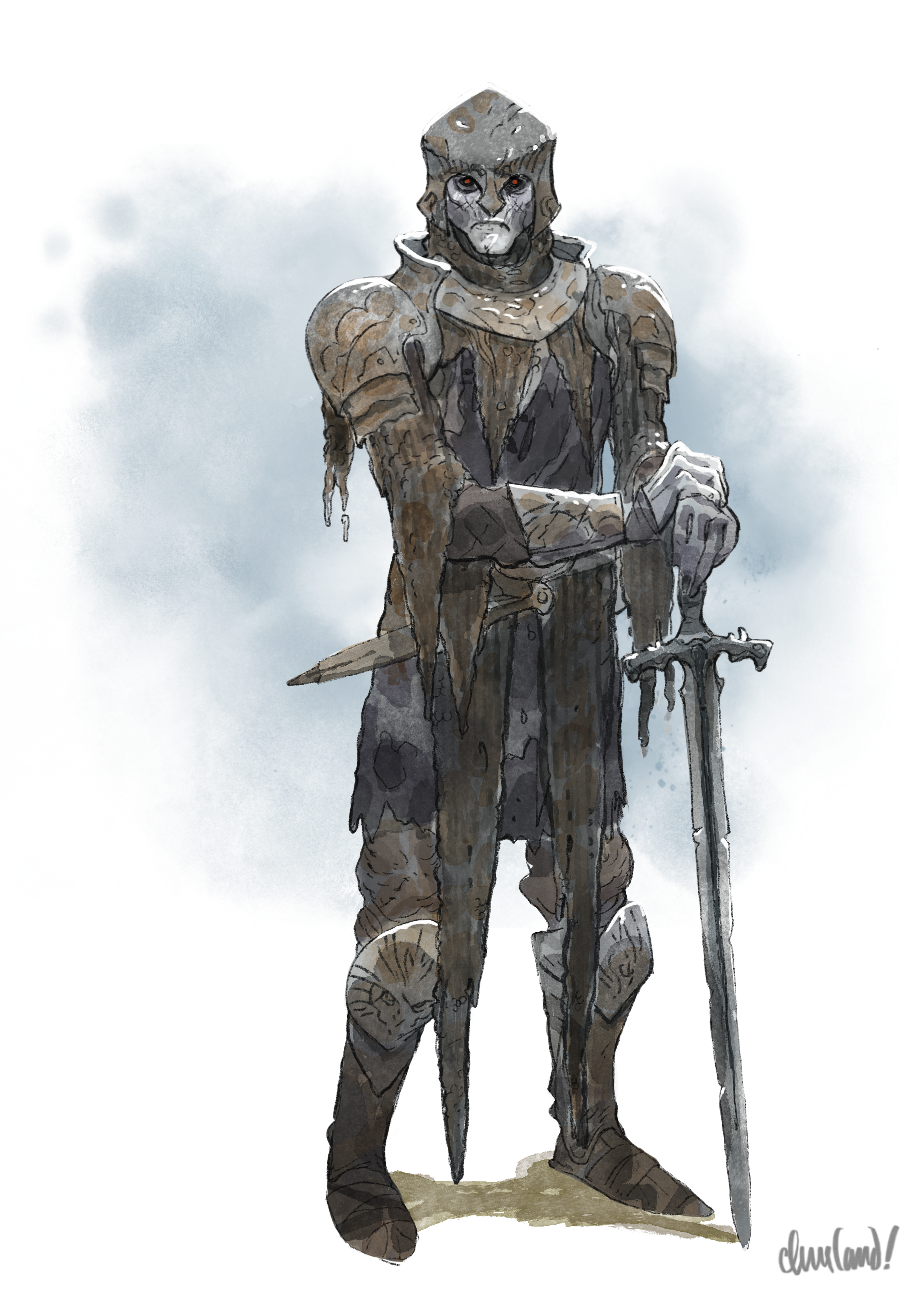
"Bridge Revenant" by Caleb Cleveland. Support him on Patreon!
This nameless revenant was banished, along with a dozen of its peers, from the ruins of Argynvostholt shortly after the failure of Doru’s rebellion three months ago.
When news of Strahd’s planned counterstroke reached them, the knights of the Order of the Silver Dragon raised their voices, begging Vladimir Horngaard to allow them to lend their swords to the cause.
Vladimir denied them and, when the knights grew enraged and unruly, banished them from the manor and forbade them from raising their swords against Strahd or any of his creatures. Now, only Sir Godfrey Gwilym, Vladimir Horngaard, and the spirits of the spectral warriors that once fought for the Order remain in Argynvostholt.
If the heroes call out to this nameless revenant knight or step onto the bridge, the knight hails them in a raspy voice and asks their business. Upon hearing their response, they say, "Old things are stirring and the lord of Castle Ravenloft roams the valley. Tell me: Do you serve him?"
If the heroes claim to serve Strahd, the revenant visibly stiffens, but stands aside, saying coldly, "Then be gone on your way, and may your foul work bring you ruin and despair."
If the heroes deny serving Strahd, the revenant is visibly relieved and invites them to approach so that they may "get a closer look at them." They introduce themself as a knight of the Order of the Silver Dragon, but claim to have long forgotten their name in life.
If the heroes' weapons are clearly visible, they ask the heroes if they oppose the lord of Castle Ravenloft. If the heroes claim to oppose Strahd, the revenant advises them to travel to Argynvostholt to the west, where Sir Godfrey Gwilym awaits those who would raise their swords against the darkness that lurks in the castle's depths.
If the heroes inquire about the Order of the Silver Dragon, the revenant shares only that the knights of the Order opposed the lord of Ravenloft in life and suggests that the heroes speak with Sir Godfrey to obtain further information. If the heroes obtained the silver pendant in the watchtower by the River Ivlis Crossroad, the revenant recognizes it, but refuses to comment further on its significance.
If the heroes ask the revenant why they are guarding the bridge, they say only, "Because I raised my voice against my commander and was banished. Now, I stand like my comrades-in-arms, watching the dark places of this land and awaiting an order that will never come."
If the heroes ask why they cannot take up arms against Strahd themself, they say only, "Because my commander forbids it, and my spirit is bound from disobeying his will." They are willing to share that their commander's name is Sir Vladimir Horngaard, but are unwilling to share more, advising the heroes to speak with Sir Godfrey instead.
If the heroes ask the revenant about the "amber doors" mentioned in Fravartiš's reading, they stiffen, then warns the heroes that they "meddle with things that ought not be meddled with." If the heroes reassure the revenant that their interest in the "amber doors" is directed at Strahd's defeat, the revenant hesitates, then informs them the knight is "bound never to reveal the secrets of that which we once guarded," but shares that Sir Godfrey can provide the information they seek.
Each revenant of the Order of the Silver Dragon has been sworn an oath which magically binds them to obey Vladimir's express commands. The revenants of the Order, excepting Sir Godfrey Gwilym, have been given the following commands:
- Do not betray the secrets of the Order of the Silver Dragon.
- Raise no weapon against the vampire Strahd von Zarovich, his servants, or his creatures.
- Do not return to Argynvostholt.
A revenant that violates one of these commands takes 15 psychic damage, which can't be reduced by any means, and is restrained until the start of its next turn by spiked black wires. (Because the revenants are bound by the oaths they swore to Vladimir in life, this effect can't be ended by any means.)
If the heroes ask for directions to Argynvostholt, the revenant advises them to travel "west, beyond the walled town, then south upon the ash-gray path."
If the heroes mention Strahd's carriage, the revenant notes their disgust for "the beast von Zarovich" and advises the heroes to be cautious of him and his servants and spies. If the heroes mention the skeletal rider, the revenant shares that "the Rider seeks a road to freedom through the mists. They will never succeed."
Before the heroes depart, the revenant warns them to beware "those who walk as wolves," who haunt the forests to the west. "Once, they did not trouble those who traveled the roads," they rasp. "Something has changed, however, and now, their hunger for violence cannot be sated." (The revenant doesn't know where to find the werewolves' den, or any further information about the pack.)
The revenant will not leave their post on the bridge under any circumstances.
C8. Black Carriage
This scene takes place in Chapter 2: Area I.
The journey from Tser Falls to the Black Carriage (p. 37) is one-and-a-half miles and takes thirty minutes. As the heroes make this journey, read:
You continue down the winding road, which climbs a short distance north before bending west to avoid a bald-headed peak on the right, its craggy cliffs bearing an array of sharp rocks that jut out over the roadway.
It's not long before the road bends north once again, a second hill arising from the fog on your left. Twisted trees dot its steep slopes, their branches reaching out like gnarled fingers.
As you travel deeper between the hills, the road narrows and the cliffs grow taller. Soon, though, the hills fall away once more, the road continuing forth into a small, fog-choked basin.
Ahead, the dirt road splits in two, widening toward the east. There you see patches of cobblestone, suggesting that the eastern branch was once an important thoroughfare.
This area is as described in Black Carriage (p. 37). (Strahd's carriage is not present, though the players can see deep grooves in the muddy road that pass from the Old Svalich Road onto the old cobblestone-strewn thoroughfare that leads to Castle Ravenloft.)
The journey from the Black Carriage to the western Gates of Barovia is a quarter-mile and takes five minutes. This area is as described in Gates of Barovia (p. 33), but seen from the opposite side.
If the heroes decide to visit Castle Ravenloft (e.g., to investigate Gertruda's disappearance), the journey from the crossroads is two-and-one-half miles long and takes fifty minutes. When the heroes arrive, the exterior of the castle is as described in Arc P - Ravenloft Heist.
C9. The Werewolves' Hunt
As the heroes continue down the road, read:
As quickly as it appeared, the cobblestone road is swallowed up by the forest again, the trees closing in around you once more. The dark undergrowth rustles and stirs in the wind, and the weight of the forest presses in from all sides. You're unable to shake the sense that, somehow, you're being watched. In the distance, you hear a raven's gurgling croak, followed by the sound of fluttering wings.
Before long, it becomes clear that your presence in this dreary land has not gone unnoticed. A raven follows you for several minutes while keeping a respectful distance.
The raven doesn't caw or try to communicate with the characters. If they leave it alone, read:
More ravens begin to take an interest in you. Before long, their numbers swell, and soon hundreds of them are watching you.
If she is with the party and able to fly, the disguised Muriel takes wing alongside the flock, but keeps a sharp eye on the heroes as they travel.
If any hero has the Alertness skill or succeeds on a medium Intuition test, add:
A humanoid shadow flickers in the distance—then vanishes from sight.
The shadow belongs to a werewolf packmate. Their companions—several wolves, one dire wolf, and an additional werewolf packmate—lurk in the woods nearby.
The werewolves don't attack immediately, preferring to wait for the perfect time to strike. If the heroes continue down the road, read:
As the road curves around the edge of the mountain, the right-hand cliffs fall away, leaving a sheer drop to a wooded ravine below. The road, now barely ten feet wide, bends up ahead, doubling back around this ravine before plunging dramatically and winding around a smaller mountain peak.
Then, without warning, a pack of wolves leaps from the forest, yellow eyes glinting as their muzzles curl into snarls!
Have the heroes roll initiative. As the swarms of ravens descend to help the heroes, all abilities targeting the wolves gain an edge.
Strahd's minions and those loyal to him, including these werewolves, don't attack Ireena.
Encounter Difficulty: Hard
Victories Awarded: 2
Expected Party: Five heroes at level 1 with 4 Victories each, and one retainer (Ireena)
Enemies:
| Group | Creatures |
|---|---|
| 1 | Werewolf packmate |
| 2 | Werewolf packmate |
| 3 | Dire wolf |
| 4 | Two wolves |
| 5 | Two wolves |
| 6 | Two wolves |
Balancing:
If you have fewer or more than 5 heroes, modify the encounter in the following ways:
| Number of heroes | Modification |
|---|---|
| 3 | Remove the dire wolf from the encounter. |
| 4 | Remove two wolves from the encounter. |
| 6 | Add two wolves (in their own initiative group) to the encounter. |
Terrain
The bottom of the ravine is 6 squares below the path. A creature force moved off the edge of the cliff falls, as normal, to the bottom of the ravine.
A creature at the bottom of the ravine has cover from creatures atop the ravine.
The mountainside above and to the west of the path is only 2 squares higher than the path. The mountainside is 6 squares west of the cliff's edge; the path is 2 squares west of the cliff's edge.
There are two large patches of brambles on the encounter map (illustrated below in light green): one to the west of the path below the mountainside, and one covering the bottom of the ravine immediately below the cliff's edge.
Trees, whose branches provide concealment and whose trunks provide cover, are abundant on the mountainside and in the eastern half of the bottom of the ravine. The trunk of a tree (in its central square) has 3 Stamina.
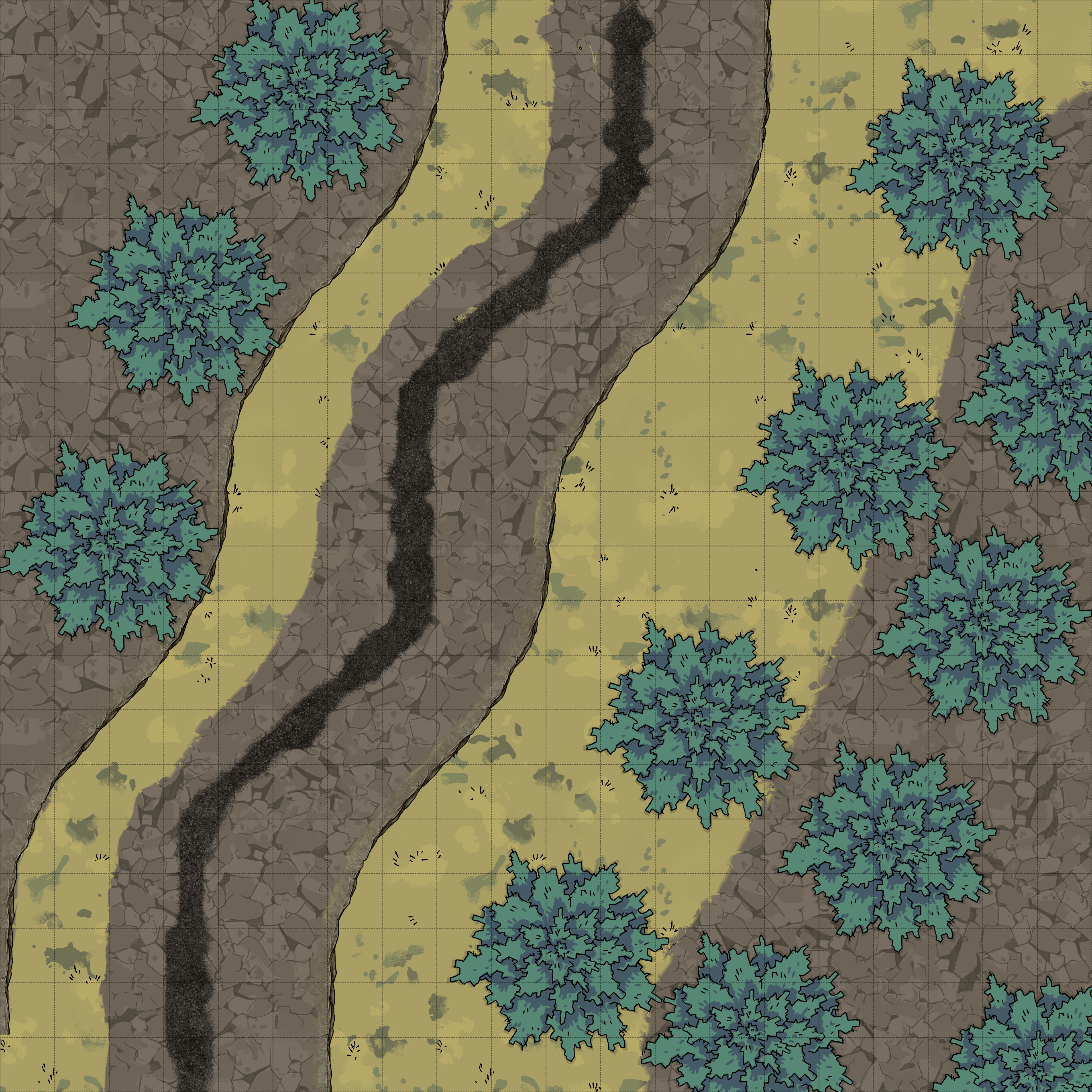
Tactics
Four wolves, the dire wolf, and one werewolf packmate start on the mountainside, with the heroes between them and the ravine. The remaining two wolves and werewolf packmate begin combat at the bottom of the ravine.
In combat, the wolves target a single hero at a time with their bite attacks, hoping to knock the heroes prone, then use Grab to drag the hero closer to the edge or Knockback to push them into the ravine. If any heroes seem likely to have low Might and low Presence, the wolves attempt to separate them from the party first.
Once the wolves have dragged a grabbed character away from the party, the nearest werewolf shifts their attention to target them with their Accursed Bite, preferring heroes with low Presence first. The first character targeted in this way notices that the werewolves are slightly larger than the other wolves and have disturbingly human eyes. Each werewolf continues to bite their chosen target until the hero is infected with lycanthropy, using Brutal Effectiveness to increase the potency of their bite if they have Malice to spare.
The werewolves and wolves ignore difficult terrain, and thus freely jump and shift into and out of the brambles to avoid their damaging effects.
Any heroes reduced to their negative winded value who would die (or otherwise become inert, turn to rubble, etc) are instead left unconscious. Strahd's goal in sending the werewolves after the heroes isn't to kill them, but to test them, frighten them, turn them against each other, and make them a threat to the ordinary people of Barovia.
Ending the Encounter
A werewolf flees if they begin their turn with 15 Stamina or fewer and don’t regenerate, or if they begin their turn with 0 Stamina on two turns in a row. Any surviving wolves follow soon after.
If the werewolves die, they revert to their true forms: a young person with pale, freckled skin and a lean, muscled frame, and a brawny young person with a sharp face and dark, oily hair. Each bears a bloody, raw, and blighted wound on their side—the source of the their lycanthropic affliction.
Any heroes who afflicted with the curse of lycanthropy soon finds that, although they regain Stamina normally, the original wound remains cosmetically bloody and raw—just as described in Van Richten's manuscript on the werewolf's curse.
In Barovia, the curse of lycanthropy spreads as described in werewolves' Accursed Rage ability. Creatures infected with werewolf lycanthropy suffer the rage effects of the Serious Case of Lycanthropy complication, but aren't affected by silver and don't experience the benefit of the complication.
On the night of the full moon, a creature infected with lycanthropy transforms into their hybrid form and cannot return to their original form until dawn. While transformed this way, the infected creature is under the Director's control, and behaves as if always in moonlight, lashing out violently and uncontrollably at anyone who comes near. At dawn, the hero gains all benefits and drawbacks of the Serious Case of Lycanthropy complication.
An infected creature can embrace the curse of lycanthropy—and so gain its full benefits—by completing a certain task, depending on the nature of their curse:
- An infected werewolf must voluntarily kill another humanoid and devour their flesh.
- An infected wereraven must be knocked unconscious while voluntarily attempting to protect another humanoid from (what they believe to be) near-certain death.
In Barovia, an infected lycanthrope can be recognized by the scar of the wound that originally transmitted the curse. The wound will never entirely heal, and remains raw and bloody until the curse is lifted.
The child of two lycanthropes possesses the full benefits of lycanthropy from birth, and may learn to control their curse as they age. A child born with lycanthropy in this way cannot be cured except by miracle.
If you're running a campaign with about 10 respites of downtime per level, as this guide assumes, the full moon arrives once every four weeks, on the first of every month. The first full moon that the heroes experience takes place on Neyavr 1, about two weeks after the heroes arrive in Vallaki.
If you're running a campaign with minimal respites, the lunar cycle is accelerated in Barovia: the full moon arrives once every two weeks, instead of once every four. The first full moon that the heroes experience takes place on Neyavr 15th—the seventh night after they first arrive in Vallaki.
The heroes can learn the date of the next full moon from the Martikovs of the Blue Water Inn, Dr. Rudolph van Richten, or the shadow elf Kasimir Velikovche. As the night of the full moon approaches, heroes infected with lycanthropy experience nightmares of increasing severity, as well as an increasing appetite for raw meat.
Heroes infected with werewolf lycanthropy will be able to search for a cure in Arc I - The Walls of Krezk after meeting Dr. Rudolph van Richten in Arc E - The Missing Girl. The Abbot can also cure lycanthropy, as described in Arc I - The Walls of Krezk. The heroes can't cure their lycanthropy with the Find A Cure downtime project, even if they were willing to haul a werewolf's corpse into the Blue Water Inn.
As noted in Session Zero, this campaign is designed for heroic player characters, rather than villainous ones. As such, it is incompatible with characters who choose to embrace werewolf lycanthropy by killing and devouring an innocent humanoid. If a player expresses any interest in doing so, warn them that embracing the curse will result in their current character being turned into a villainous NPC, requiring them to create a new character instead.
C10. Old Bonegrinder
This scene takes place in Chapter 6: Area O.
The journey from the Gates of Barovia to Old Bonegrinder is two-and-a-half miles long and takes forty-five minutes. As the heroes make this journey, read:
The road continues forward, passing between a patch of dark woods. The air here is as quiet as the grave, the trees standing perfectly still in the unnerving silence.
Not far from the road, nestled in the overgrown underbrush, stands a mossy stone stele standing just under six feet in height. It sits within a circle of old, cracked stones, and seems to bear some kind of carving.
Briefly pause to allow the heroes to act or react. If the heroes choose to investigate the slab, they find that it bears a crude carving of a raven over an engraved three-pointed star, the grooves lined with lichen and moss. (The slab is an ancient monument to the Seeker, and the three-pointed star the symbol of the Three.)
If the heroes remain silent or continue ahead, read:
The road soon emerges from the woods once more, veering between two hills. Before long, it bends to the north, hugging the base of a mountain.
The heroes emerge at the base of the hill upon which Old Bonegrinder rests, as described in Approaching the Windmill (p. 125). There are no ravens at or near the windmill.
As the windmill comes into view, the heroes also notice Morgantha approaching from the opposite direction with her cart.
You hear the sound of small, wooden wheels rolling down the road. You trace the lonely sound to a hunched figure bundled in rags, pushing a rickety wooden cart through the fog.
Morgantha (she/her), a night hag in the guise of an old woman, is coming from the town of Vallaki to Old Bonegrinder, after a long day of selling her dream pastries.
Morgantha doesn't have a child stuffed into a sack in her peddler's cart.
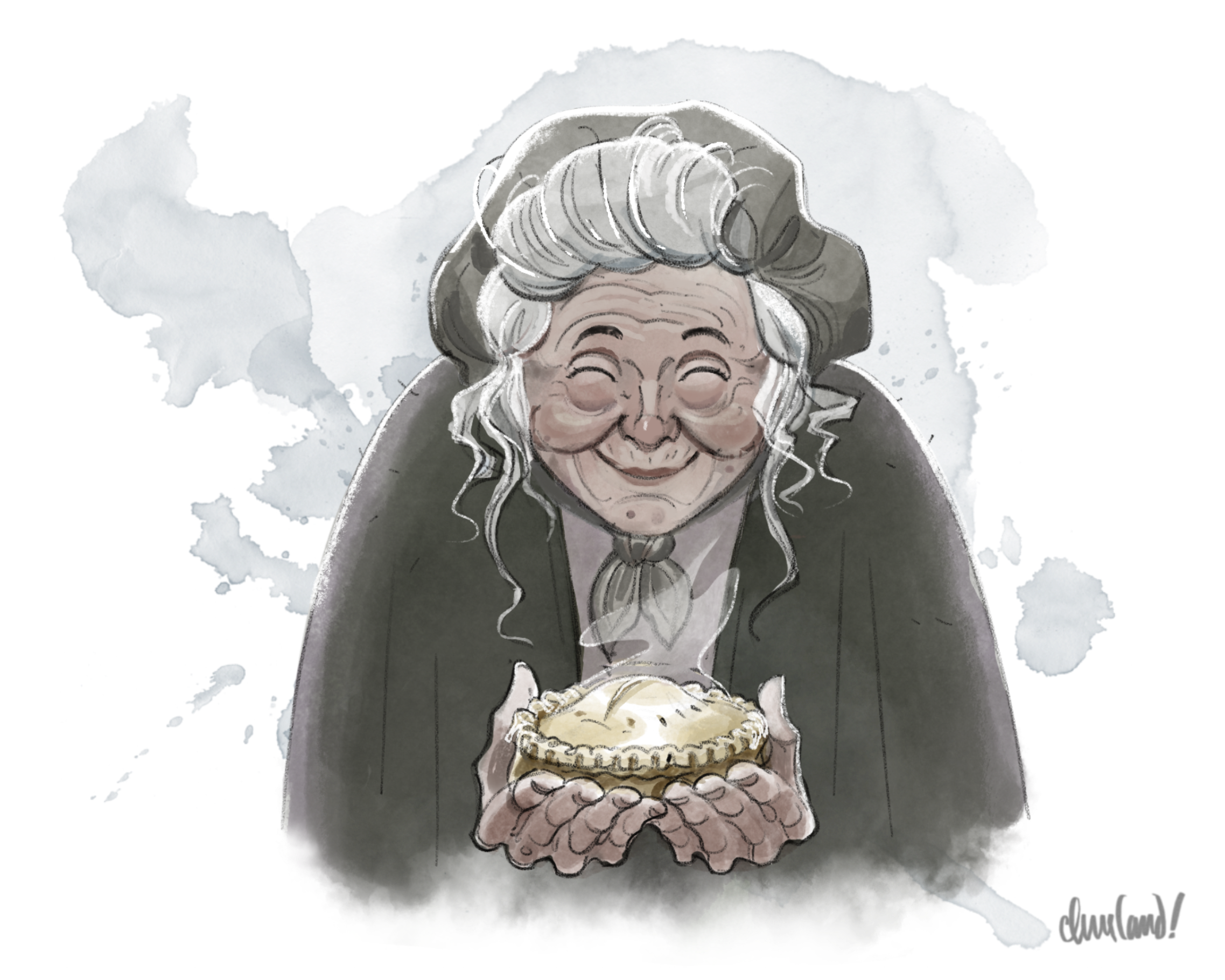
"Morgantha Disguised" by Caleb Cleveland. Support him on Patreon!
Roleplaying Information
Resonance. At the time the heroes meet her, Morgantha should inspire flattery and comfort with her grandmotherly charm, gratitude for her willingness to share compliments and "free samples," endearment for her complaints about the mundane trials of an old woman's life, and slight wariness of her confidence and comfort traveling alone on a dangerous road.
Emotions. Morgantha most often appears to feel cheerful, amused, or thoughtful.
Motivations. Morgantha wants to keep her cover, keep her business operating peacefully, make strangers feel endeared to and comfortable with her, and encourage others to try her dream pastries if they appear inclined to do so.
Inspirations. Nanny Ogg (Discworld), Dr. Kureha (One Piece)
Character Information
Persona. To the world, Morgantha is a cheerful old lady with a love for gossip and complaining. Only Morgantha and her daughters know that she is secretly the black-hearted matron of a night hag coven.
Morale. In a fight, Morgantha would attempt to parlay for peace, then use her Dreamwalker ability to escape into the ethereal plane if doing so appears fruitless.
Relationships. Morgantha is the mother of the night hags Bella and Offalia, and the dream-pastry dealer for the Barovian refugee Franz.
Morgantha greets the heroes warmly, calling them "weary travelers," and shares her hope that the road has not been too hard on them. She freely shares the following information if asked:
- She is a peddler who sells baked wares to the "good people of Barovia."
- She is just returning from a day peddling her goods to the townsfolk of Vallaki and the "poor, hungry dears" camped outside the gates. (Her latter comment is referring to a camp of Barovian refugees that has not been allowed to enter the town.)
- She lives in the old windmill up the hill with her two daughters, Bella and Offalia. (She kindly declines to share what happened to her "spouse," saying only, "Now, that's an old woman's business, meant to be shared only if she chooses.")
Morgantha has a few "dream pastries" left from her workday—"filled with the light and love of dreaming"—which she offers to the heroes for free as a "first sample." She advises the heroes that the dream pastries taste best after a warm meal, "especially with a nice bit of wine to wash them down."
These pastries look and taste like small mincemeat pies. A creature that eats one in its entirety must succeed on hard Might test or fall into a trance that lasts for 1d3 + 4 hours, during which time the creature is unconscious. The trance ends if the affected creature takes any damage or if someone else uses a main action to shake the creature out of its stupor.
While in the trance, the creature dreams of being in some joyous place, far removed from the evils of the world. The places and characters in the dream are vivid and believable, and when the dream ends, the affected creature experiences a longing to return to the place.
If asked how she manages to travel the roads safely, Morgantha only smiles and promises the heroes that "an old woman has her tricks." ("But," she complains, "my back and poor feet do complain from time to time. I can't wait to soak them in a tub of nice, hot water once I'm home.")
If the heroes ask to enter her home, Morgantha apologizes for her lack of hospitality, but notes that she's tired and not prepared for visitors, besides. (The heroes are welcome, she says, to visit another day if they'd like.)
When the conversation runs out of steam, Morgantha bids the heroes a safe journey, and lets them know that they can find her outside of Vallaki's gates in the future, should they like to purchase additional pastries.
Before she departs, Morgantha warns the heroes that the guards at the Vallaki gates are confiscating silver coins and visible silver items from newcomers as a tax. "But," she says, tapping her nose with a cheeky, half-toothed grin, "you didn't hear it from me."
When Morgantha or the other members of her coven transform, they do so physically. Morgantha's appearance isn't an illusion, so a void elementalist sees exactly the same thing that all other heroes see—a sweet-looking old woman. None of the objects currently with her are magical, save for her heartstone, which she won't reveal under any circumstances, and the dream pastries. If a void elementalist examines the dream pastries, they learn about the trance and the visions, as described above.
If a hero discerns Morgantha's fiendish nature, such as by using a human's Detect the Supernatural ability, and confronts her about it, she pauses, then congratulates them on their perceptiveness. She then smiles sweetly and notes she is breaking no laws, asking: "Is it a crime to be as one was made?" If the hero insisted on attacking her, she adds: "And does such a crime demand immediate execution?"
If the heroes insist that it does, she immediately kneels, pleading sarcastically for mercy and an opportunity to repent. "Allow me to return to my home and reflect upon my sins," she adds, grinning. If attacked, she uses her Dreamwalker ability to vanish into the ethereal plane, cackling. (The three hags share a single stat block, even if physically apart from each other.)
If the heroes approach the windmill, she notifies Bella and Offalia, who join her in the ethereal plane. If the heroes attempt to damage or destroy the windmill, the hags then return to the material world and warn them to stop on pain of death. See Morgantha Gets Suspicious for more information on conflict with the hags. (The windmill currently doesn't contain any children, and won't until Arc H - The Lost Soul begins.)
C11. The Deep Woods
The journey from Old Bonegrinder to the Town of Vallaki is five-and-three-quarter miles long and takes two hours. As the heroes make this journey, read:
The winding valley road hugs the mountainside as it meanders north. The dark woods cling to the opposite side of the road, the tall, gnarled trees creeping as close as they dare. You can hear the sound of the wind rustling through the leaves and the occasional creak of branches. From time to time, it almost sounds like the trees are whispering among themselves, or stirring their ancient roots in the old, rotten mulch.
As the heroes proceed down the road, read:
Ahead, the trees to the north break, revealing a grassy field. The tall grasses sway in the chill air, the field stretching until it reaches the shores of a dark, distant lake. Fog clings to the shoreline. Even from a distance, you can hear the faint sound of water lapping against the rocks.
If Ireena is with the party, she freezes and asks the heroes if the party can take a quick detour across the field to the lake. If asked, she notes only that the lake seems strangely familiar.
Lake Zarovich is as described in L. Lake Zarovich (p. 38):
At the foot of a mountain, nestled in the misty forest, is a large lake. The water is perfectly still and dark, reflecting the black clouds overhead like a monstrous mirror.
No boats are visible.
Upon arriving at the shore of the lake, Ireena notes with trepidation that it appears to be the same lake that she has seen in her dreams. (If she hasn't already shared it, Ireena tells the story of her dream, described in #C4d. The Dancing Fire above.)
Ireena is certain, however, that she has never visited this lake with Ismark and her father Kolyan. She is uncertain of the implications, but becomes lost in thought if a hero reminds her that her father found her wandering the Old Svalich Woods as a child.
C12. The Town of Vallaki
C12a. The Vallakian Gates
The road continues forward to the Town of Vallaki, largely as described in Approaching the Town (p. 95). However, remove the first sentence of the descriptive text and add the following text at the end of the first paragraph:
More than a dozen ramshackle tents have been set up against the palisade wall. Among them, dozens of ragged, emaciated people mill about or sit by low-burning campfires and bedrolls, their hollow gazes watching silently as you approach.
If the heroes departed from Tser Pool that morning, they arrive in Vallaki at dusk.
If Ireena is visibly traveling with the party, add:
Some of them regard Ireena with dull recognition, but none lift a hand in greeting or make any gesture of warmth.
This area is the Morning Gate. The tents are a camp of Barovian refugees, housing those who survived the trek from the village of Barovia in the wake of Strahd's siege.
The Refugee Camp
If she is with the party, Ireena is heartbroken and enraged at the sight of the refugee camp. She suggests that she meet with the refugees while the heroes find lodging in town, and promises to join the heroes later. The heroes can dissuade her with an easy Presence test and any reasonable argument, though on a Tier 1 result, Ireena attempts to visit the refugees alone at some later date. Otherwise, Ireena approaches one of the cookfires, either alone or—if the heroes have insisted on joining her—with company.
The members of the refugee camp, which include Emeric (he/him), a melancholy older man, and Magda (they/them), a grief-stricken young person, can share the following information:
- The Barovian refugees arrived at Vallaki's gates a few weeks ago, but were barred from entering. When they attempted to breach the gates by force, the guards summoned a man they called Izek, who bore a twisted devil's arm and conjured fire to drive the refugees back.
- Since then, the refugees have set up camp outside the town's walls, clustering together for protection and warmth. They've managed to secure some minor necessities, such as the tents, by bribing the guards at the gates, but have been unable to persuade the guards to allow them entry or to even invite the town's Baron to discuss their plight.
- Swarms of bats and packs of wolves have plagued the camp each night since they've arrived. Thankfully, no one has died yet, but several refugees have been wounded.
- Due to losses they suffered on the road and the threat of the Devil in Castle Ravenloft, the refugees are unwilling to risk the journey back home, instead hoping to wait until the Baron sees reason and allows them to enter the walls.
- Roughly one-quarter of the refugees have become addicted to "dream pastries," a food sold by the peddler Morgantha. These refugees seek an escape from the misery and despair of their situation. Those who eat a dream pastry fall into a trance as described in Dream Pastries.
The refugees are lost in despair. Some recall a superstition that red-haired Barovians bring misfortune, and suggest that Ireena herself has brought a curse upon their people. Few have any wish to deal with her further.
Following her interaction with the refugees, Ireena is enraged by the Baron's callousness, and vows to make her best efforts to secure entry for the refugees into Vallaki.
The Guards at the Gates
One guard has a silvered spear, while the other has a quiver containing a dozen crossbow bolts, half of which are silvered. The guards greet all visitors with suspicion, particularly those who arrive at night. If the heroes arrive at night, one or more of them must succeed on a hard Presence test to convince the guards to unlock the gate and let them enter.
At any time of day, the guards demand that each person first identify themselves. Once identified, each hero must show their teeth ("To prove you're not vampires.") and briefly be exposed to a necklace strung with bulbs of garlic ("To prove you're not werewolves"). (The Baron has, incorrectly, informed his guards that werewolves are severely allergic to garlic.)
The guards then demand each hero pay one gold piece as a toll in order to enter the town—not enough to decrease any hero's Wealth, but outrageously expensive for any ordinary person. The guards refuse to accept payment on behalf of the refugees, whom the Baron has specifically barred from entering, claiming concerns of "sickness, unruliness, and malicious unhappiness."
If the heroes pay the toll, the guards also insist that each entrant opens their purse (or equivalent) and surrender any silver pieces in their possession. (If the heroes complain, the guards assure them that the silver is needed to produce the silvered weapons necessary to defend the town from werewolves.) If any heroes are openly carrying silvered ammunition or other silver items despite earlier NPCs' warnings, they must succeed on a medium Presence test to avoid the items being confiscated.
If your players declare that they'd like their characters to fight the guards instead of giving up their items or trying a different approach, pause and check in. What is their plan, after killing two guards in plain view of the entire town and the entire refugee camp? Make it clear that if they proceed with this course of action, neither the heroes nor Ireena will be welcome in Vallaki afterward, nor will Ireena be welcome among the refugees. The heroes know of no other safe destination for Ireena, and are likely to face further deadly dangers on the roads, especially at night. And then there are the possible repercussions for the refugees...recklessness here will endanger many innocents, which isn't very heroic.
If the players confirm that they'd like to fight the guards anyway...yikes! A concerned Vallakian citizen runs to fetch Izek Strazni and the remainder of the two dozen Vallakian town guards, who arrive to put a stop to the heroes' crimes by any means necessary. Izek cares nothing for the citizens of Vallaki or their safety, much less the refugees and their safety, and will happily damage them with his abilities. What happens to the refugees and Ireena afterward is, I fear, beyond the scope of this guide.
If Izek and the guards confront the heroes and defeat them in combat, they confiscate the heroes' weapons and throw them out of town, leaving them as food for the wolves of the Svalich Wood. The heroes awaken west of Vallaki, on the Old Svalich Road, stripped of their kits and any non-hidden valuables. Izek kidnaps Ireena and takes her to the burgomaster's mansion, as described in Arc G - The Strazni Siblings.
To recover their possessions, the heroes must first sneak back into Vallaki with a montage test as in Arc E - The Missing Girl#2. Infiltrating the Mansion, avoiding the twelve guards patrolling the walls and gates around the city. The heroes can find their belongings stored in the N3m. Locked Closet (p. 107) in the burgomaster's mansion, near the chained Udo Lukovich.
To safely and openly go about their business in Vallaki again, the heroes must defeat Izek Strazni and depose the baron, as described in Arc F - Lady Wachter's Wish. Once installed, Lady Wachter is happy to pardon the heroes for any past indiscretions.
If asked about lodging, the guards can share information about the Blue Water Inn, which offers food, wine, and shelter to visitors. They mention that a strange elf is staying there; he came to Barovia from a distant land, riding into town on a carnival wagon. (This is Rictavio.) The guards are also willing to provide additional directions to other landmarks in the town in exchange for a small bribe (not enough to affect any hero's Wealth).
Each time the heroes pass through the gates, including the first, the guards nod at them and intone the Baron's favored phrase: "All will be well."
If the heroes inquire about Gertruda's fate and provide a description, the guards truthfully share that they haven't seen anyone resembling her.
Entering the Town
As the heroes pass down Vallaki's main avenue, read:
You pass from the earthen road onto cobblestone streets, mud staining your boots and the bottoms of your pants. Behind you, the gates close with a slam, and you can see the guards resume their posts behind it. In the distance, you can see two other figures bearing pikes, patrolling the walls as they look down on the twisted forest beyond.
The eaves of the buildings hang with old banners and tattered fabrics that flap and twist in the chill breeze. The banners are painted with faded words and illustrations, but time has robbed them of both their legibility and any beauty they may have once had.
Flickering candlelight lingers behind the shuttered townhouse windows, and humanoid shadows move beyond closed curtains. Long shadows lurk in the alleyways, where the grass grows long and twisted beneath the stained and sagging wood of the buildings above.
The streets are empty, though you can see a single cloaked figure traveling away from you down the central road. In the distance beyond the walls, a lone wolf howls, and a cold gust of wind cuts through the night like a knife.
The cloaked figure is Willemina Rikalovna (she/her), traveling to the church (as she does nightly) to pray for wisdom and restraint for her son, Udo Lukovich (he/they), often too outspoken in his dislike for the burgomaster.
As the characters pass through the streets, they are noticed by Ernst Larnak (he/him), who intently watches them, though doesn't follow them. Any hero who succeeds on a medium Intuition test notices him. If the heroes confront him, the conversation unfolds as described in Lady Wachter's Wish (p. 124). (Ernst does not yet deliver an invitation to dine with Lady Wachter, though he does return to N4. Wachterhaus (p. 110) to report back to Lady Wachter when the heroes leave his sight.)
C12b. The Blue Water Inn
This scene takes place in Chapter 5: Area N2.
This area is largely as described in N2. Blue Water Inn (p. 98). If Muriel is present, she bids the heroes farewell with a soft, sentimental trill, then departs to join the other ravens resting atop the roof. (If the heroes later return to the inn to look for her, she is not present.)
When the heroes first arrive, the inn contains the following notable NPCs:
- Danika Nimirovna Dorakova (she/her) , who is pouring drinks and serving patrons in N2c. Taproom;
- Urwin Martikov (he/they), who is cooking bread and beet stew in N2e. Kitchen; and
- Brom (he/they) and Bray (they/them), Danika and Urwin's children, who are playing with toys in their bedroom.
Rictavio isn't yet present.
Roleplaying Information
Resonance. Urwin should inspire amusement with his bad puns and jokes, gratitude for his fatherly counsel and support, and comfort from his compassion and sincerity.
Emotions. Urwin most often feels amused, satisfied, cheerful, thoughtful, concerned, and hopeful.
Motivations. Urwin wants to raise his children well, serve guests with hospitality and skill, and see the people of Barovia freed from Strahd’s tyranny.
Inspirations. When playing Urwin, channel Vander (Arcane), Greg Universe (Steven Universe), and Linda Belcher (Bob's Burgers).
Character Information
Persona. To the world, Urwin is a kind fatherly figure, family man, and welcoming host with an ever-present twinkle in his eye. To those he trusts, Urwin is a cunning spymaster and tactician with fierce hope for the future of Barovia. Deep down, Urwin fears for his children's futures in a realm ruled by Strahd.
Morale. In a fight, Urwin would immediately attempt to defuse the situation, and attempt to flee if unsuccessful—though not before escorting anyone else out of harm's way.
Relationships. Relationships. Urwin is the father of Brom and Bray and the husband of Danika Nimirovna Dorakova. He is also the exiled son of Davian Martikov, and the beloved older brother of Adrian, Elvir, and Stefania. Urwin no longer uses his patronymic (Davianovich), and instead just uses his given name and family name. In addition to co-owning the Blue Water Inn, Urwin is the spymaster of the Keepers of the Feather.
Roleplaying Information
Resonance. Danika should inspire amusement with her “straight-man,” good-natured banter with Urwin, gratitude for her hospitality and care, and comfort from her practical, down-to-earth nature and her fierce dedication to her family, home, and guests.
Emotions. Danika most often feels fond, satisfied, congenial, determined, defiant, and affectionate.
Motivations. Danika wants to keep her family safe, run a successful business, and ensure that her children one day see sunlight over Barovia.
Inspirations. When playing Danika, channel Tenzin (Avatar: The Legend of Korra), Bob Belcher (Bob's Burgers), and Garnet (Steven Universe).
Character Information
Persona. To the world, Danika is a practical, no-nonsense businesswoman with a heart of gold. To those she trusts, Danika is a fierce mother with a deep dedication to the Martikov clan. Deep down, Danika is grimly prepared to defend those she loves—at any cost necessary.
Morale. In a fight, Danika would swiftly attempt to de-escalate, but would fight to the death to defend her family or her guests.
Relationships. Danika is the mother of Brom and Bray, and the wife of Urwin Martikov. In addition to co-owning the Blue Water Inn, Danika is a high-ranking member of the Keepers of the Feather. Danika's matronymic comes from her mother Nimira, the current head of the Dorakova family of wereravens.
Entering the Inn
The taproom is as described in N2c. Taproom (p. 100), but alter the last sentence of the taproom's description as follows:
Four people sit at the bar: two finely dressed young nobles, laughing boisterously, and two grim-faced older people clad in furs drinking quietly.
When the heroes first enter the inn, Danika, who is waiting tables, greets them and asks them to wait at the bar while she tends to other patrons.
If the characters approach the bar, Urwin exits the kitchen carrying a tray of fresh-baked bread, hot beet stew, and wolf steaks, which he sets down on the bar. (The food smells mouthwateringly delicious.)
The two young people are Nikola (she/he/they) and Karina Wachter (she/her or sie/hir), siblings of noble birth. Besides their names and genders, they are as described in N2c. Taproom (p. 100).
The older men at the bar are Szoldar Szoldarovich and Yevgeni (no patronymic), who are mostly as described in N2c. Taproom (p. 100).
The hunters are willing to serve as guides for a reasonable price (not enough to decrease a hero's Wealth), or to provide directions to important landmarks in exchange for free drinks. They think it's foolish to travel "this cursed realm" at night and won't do so unless their payment is exorbitant (enough to decrease a hero's wealth by 1).
Urwin greets the heroes warmly and welcomes them to the Blue Water Inn. If the heroes don't direct the conversation elsewhere, he notes that they look like they've been traveling and asks if they need rooms for the night.
Before Urwin can reply to the heroes, Danika returns and apologizes to the heroes for her delay. Assuming the heroes do not interrupt, the conversation then proceeds as follows:
- Danika lightheartedly accuses Urwin of plotting to rent rooms to guests "for free" again, an allegation that Urwin cheerfully denies.
- Danika tells the heroes that Urwin would "bankrupt the inn" with generosity if she weren't there to keep the books. (Urwin graciously concedes the point.)
- "After all," Urwin says cheekily, "why else did I marry you?" With a smile, Danika replies, "A rare instance of common sense, I imagine."
- Danika pecks Urwin's cheek with a kiss and says, "The table by the window is getting hungry." Urwin winks at the heroes, picks up the tray again, and exits the bar to deliver the food.
Danika then tells the heroes the rates for room and board, which each hero can comfortably afford with even 1 Wealth.
- The inn offers beds for the night. The large guest room (four beds) is available, as are the two small guest rooms (two beds each).
- Heroes looking for something to eat are fed hot beet soup and fresh bread at no additional charge.
- A cooked wolf steak costs extra.
- Purple Grapemash No. 3 is the inn's more affordable wine option; for the discerning palate (with Wealth at least 2), there's the superior Red Dragon Crush.
Urwin takes the heroes' dinner orders, if any, and returns to the kitchen to fetch their food. The heroes then have a few minutes to talk with Danika, with the Wachter siblings, with the wolf hunters, or amongst themselves. During this conversation, Danika can provide the heroes with information about Vallaki, its festivals, and the nearby fishing village, as described in Lore of Barovia#Vallaki Lore.
- Festivals: The burgomaster, Baron Vargas Vallakovich, has decreed that the Parade of Purple will be held in the town square in three days, on Hektavr 14. The previous festival, which he called the Merriment of Music, was less than a week ago. Yet another festival, the Wolf's Head Jamboree, is scheduled for Hektavr 21.
- Vallaki has had at least one festival per week for the past several years.
- There's a small fishing village on the shore of Lake Zarovich northwest of town, mostly inhabited by hakaan. The people there are friendly enough, but don't often come to town; the baron doesn't welcome outsiders in Vallaki, and insists on "testing" everyone for lycanthropy and vampirism at the gates.
If you're running a campaign with minimal respites, the players arrive in Vallaki on the evening of Neyavr 7, just after the end of the Wolf's Head Jamboree. The Festival of the Blazing Sun takes place on Neyavr 14.
Both Urwin and Danika can provide directions to any major landmark inside of Vallaki, including N1. St. Andral's Church (head west toward the Sunset Gate), N5. Arasek Stockyard (head east toward the Morning Gate, then take the last right turn), and N8. Town Square (head directly south).
The inn's most recent shipment of wine is slightly late, but has not been sufficiently delayed as to make Urwin alarmed. As such, he does not ask the heroes to investigate the Wizard of Wines at this point. (This quest will not become available until the heroes reach level 2. See Arc J - The Stolen Gem for more information.)
If the heroes order food or wine in the taproom, Danika offers to seat them at the long table at the south end of the taproom and promises that they'll be served shortly.
Eating Dinner
As the heroes eat dinner, they can observe the following dynamics in the taproom.
- Brom and Bray are mischievous, but good-hearted. The heroes see the children lurking behind tables and chairs in the taproom, wearing painted wooden masks (one mask with a mean scowl and one with a frightened expression), startling the patrons. One startled patron bumps into Danika, who scolds the children sharply (but not unkindly). The children help mop up the spilled soup Danika was carrying.
- Danika is mildly exasperated by her children's antics, but watches them return to the kitchen to help with the cooking with deep fondness.
- Danika and Urwin are professional and attentive to their patrons' needs, but clearly affectionate with each other and with the children.
- Nikola and Karina Wachter drink too deeply and laugh too loudly, clearly not caring much for the opinions of the other patrons, but without any real malice. The other patrons all seem faintly embarrassed by their behavior, but resigned to it.
- Szoldar Szoldarovich and Yevgeni speak only to each other, and always speak quietly, not inclined to socialize with the other patrons.
If the heroes rented rooms for the night, Danika eventually approaches their table and offers to show them to their rooms. During the tour, Danika lets them know that they're free to request fresh linens or a tub of hot water (for a bath) for their rooms. "Breakfast is served at first light," she says warmly, and adds, "Feel free to let us know if you need anything else."
C12c. St. Andral's Church
The heroes may want to drop Ireena off at St. Andral's before embarking on downtime, before or after they arrive at the Blue Water Inn. St. Andral's is as described in Arc D - St. Andral's Feast, though St. Andral's bones haven't been stolen yet.
When the heroes enter the chapel, read:
A dozen ornate candelabras bathe rows of well-kept pews in candlelight, casting a soft luminescence that touches every corner of this chapel. At the far end of the room, a wooden altar stands proudly, carved with a proud sunburst with rays thrusting forth in cheery defiance. Six tall windows flank the altar. The air feels peaceful and clear here, as if you can breathe deeply for the first time since entering the mists.
A middle-aged priest with graying hair and crisp, clean vestments sits in one of the front pews beside a thin older person in threadbare commoner's clothes, face lined with worry. A young child sweeps the floor near the altar
The heroes have arrived to find Father Lucian finishing a service to his congregation. The person beside him is Willemina Rikalovna, mother to the young cobbler Udo Lukovich, who is worried about her son's increasingly outspoken protests against the baron's regime of forced positivity. The child is Yeska. After giving reassurances to Willemina, Father Lucian greets the heroes and Ireena warmly, recognizing them as newcomers to Vallaki, welcoming them to St. Andral's Church, and asking if they have come seeking fellowship or to pray to the Lady of Morning.
If the heroes bring Ireena to St. Andral's after their downtime, the Wolf's Head Jamboree has already happened, and Udo already arrested; the heroes arrive to find Willemina crying and Father Lucian comforting her as best he can.
If told that Ireena hopes to find sanctuary at the church, Father Lucian is glad to offer her a pallet to sleep on in the chapel. After Ireena offers to compensate him for his kindness, Father Lucian considers her request, then invites her to assist with Yeska's chores and education for the duration of her stay—a request which Ireena graciously accepts.
While the church is hallowed ground, creatures with the Infernal, Abyssal, or Undead keywords can't enter the area, nor can such creatures charm, frighten, or possess creatures within it. Any creature charmed, frightened, or possessed by such a creature is no longer charmed, frightened, or possessed upon entering the area. Dead bodies interred in the area can't become undead.
Heroes don't have keywords; revenant and devil heroes can enter the church freely and safely. If questioned, Father Lucian states that the Lady's grace extends to all beings, and that her saint's wrath only falls on those fiends and undead driven by malice.
C12d. Morning in Vallaki
Urwin's Advice
When the heroes first emerge from their rooms onto the balcony the following morning, Urwin—who is taking down the chairs from the taproom tables—asks them to come downstairs to the bar to speak.
Lowering his voice, Urwin warns the heroes that they must be cautious in Vallaki—both due to the town's harsh system of law enforcement and recent political tensions. Urwin can share the following additional information, as in Lore of Barovia#Vallaki Lore:
- The dates of the upcoming Parade of Purple (Hektavr 14) and the Wolf's Head Jamboree (Hektavr 21);
- Vallaki's recent history of festivals (at least one dismal festival per week for the last several years),
- The Baron's strict rules regarding his festivals—and the fates of those who speak ill of them,
- The cruel nature and terrible strength of Izek Strazni, the baron's henchman. ("Many have tried to test his strength," Urwin notes grimly. "All have failed.")
Urwin quietly notes, however, that the Baron is known to be highly susceptible to flattery—and that should the heroes ever need to win his favor, his ego may be a prime target.
If the heroes ask whether the Baron has any enemies in Vallaki, Urwin hesitates, then quietly says, "No ordinary person would oppose him openly." He doesn't elaborate.
C12e. Downtime in Vallaki
By this point, the heroes should have enough XP and Victories to level up, so they'll likely want to take a respite. This is an excellent opportunity for some downtime! The heroes have a variety of options for respite activities that won't kick off new adventures.
Festivals
Two festivals happen during the week and a half of downtime. If any heroes attend, they don't see the baron at either festival
The first festival is the Parade of Purple, on Hektavr 14, which involves the townsfolk wearing purple and throwing purple powder and paint at each other. (Nobody likes this.)
The second is the Wolf's Head Jamboree, on Hektavr 21, which is a bit more involved. Events include:
- The Wolf Parade, where children march through the town with wolves' heads on pikes;
- A wolf sausage eating contest;
- The Wolf Race, where the baron's two huge mastiffs chase competitors through town (safety not guaranteed);
- The Wolf Hunt, where children compete to see who can find a hidden papier-mâché wolf and beat it to "death" as quickly as possible.
It's not as terrible as other Vallakian festivals—until Udo Lukovich the cobbler shows up with a sign suggesting the baron should be fed to the wolves. Izek Strazni immediately arrests Udo and drags him away to the burgomaster's mansion. If any heroes attend the festival, they can't meaningfully intervene in Udo's arrest—they don't see it happen directly, and learn about it only through gossip after the fact.
You might decide to have heroes witness the arrest directly. This will make the problem of Udo more "real" and urgent, but watch out: heroes who see obvious villainy happen right in front of their faces are likely to intervene. (In fact, they may think you want them to intervene.) Even if they don't act immediately, they may, for example, decide to break into the mansion that night to rescue Udo and kill Izek, consequences (for upsetting the power balance in Vallaki, for breaking into the baron's mansion, for starting a fight with the fire guy in the middle of an extremely flammable wooden house) be damned. Given that they're theoretically in the middle of downtime, this isn't great. My advice: don't do this.
If you decide the heroes should witness the arrest anyway, good luck! The first and simplest layer of prevention here is to have the heroes see the arrest from far away, with crowds of townsfolk and guards between them and Izek; by the time they elbow their way through, Izek and Udo are gone.
If they do somehow get to Izek, he can't be talked out of arresting Udo or taking him to the burgomaster's mansion, and threatens to arrest the heroes too if they continue to intervene. The heroes can't fight Izek in the town square without endangering the ordinary people of Vallaki and risking expulsion from the town—not to mention they'd certainly lose a fight with Izek and a dozen guards and the baron's mastiffs (enjoying a day out with Izek).
Visiting the Baron?
The baron isn't available during the heroes' first stretch of downtime in Vallaki. (He overexerted himself with all the dancing during the Merriment of Music, collapsed, and has been recovering.) Without her husband available, the baroness isn't inclined to receive visitors on her own.
If the heroes insist upon being seen, the baroness receives them in the parlor and offers them tea. If the heroes offer their letter of recommendation from Kolyan Indirovich, she's happy to allow the heroes access to the baron's library for any research projects they might want to undertake. She can't provide more help than that.
Downtime Projects
Crafting
The heroes should have received recipes for healing potions (in Death House), holy water (in Van Richten's cache), buzz balm (from Adaska), and growth potions (from Adaska). The ingredients for crafting these consumables can be found as follows.
- Healing potions: The heroes should have picked up some costmary leaves in Arc A - Escape From Death House. If they run out, costmary is a common herb, and can be purchased from an ordinary apothecary in Vallaki; the Martikovs also have a regular supply of costmary, and are happy to trade it for help around the inn.
- Holy water: The heroes might have various silver trinkets from Death House, or might have successfully concealed some silver coins from the guards at the gates. A grindstone or sturdy file can be purchased at Arasek Stockyard, and a hero can spend a respite activity to produce enough powdered silver to supply their holy-water projects for the foreseeable future. Alternatively, the heroes can craft holy water without the item prerequisite at the Church of St. Andral while the bones of St. Andral remain safe, as the saint's blessing bolsters heroes engaged in holy endeavors. After the bones are stolen in Arc D - St. Andral's Feast, heroes can't craft holy water at the church until the bones are safely restored.
- Buzz balm: There is a source of demon honey in Vallaki—one person with a very strange beehive their family has maintained for generations—but it's obscure knowledge. To find this source, a hero must complete the appropriate 45-point Discover Lore project, which will likely take several days of asking around. (Since Buzz Balm can end the bleeding condition, it's particularly useful in this vampire-heavy adventure!)
- Growth potions: Water-milfoil grows plentifully in Lake Zarovich. No special activity is required to collect it.
Community Service
There are plenty of people who need help, but not heroic help, in Vallaki. The Martikovs, for instance, run a busy inn, and would be happy for some extra help, or the heroes could teach Brom and Bray some new skills.
Discovering Lore
A hero can learn any of the lore in Lore of Barovia#Beliefs or Lore of Barovia#Vallaki Lore by undertaking a 15-point Discover Lore project.
A hero with access to the baron's library can also undertake a separate 15-point Discover Lore project to look through Vallaki's official records for information about Ireena. They identify a familiar name in a genealogical tome archiving births and deaths to Vallakian families: Ireena Strazni, the younger sister of Izek Strazni and the daughter of Grygori and Fatima Strazni. According to the records, however, Ireena Strazni died more than eighteen years ago at the age of four, with Grygori and Fatima dying shortly thereafter. Grygori and Fatima’s deaths are marked as Suicide, while Ireena’s cause of death is marked as Unknown (presumed devoured by wolves).
Finding a Cure
After facing hordes of zombies in the undead siege, some heroes might be cursed with an insatiable hunger for flesh. They can complete the Find a Cure project, with a goal of 50 project points, to end this effect.
Lycanthropy can't be cured with a downtime project.
Fishing
Heroes can fish in Lake Zarovich. While doing so, they might meet Bluto, a rude, often-drunk fisherman, who has nothing to do with any kidnappings but can serve as a passerby for any relevant fishing events.
If a hero rolls a fishing event that involves finding an ancient treasure, I suggest a Deadweight, which doesn't overlap with the features of any of the Barovian Relics or the narratively significant treasures the heroes will find during the adventure.
Learning New Languages
Humans in Barovia speak Vaslorian (and Caelian). Ireena is happy to teach Vaslorian to any heroes who want to learn. The Martikovs are also willing to teach Vaslorian in exchange for help around the inn.
Learning New Skills
The people of Vallaki have a variety of skills.
- Father Lucian Petrovich at the Church of St. Andral can teach the Religion skill, as it pertains to the religions of Barovia (as described in Lore of Barovia#Religions), and asks for nothing in return.
- The Martikovs can teach the Cooking, Eavesdrop, and Rumors skills in exchange for help around the inn.
- Szoldar Szoldarovich and Yevgeni, the pair of hunters who often drink at the Blue Water Inn, can teach the Track, Handle Animals, and Nature skills, though it takes a hard Presence test to convince them to do so. On a failure, they only begrudgingly agree to teach these skills if the hero pays them enough to decrease that hero's Wealth by 1.
Perfecting New Recipes
Urwin Martikov can teach the heroes any number of modern Barovian recipes—wolf steak, beet stew, and so on. Urwin asks for nothing in return.
If the heroes ask Danika for cooking lessons, she directs them to Urwin but asks the heroes to help out around the inn in exchange.
C12f. Meeting Rictavio
On the night of their last respite (Hektavr 22/Neyavr 8), the heroes return to the Blue Water Inn to find a new guest: Rictavio, telling stories to the patrons in N2c. Taproom, including Nikola and Karina Wachter. Read:
The Blue Water Inn is as crowded as ever, but tonight there's a strange new feeling of excitement in the air. Along the staircase, a colorfully dressed high elf wearing a feathered, wide-brimmed hat gestures wildly at the head of a long table, holding the rapt attention of the several patrons sitting there. You hear a wave of laughter ripple through the group, followed by a smattering of light applause.
If asked, Danika and Urwin tell the heroes that the stranger's name is Rictavio, and he arrived this morning. Rictavio claims to be a carnival ringmaster from a distant land; he admits to having no musical talent, but he's been entertaining the locals tonight with his stories of faraway places. Danika cheerfully complains that Urwin has agreed to let Rictavio stay for free.
Two of the five listeners at Rictavio's table are Nikola and Karina Wachter.
Rictavio is wearing a Mask of the Many, which allows him to disguise himself as anyone he's previously seen. His current disguise is a carnival ringmaster he briefly traveled with some years ago. The clothes are real, not magically generated.
Astonishing fact: a Mask of the Many transforms the physical body. It's not an illusion! And the wearer's gear is magically absorbed into their body, if they don't want it kept the same or transformed into the disguise's gear. Isn't that wild? So, technically, a void elementalist looking at Rictavio should see the same thing as anybody else: a colorful, charismatic elf, with nothing magical about him at all.
If you have a void elementalist, or someone else who can detect magic, in your party and think they might feel cheated by this, or simply want to give the players another clue that Rictavio isn't who he seems, I suggest a faintly uneasy feeling when the elementalist looks at Rictavio—much like the feeling they get when seeing an illusion or an invisible creature, yet they're not visually seeing anything different from the rest of the party. Unsettling!
If a void elementalist sees Rictavio's Amulet of Privacy, which he wears hidden beneath his shirt, they learn that the amulet prevents him from being magically marked, tracked, or scried upon. (To see the amulet, they would have to go to extraordinary lengths, like breaking into Rictavio's room while he sleeps.)
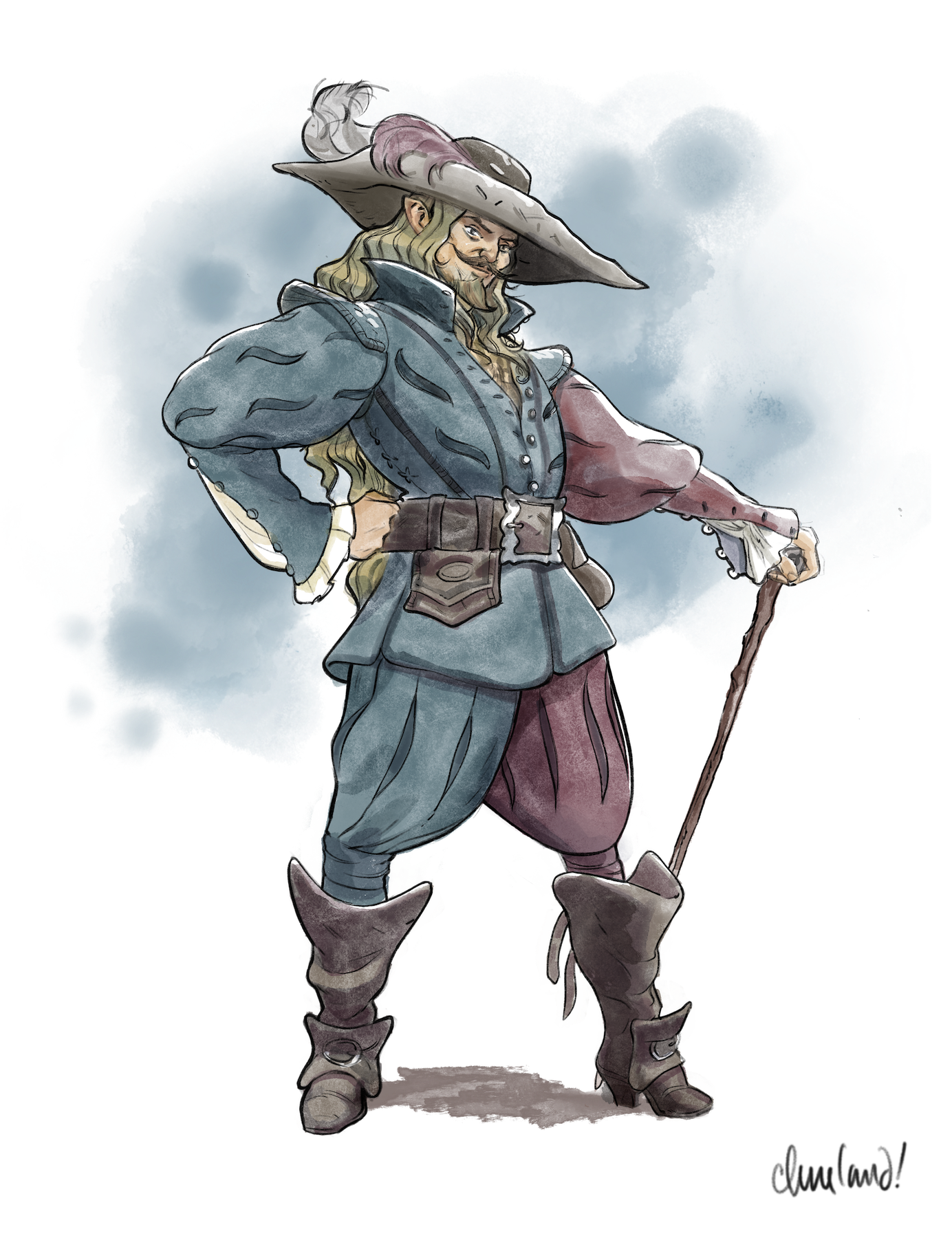
"Rictavio" by Caleb Cleveland. Support him on Patreon!
The Ringmaster's Tale
If any of the heroes approach Rictavio's table, Nikola and Karina Wachter urge them to have a seat. "He's about to tell a story," Nikola whispers loudly. (Szoldar Szoldarovich, the wolf hunter, has turned his chair away from the bar to listen in.)
Roleplaying Information
Resonance. Rictavio should inspire amusement for his flamboyant dress, his ringmaster’s extravagance, and his colorful manner of speech, which most often includes referring to himself in the third person.
Emotions. To onlookers, Rictavio most often appears to feel amused, delighted, or satisfied.
Motivations. Rictavio wants to maintain his reputation as an amusing, though somewhat outrageous carnival ringmaster.
Inspirations. When planning Rictavio, channel Varrick (Avatar: The Legend of Korra) or a carnival barker.
Character Information
Persona. To the world, Rictavio appears as a flamboyant, irreverent, and occasionally self-centered carnival ringmaster.
Morale. In a fight, Rictavio would attempt to fast-talk his way out of trouble, fleeing from battle if hostilities seem unavoidable. (He might, however, step in to defend an innocent from harm at the hands of the supernatural—though doing his best to preserve his secret identity.)
Relationships. Rictavio is secretly Dr. Rudolph van Richten, the famed vampire hunter.
After clearing his throat, Rictavio shares the following story:
The vampire Count Belasco kept his coffin, not in a crypt or keep, but in the cellar of an old, decrepit inn, which was managed by his servant, Igoron.
Poor Count Belasco had a terrible secret: In his ancient age, his hair was beginning to gray, despite his immortality. In embarrassment, he shaved his head and commanded Igoron to purchase a beautiful raven-black wig, hoping to preserve the handsome, younger man he had once been.
"A handsome man indeed," agreed one of his guests—an elderly, near-blind widow named Oksana—one particular moonlit night. Dear Oksana kept to herself, spending her days sorting and re-sorting her rock collection, which she kept lovingly in her purse. Despite the Count's odd behavior and pale skin, she suspected nothing, her old vision too blurry to make out the fangs that poked down amidst his teeth.
As always, the Count felt an urge to feed upon her—and though her flattering words quelled his interest, he felt the thirst in his fangs all the same. "Igoron!" he boomed. "Fetch my coat—I'm going hunting."
"Yes, sire," Igoron wheezed. As he returned, he whimpered, "Best be back before dawn, milord. I'm cleaning the curtains tonight. Want you nice and safe in your coffin before sunrise."
Count Belasco scoffed. "Fear not, simple Igoron," he boasted. "I know well the hour of my enemy. Not a thing could stir my spirit to linger beneath its dreadful rays."
And so the Count departed. He lurked in alleyways and prowled across rooftops—yet he found not a single morsel to sate his thirst. It was with surprise, that the hungry, defeated Count finally looked up to the velvet skies and saw the periwinkle-grey of approaching morning.
With panic, he flew through the streets. Four blocks away. A streak of orange began to slice across the sky. Three blocks. Two—
—the door to the inn slammed shut behind him.
"Goodness," Oksana said, yawning atop the staircase. "Have you been out all night?"
In an eyeblink, the Count's great silhouette towered far above her. "Yes," he growled. "But I've only just found what I've been looking for. Oksana—I want to suck your blood!"
Ordinarily, one of Count Belasco's victims would scream, flee, or faint—yet he had made one, terrible mistake.
He had forgotten that Oksana's cataract-ridden eyes couldn't quite see his fangs.
"You disgusting man!" Oksana screeched, and whirled eighteen years' worth of rare rocks and minerals directly toward his head. There was a terrible thud—and a terrible splintering of wood—and Count Belasco went tumbling down to the floor below. When he opened his eyes, he saw Oksana staring in horror, not at him, but at his head—his bare head.
There, just beneath the eastern window, lay his beloved wig. He dove for it, claws outstretched—and a sliver of sunlight grazed across his skin.
There was a sizzle, a hiss, and a burst of smoke and flame. Oksana, purse clutched to her chest, watched in awe as Count Belasco succumbed to the morning light, until all that remained was a smoldering heap of ash and a charred, smoking wig.
"Poor Oksana never quite got over it," Rictavio concludes, his eyes twinkling. "After all—it was quite the 'hair-raising' experience!" As his listeners boo, guffaw, and applaud, he bows, then waves to Danika for another round of drinks. As she approaches, Brom and Bray run past her into the kitchen, giggling.
If spoken with, Rictavio is willing to share the following information over drinks:
- He is Rictavio, a carnival ringmaster having traveled long and far in search of new acts for his carnival. He's not entirely sure how he wound up in Barovia, but he's working to make the most of it. (This is a lie. A medium Intuition test reveals that Rictavio's words sound a bit too smooth and practiced.)
- He recently arrived that morning, and took up residence in the Blue Water Inn's private suite. "The good innkeepers have generously let me stay in exchange for tales and good humor," he notes, smiling.
During the conversation, Rictavio subtly attempts to learn more information than he reveals, hoping to glean the heroes' identities, capabilities, relationships, and histories in and beyond Barovia. If asked why he seems to be so curious, he bombastically insists that he's always in search of new tales to add to his repertoire.
When he's finished his drink, Rictavio takes another flourishing bow and excuses himself. As he does, Nikola and Karina boo and urge Rictavio to tell another story. "We've heard one about a foolish Count," Nikola says. "What about a foolish Baron?"
If the heroes don't intervene, the following sequence of events then occurs:
- The table and nearby taproom go silent, with many patrons eyeing Nikola and Rictavio nervously.
- From his place at the bar, Szoldar rumbles, "Best not, youngster." (Behind him, Yevgeni grunts, then echoes, "Best not.")
- Karina scoffs. "Cowards, the lot of you," sie says, glancing about hir. "Not a funny bone in your bodies."
- Rictavio clears his throat. "Alas, my friends," he says, "but the day has been long, and I must retire. Another day, perhaps." As Nikola and Karina groan and turn back to their drinks, Rictavio bows with a flourish, then ascends the stairs to the private guest room.
Any hero who watches as Rictavio makes his way along the great balcony sees him pass Brom and Bray, who are crouched along the balcony in front of their bedroom. (The children are dangling a stuffed (real) bat on puppet strings over the bar below, giggling while Nikola and Karina drunkenly swat at it. The children used the secret stairs to scamper quietly from the kitchen to the balcony while the heroes were drinking, unseen by the inn's patrons.)
The Siblings Wachter
If the heroes linger at Rictavio's table, the Wachter siblings are happy (if prodded) to rant about:
- the Festival of the Blazing Sun (to be held in the town square in less than a week, at dawn on Hektavr 28, though the previous festival, which he called the Wolf's Head Jamboree, was just the other day),
- Vallaki's recent history of festivals,
- the Baron's response to those who speak ill of the festivals, and
- the flashes of purple light that have been seen from the attic of the burgomaster's mansion.
(See Lore of Barovia#Vallaki Lore.) Once the heroes have won the siblings' trust, they ask for tales of the characters' harrowing adventures or how the characters plan to free Vallaki from the burgomaster's regime of forced positivity.
Through conversation, it becomes evident that the siblings have a deep, personal enmity toward Izek Strazni and the Vallakovich family. However, neither sibling will reveal the underlying reason—Stella Wachter's illness (see Arc H - The Lost Soul)—unless the heroes ask and succeed on a hard Presence test.
At some point during the conversation, Danika approaches the table to clear away empty plates. As she does, Nikola cheerfully demands more wine. If the heroes don't intervene, the conversation proceeds as follows:
- Danika greets Karina and Nikola by name, and asks, "Haven't you already had too much to drink?"
- Nikola waves away her words and says, "Nonsense—we've only begun! Two pints of wine to start, and keep them coming."
- Danika replies, "Can I start you with some Purple Grapemash No. 3?" Nikola scoffs and says, "What do you take us for—tasteless peasants? Red Dragon Crush, and don't be stingy."
- As she pours their wine, Danika says idly, "Does your mother know what you're up to this evening?" Karina waits until she receives her pint, then grunts, "Mother's far too busy these days. And what she doesn't know can't hurt her." ("Or us," Nikola charms in, elbowing his sibling. The two chuckle, then return to their drinks.)
If the heroes ask Urwin or Danika about the Wachter siblings, Urwin can tell them that the siblings are of noble birth, always brash and loud, and that they frequently drink too much and get into trouble at the inn.
If the heroes ask about their mother, or about their words about a "foolish Baron," Urwin becomes visibly uneasy, and promises to speak with the heroes further in the morning.
The siblings won't talk about their mother. Eventually, they stumble out of the inn and end the night sleeping in the shed outside, too drunk to make it home.
C12g. News from Ireena
When the heroes emerge from their rooms the morning after meeting Rictavio, they find Ireena waiting for them in the taproom. She invites them to share breakfast with her; during breakfast, she first asks how their time in Vallaki has been so far, then asks the heroes to visit the church to speak with Father Lucian about an "incident." Father Lucian has asked her not to speak of the incident outside of the church, for fear of raising a panic. (The "incident" she refers to is the theft of St. Andral's bones.) Arc D - St. Andral's Feast has begun.
If the heroes have questions about the Wachter siblings and their mother, Urwin joins them at their table. Urwin can share the following information:
- Nikola and Karina are the children of Lady Fiona Wachter (she/her).
- Lady Wachter openly hates the burgomaster; she's often quoted as saying "I'd rather serve the devil than a fool." Urwin isn't sure if she means the Devil, as in Strahd, or if she's just speaking metaphorically.
- Lady Wachter rarely leaves Wachterhaus.
- Nikola and Karina have a younger sister, Stella (she/her), though Stella hasn't left the grounds of Wachterhaus lately.
- Lady Wachter's family has old ties to Strahd, so the burgomaster fears her enough not to confront her or her children.
Urwin can also share that another festival, the Festival of the Burning Sun, has been announced; it will take place from dawn to noon on Hektavr 28, five days from now.
As breakfast draws to a close, Rictavio descends the stairs from his room and approaches the bar, greeting the heroes with a nod. Urwin bids him good morning and removes a small parcel from beneath the counter, which Rictavio accepts and tucks into his cloak.
If asked, Urwin can inform the heroes that the parcel merely contains food—a few apples, some loaves of bread, and a wheel of cheese.
Following the Ringmaster
If one or more heroes follow Rictavio out of the Blue Water Inn, they can follow him to the stable without difficulty.
Once inside, Rictavio removes the parcel from his coat, withdraws two apples, and proceeds to feed them to his horse, Drusilla. Once Drusilla has finished eating, Rictavio checks his surroundings, forcing any hidden heroes to succeed on a hard group Agility test or be detected.
Rictavio is wearing a Mask of the Many, which allows him to disguise himself as anyone he's previously seen. His current disguise is a carnival ringmaster he briefly traveled with some years ago. The clothes are real, not magically generated.
Astonishing fact: a Mask of the Many transforms the physical body. It's not an illusion! And the wearer's gear is magically absorbed into their body, if they don't want it kept the same or transformed into the disguise's gear. Isn't that wild? So, technically, a void elementalist looking at Rictavio should see the same thing as anybody else: a colorful, charismatic elf, with nothing magical about him at all.
If you have a void elementalist, or someone else who can detect magic, in your party and think they might feel cheated by this, or simply want to give the players another clue that Rictavio isn't who he seems, I suggest a faintly uneasy feeling when the elementalist looks at Rictavio—much like the feeling they get when seeing an illusion or an invisible creature, yet they're not visually seeing anything different from the rest of the party. Unsettling!
If a void elementalist sees Rictavio's Amulet of Privacy, which he wears hidden beneath his shirt, they learn that the amulet prevents him from being magically marked, tracked, or scried upon. (To see the amulet, they would have to go to extraordinary lengths, like breaking into Rictavio's room while he sleeps.)
If he detects any heroes, Rictavio calls out to them and notes, amusedly, that it's impolite to lurk in dark places. He then lightheartedly interrogates them, doing his best to uncover their purpose in following him while avoiding revealing his true identity.
If asked who the food is for, Rictavio insists that it is for "my friend, the destitute toymaker." (He is referring to Gadof Blinsky, described further in N7. Blinsky Toys (p. 118).)
If confronted regarding his magic items or true identity, Rictavio directs the heroes to check their surroundings for spies, then demands that they prove themselves not to be spies of Strahd. If the heroes respond persuasively, he then insists that they swear themselves to secrecy. If they do, his story changes as follows:
- If the heroes do not suspect his true identity, Rictavio "reveals" that he is a secret agent of the Keepers of the Feather, a secret society dedicated to resisting Strahd. (His true name, he claims, is classified, for fear that it may lead Strahd to pursue his loved ones.)
- If the heroes do suspect his true identity, Rictavio "reveals" that he is Andrey Ivanovich, a former student of Van Richten, who grew concerned and set out to look for Van Richten when he heard the vampire hunter had gone missing.
These are lies. A hard Intuition test indicates that Rictavio's eyes flicker upwards and he pauses for a moment before he gives the Keepers' name or Andrey's. If further confronted, Rictavio denies any additional allegations. "Believe what you will," he concedes, shrugging. "What you think is no concern of mine."
Rictavio declines to share further information for fear that Strahd's agents might steal it from them.
If he fails to detect the heroes, Rictavio uses his Mask of the Many to assume the form of a random Vallakian commoner, then slips out of the stable onto the street. He then proceeds to weave through the streets and alleys of Vallaki in a paranoid attempt to lose any followers. A hero attempting to follow him must succeed on a hard Intuition test or lose him in the crowd.
Once he departs the Blue Water Inn's stable, Rictavio proceeds to Arasek Stockyard, where he slips the parcel of food through the slats of the rear door of his wagon. He then provides Sitarey a brief update on the town's activities as she eats, kneeling before the wagon as described in Arc E - The Missing Girl.
Exiting the Inn
As the heroes depart the Blue Water Inn, they find the street full of townsfolk. Assuming the heroes do not interfere, the following scene then unfolds:
- The heroes hear the sound of a whinnying horse from down the street—and the townsfolk freeze and fall silent. A small procession lies to the south: Baron Vargas Vallakovich riding upon his chestnut horse, flanked by his two mastiffs (who have the statistics of wolves) named Claw and Fang, and followed by four human guards. Izek Strazni leads the procession.
- The heroes can see that an old, frightened-looking woman wearing threadbare commoner’s clothes has just stumbled away from the horse and fallen into a puddle of mud a few feet away from the horse. The horse has come to an abrupt halt, and the procession has stopped along with it. Izek’s devilish arm is outstretched, suggesting that he has just pushed—or flung—the old woman into the mud. (The woman is Willemina Rikalovna, the mother of the imprisoned shoemaker Udo Lukovich.)
- The Baron angrily scolds the woman for getting mud on his cloak with her “filthy peasant’s hands.” The old woman, her voice quavering, apologizes and pleads with the Baron to release her son, Udo, claiming that he meant no harm with his “foolish joke.”
- The Baron insists that Udo needs “rehabilitation” for his “malicious unhappiness,” and suggests that the woman does as well. He commands Izek to seize her and lock her in the stocks, suggesting that “a few days in the stocks ought to tighten her tongue.” Izek steps forward, flexing his devilish arm with a cruel glint in his eye.
- Izek grabs the woman, hauls her to her feet, and thrusts her rudely into the guards’ waiting arms. Two of the guards pull the old woman’s arms behind her back and begin to pull her south as she struggles, weeps, and pleads for her son’s freedom. No townsfolk dare to help her.
- As the old woman is hauled away, the Baron turns to the townsfolk surrounding him and announces: “Let that be a lesson as to the dangers of malicious unhappiness! The Devil’s hand is long, but our joy shall overcome his shadow.”
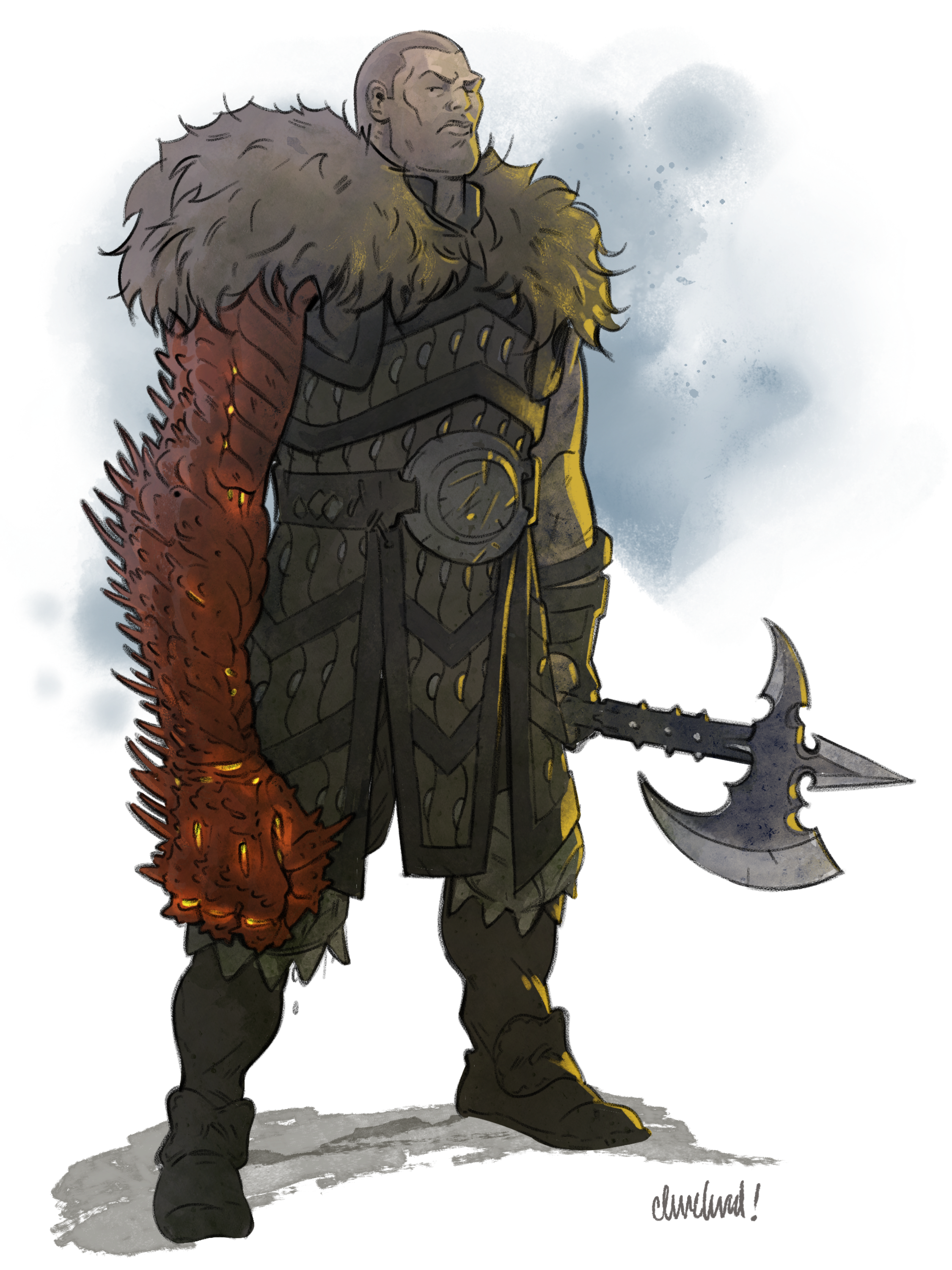
"Izek Strazni" by Caleb Cleveland. Support him on Patreon!
Roleplaying Information
Resonance. Vargas should inspire frustration with his obstinance, disgust for his narcissistic arrogance, and mild amusement for his utter and ridiculous self-assurance.
Emotions. Vargas most often feels annoyed, offended, satisfied, outraged, impatient, or smug.
Motivations. Vargas wants to secure his power free from Strahd's influence and lead Vallaki to escape the Mists by forcing everyone in the town to be happy.
Inspirations. When playing Vargas, channel Lord Farquaad (Shrek), Joffrey Baratheon (Game of Thrones), and Laszlo Cravensworth (What We Do in the Shadows).
Character Information
Persona. To the world, Vargas is an entitled, self-centered, blue-blooded noble with a bad temper, foolish dreams of salvation, and a love for praise and adoration.
Morale. In a fight, Vargas would command his dogs, Claw and Fang, as well as Izek Strazni and any present guards to seize any who oppose him. If deprived of his defenders, Vargas would either attempt to flee, or—if flight were obstructed—grovel pathetically at the feet of his attacker, begging for mercy.
Relationships. Vargas, the burgomaster of Vallaki, is the father of Victor Vallakovich, the husband of Baroness Lydia Petrovna, the brother-in-law of Father Lucian Petrovich, and the son of the late Baron Valentin Vallakovich. He is also the employer and adoptive "father" of Izek Strazni, his captain of the guard and chief enforcer.
Roleplaying Information
Resonance. Izek should inspire disgust with his cruelty and indifference to human life, and discomfort with his unnerving interest in Ireena Kolyanovna.
Emotions. Izek most often feels irritated, enraged, impatient, sadistic, obsessed, or bored.
Motivations. Izek wants to serve the Baron faithfully—and, far more importantly, find and possess the woman he's been dreaming of.
Inspirations. When playing Izek, channel Ser Gregor Clegane (Game of Thrones), Aerion Targaryen (A Knight of the Seven Kingdoms), and Kratos (God of War).
Character Information
Persona. To the world, Izek is a cruel enforcer with a love for fire and blood.
Morale. In a fight, Izek would gladly draw his silvered battleaxe and fight to the death.
Relationships. Izek is the adoptive "son" of Baron Vargas Vallakovich, the captain of Vallaki's town guard, a frequent customer of the toymaker Gadof Blinsky, and (unbeknownst to either of them) the biological brother of Ireena Kolyanovna.
If the heroes interrupt Willemina’s arrest, the Baron greets them as outsiders and asks, with amusement, whether they seek to claim responsibility for the “old fool’s” rehabilitation themselves.
Diplomacy. If the heroes make a successful medium Presence test to persuade the Baron, or make an argument that sufficiently flatters the Baron’s ego, he directs the guards to release her into their custody. He welcomes them to Vallaki and pompously commands them to ensure that they educate themselves as to the town’s rules and traditions.
Hostility. If the heroes indicate a willingness to start a fight, the Baron’s eyes narrow and his mastiffs begin to growl. Meanwhile, Izek’s arm burns with a crimson flame, his grip tightening around the haft of his silvered battleaxe.
The Baron first demands to know whether the heroes are “spies of the Devil Strahd.” The heroes can attempt to calm the situation and secure Willemina’s arrest peacefully, but any subsequent Presence tests made to sway the Baron are made with a bane.
If it appears that combat is imminent, Father Lucian Petrovich steps forth from the crowd and urges peace. The Baron greets him warmly by name, and Father Petrovich apologizes for Willemina’s behavior, noting that she has been troubled in recent days at his congregations. He promises to escort her to St. Andral’s Church and see that her troubled mind is eased—a proposition that the Baron reluctantly accepts.
After discovering St. Andral's missing bones and sending Yeska to recruit Henrik to leave materials to repair the crypt, Father Petrovich sought out Baron Vallakovich in the hopes of obtaining his help in finding the bones. He decided against it, however, after observing the Baron's mood and behavior in the streets. (Lucian doesn't share this unless he's already told the heroes about the missing bones in Arc D - St. Andral's Feast. He will, however, share that he was hoping to ask the Baron about something, but decided against it after seeing the man's current mood.)
The Baron also wonders aloud whether he should punish the heroes for their insolence. Father Petrovich assures the Baron that they are merely outsiders, untaught in Vallaki’s ways, and that he shall see to it that they are properly educated.
The Baron imperiously orders that he see to it, then informs the heroes that they have caught him “in a good mood,” and that they should be grateful for “the Lady’s grace.” He warns them, however, that future lawbreaking shall be met with harsh punishments.
Departure. As the Baron departs the scene, he announces to the crowd: “I shall expect to see you all at the Festival of the Blazing Sun five days hence. All will be well!”
The townsfolk, bearing smiles that better resemble grimaces, grimly intone, “All will be well.” The Baron nods, evidently satisfied, and continues riding north, followed by Izek, his mastiffs, and any remaining guards. The activity of the street resumes shortly thereafter.
If Ireena is with the party, she has drawn up the hood of her cloak upon exiting the inn. Nonetheless, unless the party has taken specific action to prevent Izek from noticing her, he catches Ireena’s eye and holds her gaze for a long, lingering moment before ultimately departing, leaving Ireena feeling uncomfortable and cold. Arc G - The Strazni Siblings then begins.
If asked, Ireena notes with uncertainty that something about Izek seemed almost familiar, though she can’t remember why.
If the heroes defied Vargas or Izek in any way, or otherwise assisted Willemina, Ernst Larnak reports their actions to Lady Fiona Wachter at Wachterhaus. Arc F - Lady Wachter's Wish then begins.
End of an Act. When the heroes set off from the Blue Water Inn for their first full day in Vallaki after downtime, Act I ends and Act II begins.
Design Notes: Into the Valley
Journey to Vallaki
Changes to Lycanthropy. Lycanthropic immunity has been changed to silver-based regeneration in order to ensure that lycanthropes resonate with common understandings of lycanthropy and to ensure that all classes can meaningfully contribute to a lycanthrope's defeat, with or without magic. Lycanthropes have also been made weak to corruption damage (in addition to damage from silvered weapons) in order to provide creative heroes with an alternate means of halting their regeneration and (more importantly) to explain how Strahd, who owns no silver weapons, is able to keep the werewolves in line.
Wolves and Werewolves. The first wolf encounter has been converted to a group test, to avoid an uninteresting combat and avoid repetition with the werewolf encounter immediately following. To avoid wasting interesting terrain, the ravine has been made the location of the werewolf encounter, and the werewolf encounter moved accordingly earlier in the heroes' journey to Vallaki (but still after Tser Falls, where the heroes are warned of werewolves).
Barovian Hakaan. Sometimes, part of a module is so unavoidably, heinously racist that you just can't salvage any part of it, and that's the trouble with the Vistani in Curse of Strahd. (Incidentally, if you, dear Director, are thinking about reading I, Strahd for research, don't. It's full of racial slurs.) The Vistani have been removed. Various NPCs have been renamed, reworked, or removed. The relationship between Strahd and the seer's people (now hakaan) has been entirely scrapped and rewritten from scratch to get as far away as possible from racist lore inherited from Dracula. Descriptions of the settlement at Tser Pool have been rewritten. The settlement outside Vallaki has been moved, both to give the heroes a good reason not to go there weeks before Sitarey's nameday and to reinforce its existence as its own rooted, settled place. Special thanks to my sensitivity reader Fabian Blake, without whom I could not possibly have written this arc (or indeed any of this project).
Van Richten. Arturi Radanavich has been removed and Van Richten's backstory entirely reworked to avoid racist tropes. Van Richten's backstory now also gives him a deeper reason to hate Strahd and Strahd's minions specifically (rather than vampires in general), closer ties to the people of Barovia, and hopefully some sympathetic resonance as a failed hero.
Marya. Nobody needs the specter of Disney racism haunting their game, and "Ez" isn't any better. Van Richten's apprentice has been renamed—she is now Marya, after Marya Morevna, the warrior princess from the Russian fairy tale The Death of Koschei the Deathless. It felt appropriate. Her backstory has also been reworked to fit with new Barovian hakaan lore, to align with Van Richten's new backstory, and to connect more deeply with the history of Barovia.
The Dancing Fire. The game of stories has been reframed to align with the Nordic inspirations for hakaan culture. Adaska's tale illustrates the relationship between Strahd and the hakaan, thereby explaining the hakaan presence in Barovia when the Mists appeared and foreshadowing Strahd's interest in using the hakaan, and specifically Sitarey, for his own ends. Adaska's wager has been changed to allow the Director to give out some recipes to be used in upcoming downtime activities, since it's tough to find a reasonable place to put them in Vallaki without sending the heroes into the burgomaster's mansion.
Sitarey's Nameday. Sitarey, the seer's soon-to-be-kidnapped great-granddaughter, has been aged up to the cusp of adulthood, and her birthday changed to her nameday. Part of this is due to personal taste and convenience; I don't find children-in-danger plotlines fun, and also, there's no canonical Draw Steel lore for what young hakaan are like. But also, choosing your own name and celebrating that choice are two of my very favorite things about being transgender, so I thought it would be neat to include those here, albeit in a different context. Her great-great-aunt still asks the heroes to buy her a children's toy because...well, I'm sure we've all gotten a gift from a well-meaning relative who doesn't understand that our tastes might have changed since age ten. And, also, of course, to maintain the hook to Blinsky's, where the heroes can find Izek's Ireena dolls and Van Richten's monkey.
The Divination. The method of divination has been changed to rune casting, and the seer's characterization changed, to avoid racist tropes and to better align with hakaan origins in Vanigar. (Without using actual real-world runes, lest white supremacists see this as some kind of dogwhistle.) Fravartiš's warnings at the beginning of the casting have been rewritten to reflect Fravartiš's unique perspective on fate and doom, and to give the heroes the chance to choose to be heroes, rather than having it thrust upon them unwillingly.
The Three. Once I'd decided that Salorna is the primary god worshiped by Barovians, and named her the Lady of Morning, I couldn't very well have three other Ladies running around, spiritually speaking. Plus, the Three, to me, are the literal living spirits of the land. The Seeker, for instance, is the living spirit of Mt. Ghakis. Why gender a mountain? So now it's just the Three.
Welcome to Vallaki
Downtime. The sequence of events around the heroes' arrival in Vallaki has been reworked to allow for some downtime before Act II begins.
Taproom Scenes. A scene involving Danika and the Martikov children has been cut and replaced with a brief description. The heroes already have a hook to Blinsky's, and I hate to make a GM talk to themselves unnecessarily. The Wachter siblings have been renamed and re-pronouned, because I think people of all genders should get to be drunk and foolish if they want, and there are frankly far too many men in this adventure. Also because I think players might be more inclined to talk to them, and thus learn more about Vallaki, if they're not drunk young men, specifically.
Meeting the Baron. I've moved the heroes' dramatic meeting with the baron to after downtime, in hopes that the heroes wouldn't feel pressured to immediately leap into action and try to rescue Udo, kill Izek, assassinate the baron, etc. In playtesting, however, my players naturally tried to meet with the baron during downtime, which had...interesting results. As I'm writing these design notes, my players currently believe that the baron is secretly dead and the baroness is covering it up. There are many mysteries in Vallaki, but that isn't one of them!
If your players are inclined to immediately leap into action at the first sign of villainy, I still think delaying the meeting with the baron until after downtime is a good idea. If, on the other hand, your players are a little more chill, or a little more inclined to listen to an above-table "hey, listen, you said you wanted time for downtime projects, and if you start doing hero stuff, you won't have more downtime for a while", and you don't like having the baron unavailable for the heroes' first two weeks in Vallaki, you might consider running the first encounter with the baron before downtime.